Nora Koch – författare
Visar alla böcker från författaren Nora Koch. Handla med fri frakt och snabb leverans.
6 produkter
6 produkter
Del 8998 - Lecture Notes in Computer Science
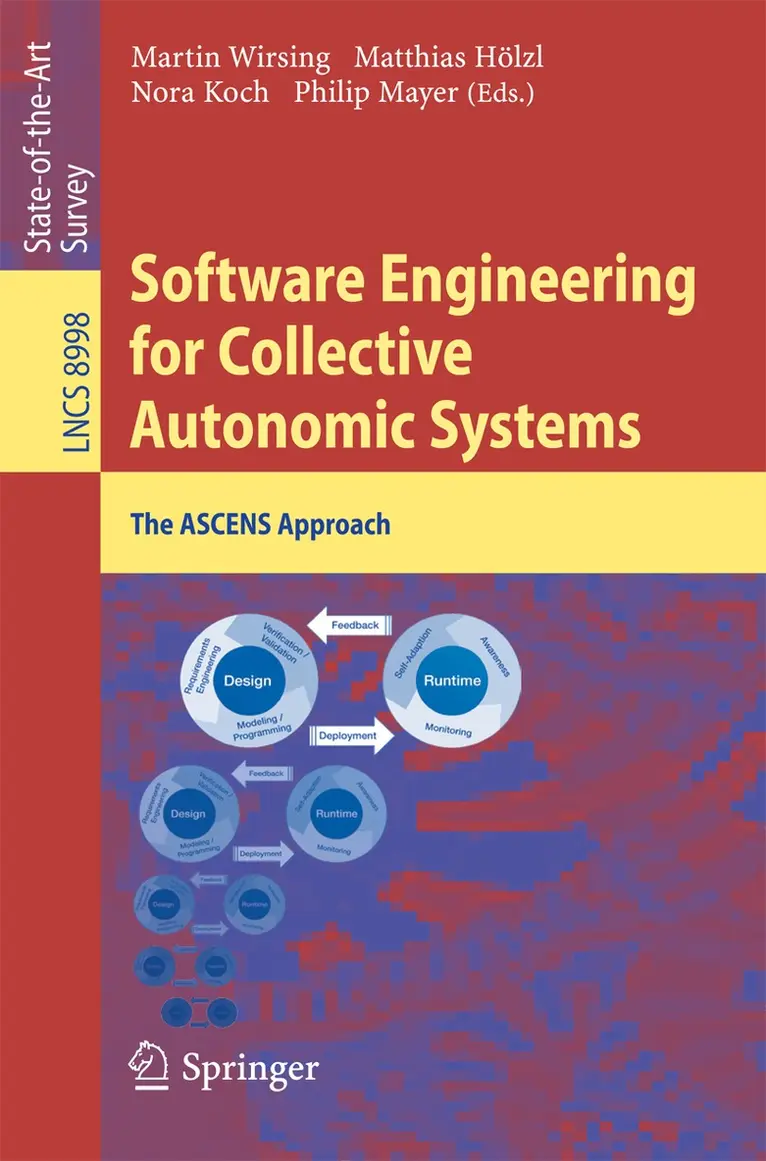
Software Engineering for Collective Autonomic Systems
The ASCENS Approach
Häftad, Engelska, 2015
565 kr
Skickas inom 10-15 vardagar
A collective autonomic system consists of collaborating autonomic entities which are able to adapt at runtime, adjusting to the state of the environment and incorporating new knowledge into their behavior. These highly dynamic systems are also known as ensembles. To ensure correct behavior of ensembles it is necessary to support their development through appropriate methods and tools which can guarantee that an autonomic system lives up to its intended purpose; this includes respecting important constraints of the environment.This State-of-the-Art Survey addresses the engineering of such systems by presenting the methods, tools and theories developed within the ASCENS project. ASCENS was an integrated project funded in the period2010-2015 by the 7th Framework Programme (FP7) of the European Commission as part of the Future Emerging Technologies Proactive Initiative (FET Proactive). The 17 contributions included in this book are organized in four parts corresponding to the research areas of the project and their concrete applications: (I) language and verification for self-awareness and self-expression, (II) modeling and theory of self-aware and adaptive systems, (III) engineering techniques for collective autonomic systems, and last but not least, (IV) challenges and feedback provided by the case studies of the project in the areas of swarm robotics, cloud computing and e-mobility.
E-bok
PDF, Engelska, 2015714 kr
Läs direkt efter köp
A collective autonomic system consists of collaborating autonomic entities which are able to adapt at runtime, adjusting to the state of the environment and incorporating new knowledge into their behavior. These highly dynamic systems are also known as ensembles. To ensure correct behavior of ensembles it is necessary to support their development through appropriate methods and tools which can guarantee that an autonomic system lives up to its intended purpose; this includes respecting important constraints of the environment.This State-of-the-Art Survey addresses the engineering of such systems by presenting the methods, tools and theories developed within the ASCENS project. ASCENS was an integrated project funded in the period2010-2015 by the 7th Framework Programme (FP7) of the European Commission as part of the Future Emerging Technologies Proactive Initiative (FET Proactive). The 17 contributions included in this book are organized in four parts corresponding to the research areas of the project and their concrete applications: (I) language and verification for self-awareness and self-expression, (II) modeling and theory of self-aware and adaptive systems, (III) engineering techniques for collective autonomic systems, and last but not least, (IV) challenges and feedback provided by the case studies of the project in the areas of swarm robotics, cloud computing and e-mobility.
Häftad, Engelska, 2004
1 123 kr
Skickas inom 10-15 vardagar
Web engineering is a new discipline that addresses the pressing need for syst- atic and tool-supported approaches for the development, maintenance and te- ing of Web applications. Web engineering builds upon well-known and succe- ful software engineering principles and practices, adapting them to the special characteristics of Web applications. Even more relevant is the enrichment with methods and techniques stemming from related areas like hypertext authoring, human-computer interaction, content management, and usability engineering. The goal of the 4th International Conference on Web Engineering (ICWE 2004), inlinewiththepreviousICWEconferences,wastoworktowardsabetterund- standing of the issues related to Web application development. Special attention was paid to emerging trends, technologies and future visions, to help the a- demic and industrial communities identify the most challenging tasks for their research and projects. Following a number of successful workshops on Web engineering since 1997 at well-known conferences, such as ICSE and WWW, the ?rst conference on Web engineering was held in C´ aceres, Spain in 2001. It was followed by ICWE 2002 in Santa Fe, Argentina and ICWE 2003 in Oviedo, Spain. In 2004 ICWE moved to the center of Europe and was held in Munich, Germany from July 26 to 30. ICWE 2004 was organized by the Institute for Informatics of the Ludwig- Maximilians-Universit¨ at (LMU) Munich. The ICWE 2004 edition received a total of 204 submissions, out of which 25 paperswereselectedbytheProgramCommitteeasfullpapers(12%acceptance).
E-bok
PDF, Engelska, 20041 408 kr
Läs direkt efter köp
Web engineering is a new discipline that addresses the pressing need for syst- atic and tool-supported approaches for the development, maintenance and te- ing of Web applications. Web engineering builds upon well-known and succe- ful software engineering principles and practices, adapting them to the special characteristics of Web applications. Even more relevant is the enrichment with methods and techniques stemming from related areas like hypertext authoring, human-computer interaction, content management, and usability engineering. The goal of the 4th International Conference on Web Engineering (ICWE 2004), inlinewiththepreviousICWEconferences,wastoworktowardsabetterund- standing of the issues related to Web application development. Special attention was paid to emerging trends, technologies and future visions, to help the a- demic and industrial communities identify the most challenging tasks for their research and projects. Following a number of successful workshops on Web engineering since 1997 at well-known conferences, such as ICSE and WWW, the ?rst conference on Web engineering was held in C´ aceres, Spain in 2001. It was followed by ICWE 2002 in Santa Fe, Argentina and ICWE 2003 in Oviedo, Spain. In 2004 ICWE moved to the center of Europe and was held in Munich, Germany from July 26 to 30. ICWE 2004 was organized by the Institute for Informatics of the Ludwig- Maximilians-Universit¨ at (LMU) Munich. The ICWE 2004 edition received a total of 204 submissions, out of which 25 paperswereselectedbytheProgramCommitteeasfullpapers(12%acceptance).
Häftad, Engelska, 2012
566 kr
Skickas inom 10-15 vardagar
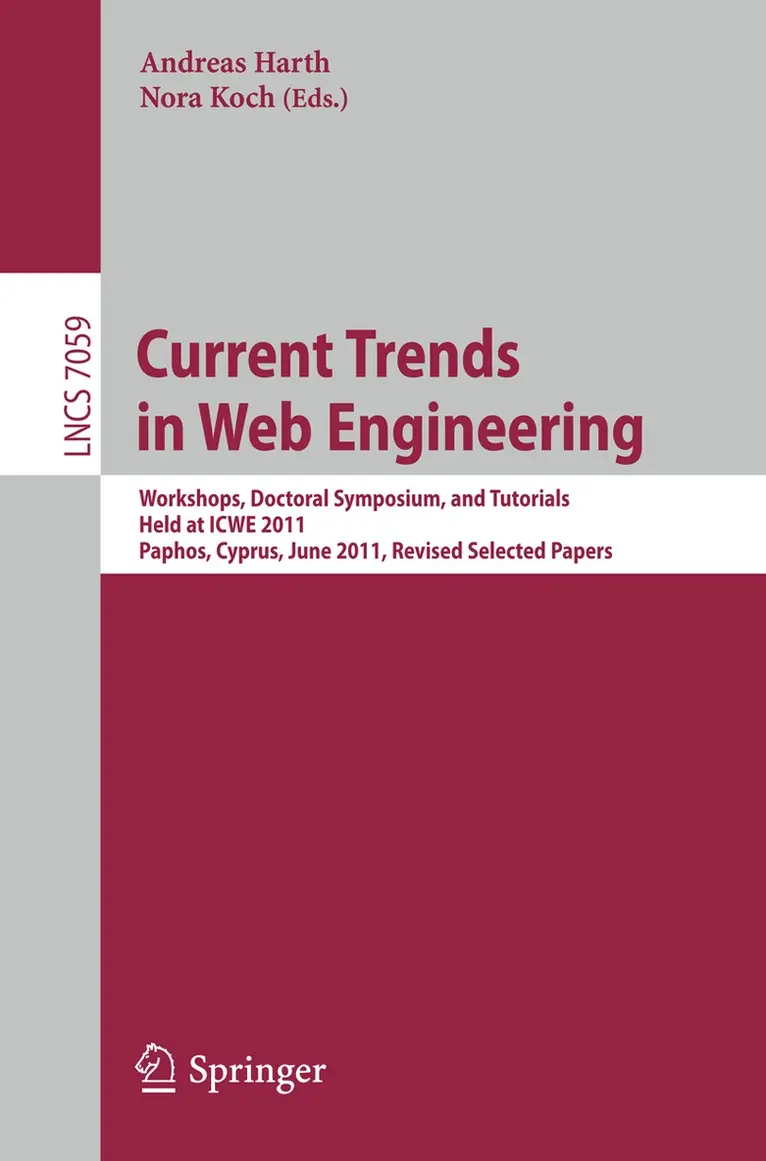
This book constitutes the thoroughly refereed post-conference proceedings of the workshops held at the 11th International Conference on Web Engineering, ICWE 2011, in Paphos, Cyprus, in June 2011. The 42 revised full papers presented were carefully reviewed and selected from numerous submissions . The papers are organized in sections on the Third International Workshop on Lightweight Composition on the Web (ComposableWeb 2011); First International Workshop on Search, Exploration and Navigation of Web Data Sources (ExploreWeb 2011); Second International Workshop on Enterprise Crowdsourcing (EC 2011); Seventh Model-Driven Web Engineering Workshop (MDWE 2011); Second International Workshop on Quality in Web Engineering (QWE 2011); Second Workshop on the Web and Requirements Engineering (WeRE 2011); as well as the Doctoral Symposium2011, and the ICWE 2011 Tutorials.
E-bok
PDF, Engelska, 2012708 kr
Läs direkt efter köp
This book constitutes the thoroughly refereed post-conference proceedings of the workshops held at the 11th International Conference on Web Engineering, ICWE 2011, in Paphos, Cyprus, in June 2011. The 42 revised full papers presented were carefully reviewed and selected from numerous submissions . The papers are organized in sections on the Third International Workshop on Lightweight Composition on the Web (ComposableWeb 2011); First International Workshop on Search, Exploration and Navigation of Web Data Sources (ExploreWeb 2011); Second International Workshop on Enterprise Crowdsourcing (EC 2011); Seventh Model-Driven Web Engineering Workshop (MDWE 2011); Second International Workshop on Quality in Web Engineering (QWE 2011); Second Workshop on the Web and Requirements Engineering (WeRE 2011); as well as the Doctoral Symposium2011, and the ICWE 2011 Tutorials.