O. Braun-Falco - Böcker
Visar alla böcker från författaren O. Braun-Falco. Handla med fri frakt och snabb leverans.
10 produkter
10 produkter
551 kr
Skickas inom 10-15 vardagar
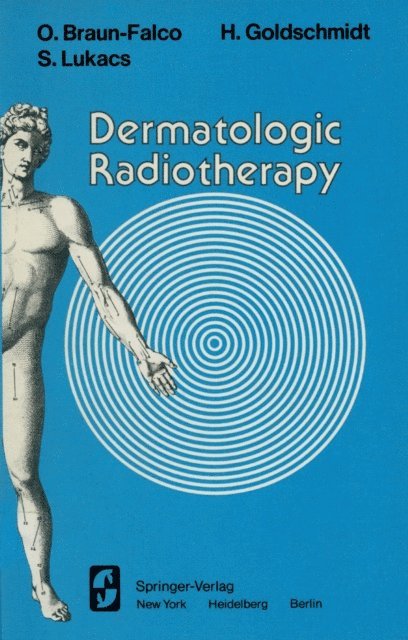
TO THE ENGLISH EDITION Ionizing radiation has played an important role in the treatment of skin diseases for many decades. With strict adherence to modern standards of radiation protection, radiotherapy is a safe and effective method that benefits many patients who cannot be treated adequately by other means. Although indications for dermatologic radiotherapy have decreased significantly due to advances in other therapeutic modalities, many dermatologists feel strongly that ionizing radiation is an integral part of dermatologic therapy that should not be relinquished to other specialties because of the highly specialized anatomic, pathologic, and technologic knowledge required. A recent survey of the National Program for Dermatology showed that 44% of 2,444 responding dermatologists use radiotherapy regularly for various skin conditions, particularly in the treatment of cutaneous carcinomas. Significantly, the American Board of Dermatology has decided to continue its requirement of special knowledge in dermatologic radiation therapy for board certification. Because I have taught this dermatologic subspecialty at various levels, both in Europe and in the United States, I readily agreed to accept Pro fessor Braun-Falco's invitation to cooperate with him and Dr. Lukacs in the preparation of the English edition of this new guide. The text deals mostly with modern concepts of dermatologic radiotherapy and empha sizes practical aspects of treatment. Although it is written as an introduc tion for young dermatologists, it may also be useful to experienced clinicians who want to keep up with recent developments in this field.
Del 3 - Der Hautarzt Supplementa
Retikulosen und Lymphome der Haut aus heutiger Sicht
Symposion der Universitätsklinik für Dermatologie und Venerologie in Graz am 21. April 1978
Häftad, Tyska, 1979
567 kr
Skickas inom 10-15 vardagar
821 kr
Skickas inom 10-15 vardagar
567 kr
Skickas inom 10-15 vardagar
567 kr
Skickas inom 10-15 vardagar
770 kr
Skickas inom 10-15 vardagar
Zu Kosmetika-Risiken und -Nebenwirkungen schnell nachschlagen: Praxisbezogener Ratgeber mit den neuesten wissenschaftlichen Erkenntnissen
1 624 kr
Skickas inom 10-15 vardagar
With the aromatic retinoic acid analog Tigason oral and intravenous pharmacokinetic studies have been performed in 5 normal volunteers. Simultaneous fitting of single i. v. and oral data to a three-compartment model assuming first-order absorption was possible. Using Nonlin parameter estimates of the single-dose data, one is able to predict the decline in plasma levels of parent drug following cessation of a 10 days multiple dosing regimen up to 24 hours. The model is however unable to predict a phase of prolonged elimination observed beyond 24 hours. Moreover in 5 patients, who underwent chronic therapy (8-15 months), substantial plasma levels of both unchanged drug and main metabolite (corre sponding carboxylic acid) were observed up to 140 days after cessation of the therapy. An apparent half-life of elimination of 80-100 days can be calculated. The drug appears to be stored at some yet unknown storage site. Investigation of metabolism of Tigason in rats and humans revealed 19 different bio transformation products thus far, most of them appearing in the urine in low amounts (20010 of dose). A few of them (mainly the acid Ro 10-1670) after conjugation to glucuronic acid are excreted in the bile in high amounts (60-80% of dose). No drug appeared unchanged in the excreta after i. v. administration to rats. References 1. Bollag W (1971) Effects of vitamin A acid (NSC-122758) on transplantable and chemically-induced tumors. Cancer Chemother Rep 55:53-58 2.
1 095 kr
Skickas inom 10-15 vardagar
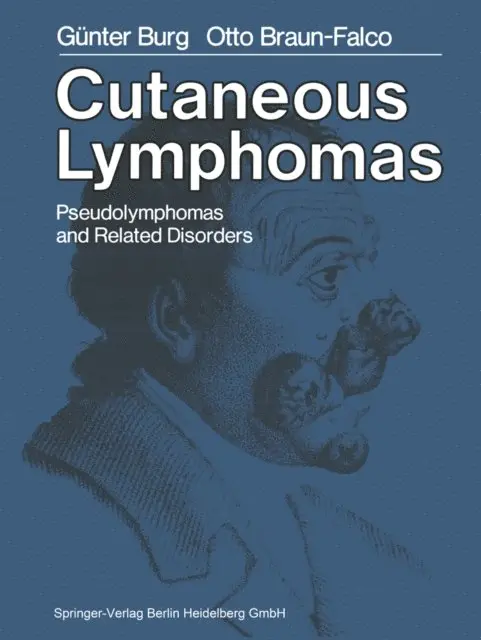
The term "lymphoma" was originally used by Billroth in 1871 [55], and by Virehow [763] some years before that, for the designation of swelling of lymph nodes that was not due to "eareinoma, sareoma, ehondroma, myxoma, ete. " In his paper, Billroth reeounted sueeessful treatment with arsenie (" Fowler's solution") of multiple "lymphomas" that had developed in a 40-year-old woman during a 10-month period. From this report it is not entirely clear if the multiple" lymphomas" deseribed were infeetious or if they were eonsis- te nt with what we now mean by "malignant lymphoma. " Today, the term "malignant lymphoma" is generally used eolleetively for malignant lymphoproliferative neoplasms that tend to arise in lymph nodes and also eneompasses Hodgkin's disease and non-Hodgkin's lymphomas. The adjeetive "malignant" seems somewhat superfluous sinee, in addition to Bill- roth's original eonnotation, the sense of malignaney is nowadays read into the word "lymphoma. " To be sure, true, i. e. , malignant, lymphomas have to be differentiated from "pseudolymphomas," or to put it more exaetly, "pseudomalignant lymphomas." In this book, "lymphoma" and "malignant lymphoma" are used interehan- geably for malignant neoplastie lymphoproliferative disorders, and "pseudo- lymphoma" is used for benign lymphomatous proeesses. Our editorial eonsultant, Dr. M. Leider, disagrees with all of this. In his Dictionary of Dermatological Words, Terms, and Phrases [421] and other works, he maintains that there is no etymologieal basis for words bearing the eontrived suffix" -oma" or the true Greek suffix" -ma" to denote malignaney.