Octavia A. Dobre – författare
1 283 kr
Skickas inom 5-8 vardagar
1 450 kr
Läs direkt efter köp
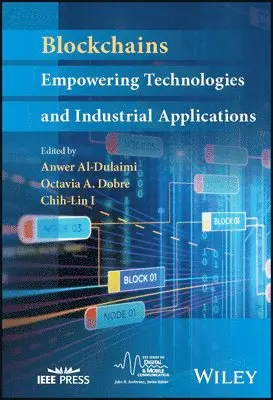
A comprehensive guide to the most recent developments in blockchains in theoretical and industrial perspectives
Originally introduced as a method to keep track of Bitcoin transactions over a peer-to-peer network, blockchain is a continuously growing list of records, called blocks, which are linked and secured using cryptography into a chain held in public databases. The use of this technology has grown since its cryptocurrency creation and now store three types of information: 1) transactions, including the date, time, and value of purchases; 2) records of participates in transactions; and 3) unique code known as a “hash” that distinguishes one block from another. A single block on the blockchain can hold 1 MB of data, or potentially thousands of transactions — this then can allow for hundreds of thousands of transactions to be recorded as each block can join the state-of-the-art blockchain.
Blockchains provides a detailed overview of the latest and most innovative concepts, techniques, and applications related to the developing blockchain. Aimed at novices and experts on the subject, the book focuses on blockchain technologies, integrated systems, and use cases, specifically by looking at three major technical areas: blockchain platforms and distributed database technologies, consensus and fault tolerance, and Blockchain as a Service (BaaS). These avenues of research are essential to support blockchain functionalities, such as acquiring and updating existing data, securing data resources and the recovery of failures, and using blockchains in various services that range from cryptocurrencies to cloud automation.
Blockchains readers will also find:
Brainstorming activities that gradually builds the knowledge of readers on the described technology and deployment scenarios Investigation of specific topics such as novel networking protocols, wireless techniques, new infrastructure designs, operations management, and deployment strategies Discussion of technical challenges in blockchain, as well as how to manage cloud-based networks, service automation, and cyber security Numerous elementary and advanced examples on various topics at the end of the book that can be used for training purposes Illustrations including tables and diagrams to help elucidate points made throughout the volume Glossary of relevant terminology to blockchains in enterpriseBlockchains is a useful reference for researchers in vehicular networking and computer science, as well as cloud storage providers and governmental offices for data management.
1 496 kr
Läs direkt efter köp
A comprehensive guide to the most recent developments in blockchains in theoretical and industrial perspectives
Originally introduced as a method to keep track of Bitcoin transactions over a peer-to-peer network, blockchain is a continuously growing list of records, called blocks, which are linked and secured using cryptography into a chain held in public databases. The use of this technology has grown since its cryptocurrency creation and now store three types of information: 1) transactions, including the date, time, and value of purchases; 2) records of participates in transactions; and 3) unique code known as a “hash” that distinguishes one block from another. A single block on the blockchain can hold 1 MB of data, or potentially thousands of transactions — this then can allow for hundreds of thousands of transactions to be recorded as each block can join the state-of-the-art blockchain.
Blockchains provides a detailed overview of the latest and most innovative concepts, techniques, and applications related to the developing blockchain. Aimed at novices and experts on the subject, the book focuses on blockchain technologies, integrated systems, and use cases, specifically by looking at three major technical areas: blockchain platforms and distributed database technologies, consensus and fault tolerance, and Blockchain as a Service (BaaS). These avenues of research are essential to support blockchain functionalities, such as acquiring and updating existing data, securing data resources and the recovery of failures, and using blockchains in various services that range from cryptocurrencies to cloud automation.
Blockchains readers will also find:
Brainstorming activities that gradually builds the knowledge of readers on the described technology and deployment scenarios Investigation of specific topics such as novel networking protocols, wireless techniques, new infrastructure designs, operations management, and deployment strategies Discussion of technical challenges in blockchain, as well as how to manage cloud-based networks, service automation, and cyber security Numerous elementary and advanced examples on various topics at the end of the book that can be used for training purposes Illustrations including tables and diagrams to help elucidate points made throughout the volume Glossary of relevant terminology to blockchains in enterpriseBlockchains is a useful reference for researchers in vehicular networking and computer science, as well as cloud storage providers and governmental offices for data management.
1 550 kr
Skickas inom 5-8 vardagar
1 755 kr
Läs direkt efter köp
1 755 kr
Läs direkt efter köp
1 442 kr
Skickas inom 5-8 vardagar
1 633 kr
Läs direkt efter köp
1 633 kr
Läs direkt efter köp
1 573 kr
Skickas inom 3-6 vardagar
482 kr
Skickas inom 5-8 vardagar
611 kr
Läs direkt efter köp
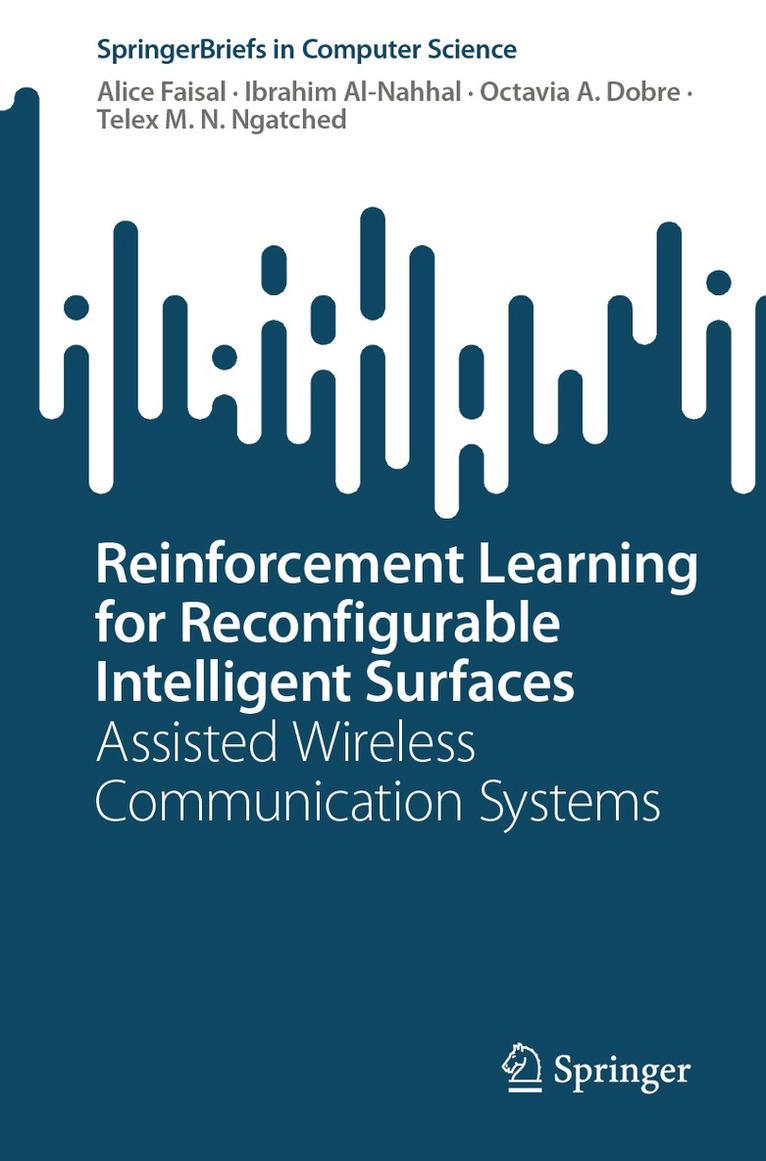
This book presents the intersection of two dynamic fields: Reinforcement Learning (RL) and RIS- Assisted Wireless Communications. With an emphasis on both discrete and continuous problems, it introduces a comprehensive overview of RL techniques and their applications in the evolving world of RIS-assisted wireless communications. Chapter 1 introduces the fundamentals of RL and deep RL (DRL), providing a solid foundation for understanding subsequent chapters. It also presents the Q-learning, deep Q-learning, and deep deterministic policy gradient algorithms. Chapter 2 provides a holistic overview of RIS-assisted systems and details several use cases in wireless communications. Then, Chapters 3 and 4 present various applications of the discrete and continuous DRL to RIS-assisted wireless communications. From maximizing the sum-rate to minimizing, the system resources and maximizing the energy efficiency. These chapters showcase the versatility of the DRL algorithms in tackling arange of challenges. This book concludes with Chapter 5, which introduces the challenges and future directions in this field. It explores the particulars of hyperparameter tuning, problem design, and complexity analysis, while also highlighting the potential of hybrid DRL, multi-agent DRL, and transfer learning techniques for advancing wireless communication systems.
Optimizing RIS-Assisted Wireless Systems requires powerful algorithms to cope with the dynamic propagation environment. DRL is envisioned as one of the key enabling techniques to exploit the full potential of RIS-Assisted Wireless Communication Systems. It empowers these systems to intelligently adapt to dynamic wireless environments, maximize performance metrics, and adjusts their configurations to accommodate diverse use cases efficiently.This book serves as a valuable resource, shedding light on the potential of DRL to optimize RIS-Assisted Wireless Communication, enabling researchers, engineers, advanced level students in computer science and electrical engineering and enthusiasts to grasp the intricacies of this topic. It offers a comprehensive understanding of the principles, applications, and challenges, making it a reference to recognize the full potential of the RIS technology in modern wireless communication systems.