of Cilicia Simplicius – författare
Visar alla böcker från författaren of Cilicia Simplicius. Handla med fri frakt och snabb leverans.
19 produkter
On Aristotle "On the Soul 1 and 2, 1-4"
Inbunden, 1995
2131 kr
Lägg i varukorg
This is the commentary attributed to Simplicius on Aristotle's "On the Soul". It is intended to provide a wider readership with the opportunity to assess the disputed question of authorship. Is the work by Simplicius, or by his colleague Priscian, or by another commentator? The commentary is a …
On Aristotle "Physics 2"
Av of Cilicia Simplicius, Barrie Fleet
Inbunden, 1997
2131 kr
Lägg i varukorg
Book two of Aristotle's "Physics" is thought by some to be the most interesting and representative book in the whole of his corpus. It explains his conception of nature, of physics as opposed to mathematics, of causation and explanation, of chance and of purpose in nature. Simplicius, writing in …
On Aristotle "Physics 5"
Av of Cilicia Simplicius, Aristotle
Inbunden, 1997
2131 kr
Lägg i varukorg
In the sixth century AD Simplicius produced detailed commentaries on several of the works of Aristotle, which help in our understanding of the "Physics", and of its interpretation in the ancient world. This is Urmson's translation of Simplicius' commentaries on "Physics 5" in which Aristotle lays …
On Aristotle "On the Soul 3.1-5"
Inbunden, 2000
2131 kr
Lägg i varukorg
In "On the Soul" 3.1-5, Aristotle goes beyond the five senses to the general functions of sense perception, the imagination and the so-called active intellect, whose identity was still a matter of controversy in the time of Thomas Aquinas. In his commentary on Aristotle's text, Simplicius insists …
On Aristotle "On Categories 9-15"
Inbunden, 2000
2131 kr
Lägg i varukorg
Simplicius' commentary on Aristotle's "Categories" falls into two parts. First, it examines the six categories dealt with in chapter 9 of "Categories", namely acting, undergoing, being in a position, when, where, and having. Secondly, it examines the so-called "Postpraedicamenta" consisting of …
On Aristotle "Categories 5-6"
Inbunden, 2001
2131 kr
Lägg i varukorg
Chapters 5 and 6 of Aristotle's "Categories" describe his first two categories, Substance and Quantity. It is usually taken that Plotinus attacked Aristotle's "Categories", but that Porphyry and Iamblichus restored it to the curriculum once and for all. Nonetheless, the introduction to this text …
On Aristotle "Categories 7-8"
Av of Cilicia Simplicius, Barrie Fleet
Inbunden, 2002
1853 kr
Lägg i varukorg
In "Categories" chapters 7 and 8 Aristotle considers his third and fourth categories - those of Relative and Quality. Critics of Aristotle had suggested for each of the non-substance categories that they could really be reduced to relatives, so it is important how the category of Relative is …
On Aristotle "Physics 8.6-10"
Inbunden, 2001
2131 kr
Lägg i varukorg
Aristotle's "Physics" is about the causes of motion and culminates in a proof that God is needed as the ultimate cause of motion. Aristotle argues that things in motion need to be moved by something other than themselves - he rejects Plato's self-movers. On pain of regress, there must be an unmoved …
On Aristotle "Physics 5"
Av of Cilicia Simplicius, Peter Lautner
Inbunden, 2002
2131 kr
Lägg i varukorg
Aristotle's "Physics Book 3" covers two subjects: the definition of change and the finitude of the universe. Change enters into the very definition of nature as an internal source of change. Change receives two definitions in chapters 1 and 2, as involving the actualisation of the potential or of …
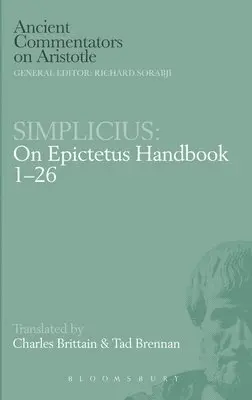
On Epictetus "Handbook 1-26"
Inbunden, 2002
2131 kr
Lägg i varukorg
The "Enchiridion" or "Handbook" of the first-century AD Stoic Epictetus was used as an ethical treatise both in Christian monasteries and by the sixth-century pagan Neoplatonist Simplicius. Simplicius chose it for beginners, rather than Aristotle's "Ethics", because it presupposed no knowledge of …
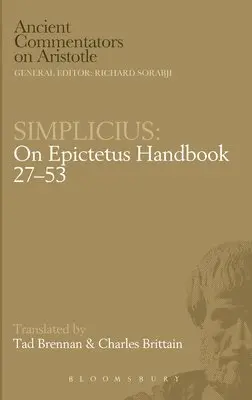
On Epictetus "Handbook 27-53"
Inbunden, 2002
2131 kr
Lägg i varukorg
The "Enchiridion" or "Handbook" of the first-century AD Stoic Epictetus was used as an ethical treatise both in Christian monasteries and by the sixth-century pagan Neoplatonist Simplicius. Simplicius chose it for beginners, rather than Aristotle's "Ethics", because it presupposed no knowledge of …
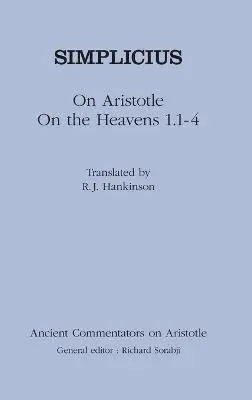
On Aristotle "On the Heavens 1.1-4"
Inbunden, 2002
1853 kr
Lägg i varukorg
In chapter 1 of "On the Heavens" Aristotle defines body, and then notoriously ruptures dynamics by introducing a fifth element, beyond Plato's four, to explain the rotation of the heavens, which, like nearly all Greeks, Aristotle took to be real, not apparent. Even a member of his school, …
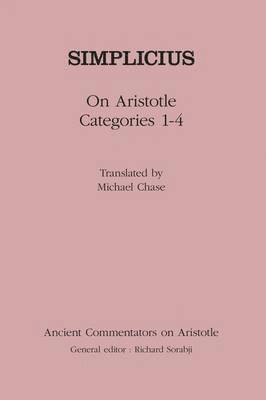
On Aristotle "Categories 1-4"
Av of Cilicia Simplicius, Michael Chase
Inbunden, 2003
2131 kr
Lägg i varukorg
Simplicius' commentary on Aristotle's "Categories" is the most comprehensive philosophical critique of the work ever written, representing 600 years of criticism. In his "Categories", Aristotle divides what exists in the sensible world into ten categories of Substance, Quantity, Relative, Quality …
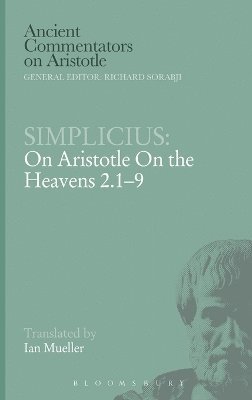
On Aristotle "On the Heavens 2.1-9"
Av of Cilicia Simplicius, Ian Mueller
Inbunden, 2004
2131 kr
Lägg i varukorg
Aristotle believed that the outermost stars are carried round us on a transparent sphere. There are directions in the universe and a preferred direction of rotation. The sun moon and planets are carried on different revolving spheres. The spheres and celestial bodies are composed of an everlasting …
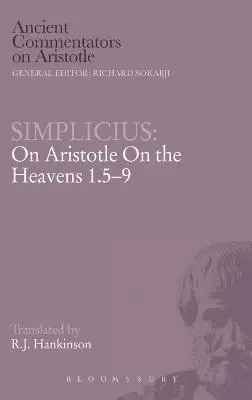
On Aristotle "On the Heavens 1.5-9"
Av of Cilicia Simplicius, R. J. Hankinson m. fl.
Inbunden, 2004
2131 kr
Lägg i varukorg
Aristotle argues in "On the Heavens" 1.5-7 that there can be no infinitely large body, and in 1.8-9 that there cannot be more than one physical world. As a corollary in 1.9, he infers that there is no place, vacuum or time beyond the outermost stars. As one argument in favour of a single world, he …
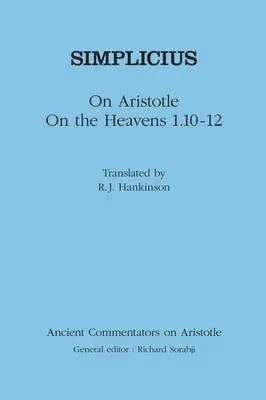
On Aristotle "On the Heavens 1.10-12"
Inbunden, 2006
2131 kr
Lägg i varukorg
In the three chapters of "On the Heavens" dealt with in this volume, Aristotle argues that the universe is ungenerated and indestructible. In Simplicius' commentary, translated here, we see a battle royal between the Neoplatonist Simplicius and the Aristotelian, Alexander, whose lost commentary on …