Ove Stephansson - Böcker
Visar alla böcker från författaren Ove Stephansson. Handla med fri frakt och snabb leverans.
11 produkter
11 produkter
Del 2 - Geo-Engineering Book Series
Coupled Thermo-Hydro-Mechanical-Chemical Processes in Geo-systems
Inbunden, Engelska, 2004
3 483 kr
Skickas inom 7-10 vardagar
Among the most important and exciting current steps forward in geo-engineering is the development of coupled numerical models. They represent the basic physics of geo-engineering processes which can include the effects of heat, water, mechanics and chemistry. Such models provide an integrating focus for the wide range of geo-engineering disciplines. The articles within this volume were originally presented at the inaugural GeoProc conference held in Stockholm and contain a collection of unusually high quality information not available elsewhere in an edited and coherent form. This collection not only benefits from the latest theoretical developments but also applies them to a number of practical and wide ranging applications. Examples include the environmental issues around radioactive waste disposal deep in rock, and the search for new reserves of oil and gas.
Del 85 - Developments in Geotechnical Engineering
Fundamentals of Discrete Element Methods for Rock Engineering: Theory and Applications
Inbunden, Engelska, 2007
1 825 kr
Skickas inom 7-10 vardagar
This book presents some fundamental concepts behind the basic theories and tools of discrete element methods (DEM), its historical development, and its wide scope of applications in geology, geophysics and rock engineering. Unlike almost all books available on the general subject of DEM, this book includes coverage of both explicit and implicit DEM approaches, namely the Distinct Element Methods and Discontinuous Deformation Analysis (DDA) for both rigid and deformable blocks and particle systems, and also the Discrete Fracture Network (DFN) approach for fluid flow and solute transport simulations. The latter is actually also a discrete approach of importance for rock mechanics and rock engineering. In addition, brief introductions to some alternative approaches are also provided, such as percolation theory and Cosserat micromechanics equivalence to particle systems, which often appear hand-in-hand with the DEM in the literature. Fundamentals of the particle mechanics approach using DEM for granular media is also presented.� Presents the fundamental concepts of the discrete models for fractured rocks, including constitutive models of rock fractures and rock masses for stress, deformation and fluid flow� Provides a comprehensive presentation on discrete element methods, including distinct elements, discontinuous deformation analysis, discrete fracture networks, particle mechanics and Cosserat representation of granular media� Features constitutive models of rock fractures and fracture system characterization methods detaiing their significant impacts on the performance and uncertainty of the DEM models
860 kr
Skickas inom 10-15 vardagar
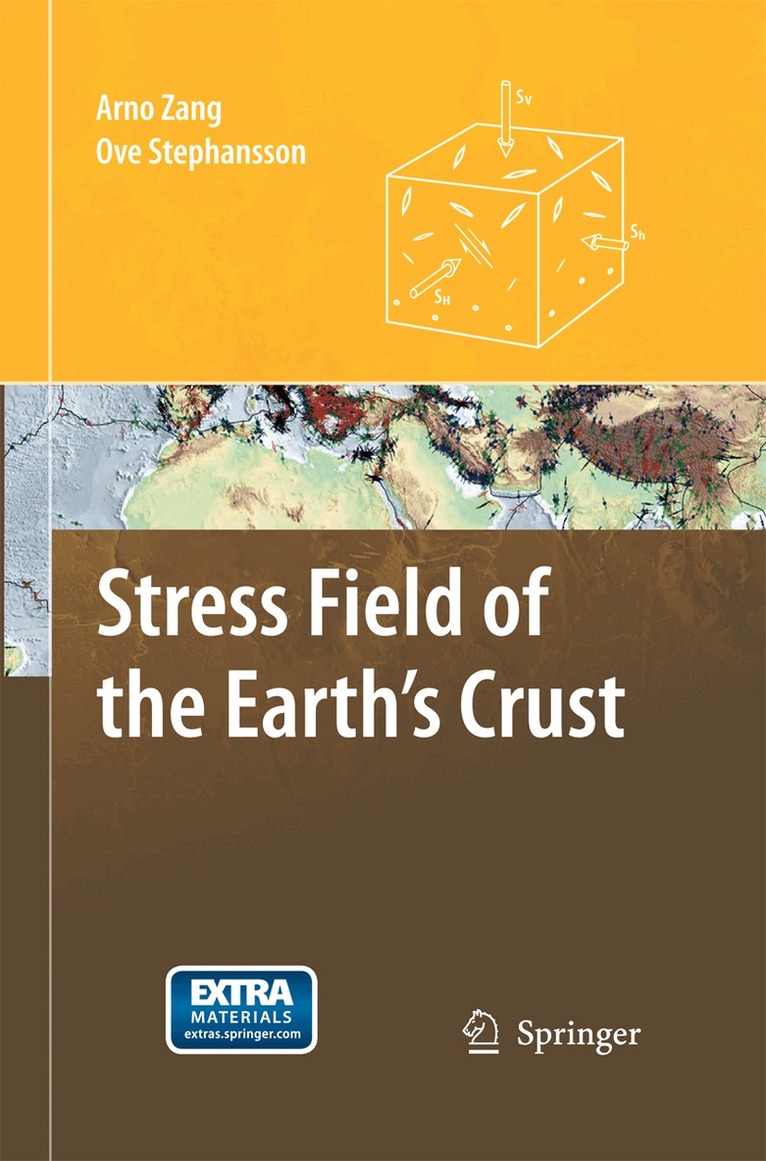
Stress Field of the Earth’s Crust is based on lecture notes prepared for a course offered to graduate students in the Earth sciences and engineering at University of Potsdam. In my opinion, it will undoubtedly also become a standard reference book on the desk of most scientists working with rocks, such as geophysicists, structural geologists, rock mechanics experts, as well as geotechnical and petroleum en- neers. That is because this book is concerned with what is probably the most pe- liar characteristic of rock – its initial stress condition. Rock is always under a natural state of stress, primarily a result of the gravitational and tectonic forces to which it is subjected. Crustal stresses can vary regionally and locally and can reach in places considerable magnitudes, leading to natural or man-made mechanical failure. P- existing stress distinguishes rock from most other materials and is at the core of the discipline of “Rock Mechanics”, which has been developed over the last century. Knowledge of rock stress is fundamental to understanding faulting mechanisms and earthquake triggering, to designing stable underground caverns and prod- tive oil fields, and to improving mining methods and geothermal energy extraction, among others. Several books have been written on the subject, but none has atte- ted to be as all-encompassing as the one by Zang and Stephansson.
913 kr
Skickas inom 10-15 vardagar
This book is the second edition of the well-known textbook Modelling Rock Fracturing Processes. The new and extended edition provides the theoretical background of rock fracture mechanics used for modelling of 2-D and 3-D geomechanics problems and processes. Fundamentals of rock fracture mechanics integrated with experimental studies of rock fracturing processes are highlighted. The computer programs FRACOD 2D and 3D are used to analyse fracture initiation and propagation for the three fracture modes: Mode I, II and III. Coupled fracture modelling with other continuous and distinct element codes including FLAC, PFC, RFPA, TOUGH are also described. A series of applications of fracture modelling with importance for modern society is presented and discussed by distinguished rock fracture modelling experts.
646 kr
Skickas inom 10-15 vardagar
This book is the second edition of the well-known textbook Modelling Rock Fracturing Processes. A series of applications of fracture modelling with importance for modern society is presented and discussed by distinguished rock fracture modelling experts.
540 kr
Skickas inom 10-15 vardagar
Mechanical properties and fluid transport in rocks are intimately linked as deformation of a solid rock matrix immediately affects the pore space and permeability. This may result in transient or permanent changes of pore pressures and effective pressures causing rock strength to vary in space and time. Fluid circulation and deformation processes in crustal rocks are coupled, producing significant complexity of mechanical and fluid transport behavior. This often poses severe technical and economic problems for reservoir and geotechnical engineering projects involved in oil and gas production, CO2 sequestration, mining and underground waste disposal. For example, the depletion of hydrocarbon and water reservoirs leading to compaction may have adverse effects on well production. Solution/precipitation processes modify porosity and affect permeability of aquifers and reservoir rocks. Fracture damage from underground excavation will critically influence the long-term stability and performance of waste storage.Part I of this topical volume covers mainly the nucleation and evolution of crack damage in rocks, new or modified techniques to measure rock fracture toughness and a discussion of upscaling techniques relating mechanical and fluid transport behaviour in rocks at different spatial scales.Part II, to be published later in 2006, will include studies investigating the coupling of rock deformation and fluid flow.
913 kr
Skickas inom 10-15 vardagar
Mechanical properties and fluid transport in rocks are intimately linked as deformation of a solid rock matrix immediately affects the pore space and permeability. The coupling of fluid circulation and deformation processes in crustal rocks results in significant complexity of the mechanical and fluid transport behavior. This often poses severe technical and economic problems for reservoir and geotechnical engineering projects involved in oil and gas production, CO2 sequestration, mining and underground waste disposal. The volume results from the 5th Euroconference on Rock Physics and Geomechanics, which was held in Potsdam, Germany in September 2004. Part I of the topical volume mainly contains contributions investigating the nucleation and evolution of crack damage in rocks, new or modified techniques to measure rock fracture toughness and a discussion of upscaling techniques relating mechanical and fluid transport behavior in rocks at different spatial scales.Part II contains contributions discussing fluid flow and transport in rocks as observed on the laboratory scale and in boreholes. The evolution of rock damage pertinent to the stability of underground excavations is studied and scaling relations of elastic properties and seismic events are discussed.
Rock Joints
Proceedings of a regional conference of the International Society for Rock Mechanics, Loen, 4-6 June 1990
Inbunden, Engelska, 1990
3 556 kr
Skickas inom 7-10 vardagar
Rock joint behaviour impacts many branches of engineering including surface and underground mining, dam foundations, tunnelling for hydro power and transport, petroleum reservoirs and nuclear waste storage. The subject is in a very active stage of development, and engineers, geologists, and scientists involved in these developments have indicated by their 110 papers that rock joints are of great importance in many fields of engineering. Selected papers span five continents and thirty countries.The subjects covered include geological aspects of joint origin and morphology, mechanical behaviour such as shear strength and deformability, hydraulic behaviour, and dynamic behaviour. The influence of water flow on frictional strength and the effect of joint deformation on water flow are also strongly represented.Great activity is evident in many countries in computer modelling for solving complicated engineering problems where joint behaviour is important. Articles describe the modelling of joints under dams, around wellbores, in petroleum reservoirs, in open pit mines, and around tunnels, shafts and nuclear waste repository excavations. The conference proceedings forms a unique collection of keynote and specialist articles on all aspects of rock joint behaviour.
Rock bolting: Theory and application in mining and underground construction
Proceedings of the international symposium, Abisko, Sweden, 28 August-2 September 1983
Inbunden, Engelska, 1984
6 636 kr
Skickas inom 7-10 vardagar
Rock bolts today represent the dominant support system in mines and underground structures. Some results and experiences are discussed to give a better understanding of the strength of individual rock bolts and systems of bolts, and the interaction between bolts and rock masses of various types. Topics covered are as follows: rock bolting in theory and experiments; design principles and experience; and ground control and instrumentation: cable bolting
704 kr
Skickas inom 10-15 vardagar
In my opinion, it will undoubtedly also become a standard reference book on the desk of most scientists working with rocks, such as geophysicists, structural geologists, rock mechanics experts, as well as geotechnical and petroleum en- neers.
753 kr
Skickas inom 10-15 vardagar
This text book provides the theoretical background of rock fracture mechanics and displacement discontinuity methods used for the modelling of geomechanical problems. The computer program FRACOD is used to analyse the fracture problems, assessing fracture initiation and propagation in tension (Mode I), shear (Mode II) and mixed mode I and II of solid intact or jointed geomaterials. The book also presents the fundamentals of thermo-mechanical coupling and hydro-mechanical coupling. Formulations of multiple regional mechanical, thermal and hydraulic functions, which allow analyses of fracture mechanics problems for structures made of brittle, rock-like materials, are provided. In addition, instructive examples of code verification and applications are presented.Additional material: The 2-D version of the FRACOD program, a manual on the program and a wealth of verification examples of classical problems in physics, mechanics and hydromechanics are available at http://extras.springer.com. A large number of applications related to civil, mining, petroleum and environmental engineering are also included.- The first textbook available on modelling of rock fracture propagation- Introduces readers to the fundamentals of rock fracturing- Uses a modern style of teaching with theory, mathematical modelling and applications in one package- The basic version of the FRACOD software, manual, verification examples and applications are available as additional material- The FRACOD program and manual enable the readers to solve fracture propagation problems on their own ---------------------------Ki-Bok Min, Department of Energy Resources Engineering,College of Engineering, Seoul NationalUniversity, Korea“Challenging rock engineering applications require extreme conditions of stress, temperature and hydraulic pressure resulting in rock fracturing to a various extent. The FRACOD is one of few computer codes available in engineering rock mechanics that can simulate the initiation and propagation of fractures often interacting with natural fractures. Its capability has been significantly enhanced to include the hydraulic and thermal fracturing with concerted interaction from multi-national research and industry partners. My experience with the FRACOD is very positive and I am certain that its already-excellent track record will expand further in the future."