Patrice Perny – författare
Visar alla böcker från författaren Patrice Perny. Handla med fri frakt och snabb leverans.
11 produkter
11 produkter
Del 32 - International Series in Operations Research & Management Science
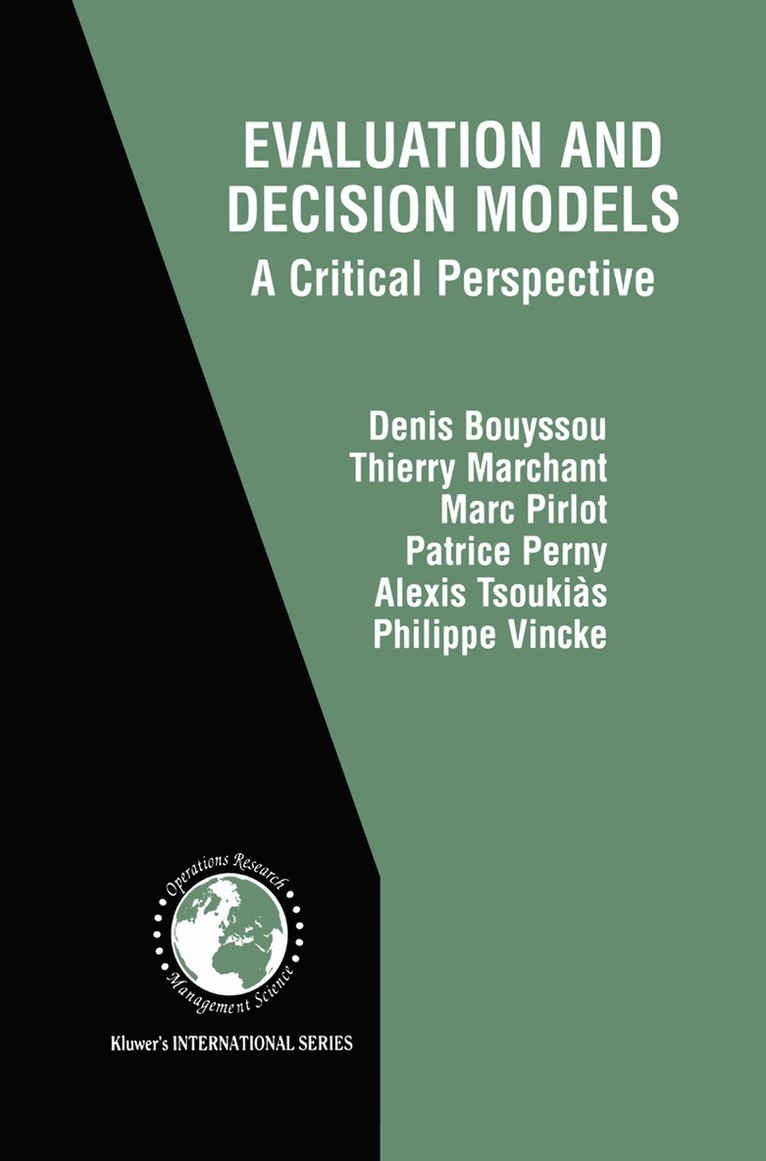
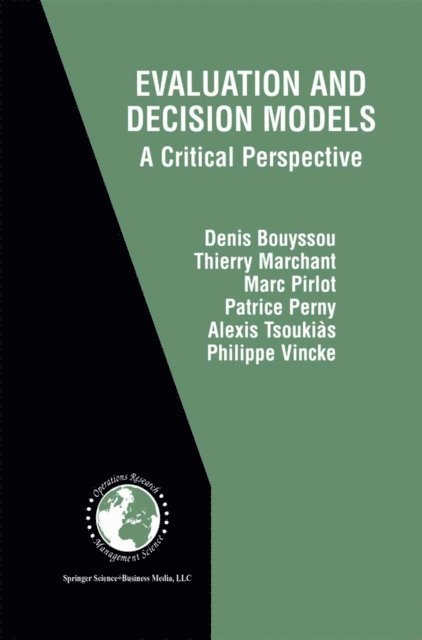
Evaluation and Decision Models
A Critical Perspective
Inbunden, Engelska, 2000
1 670 kr
Skickas inom 10-15 vardagar
1. 1 Motivations Deciding is a very complex and difficult task. Some people even argue that our ability to make decisions in complex situations is the main feature that distinguishes us from animals (it is also common to say that laughing is the main difference). Nevertheless, when the task is too complex or the interests at stake are too important, it quite often happens that we do not know or we are not sure what to decide and, in many instances, we resort to a decision support technique: an informal one-we toss a coin, we ask an oracle, we visit an astrologer, we consult an expert, we think-or a formal one. Although informal decision support techniques can be of interest, in this book, we will focus on formal ones. Among the latter, we find some well-known decision support techniques: cost-benefit analysis, multiple criteria decision analysis, decision trees, . . . But there are many other ones, sometimes not presented as decision support techniques, that help making decisions. Let us cite but a few examples. • When the director of a school must decide whether a given student will pass or fail, he usually asks each teacher to assess the merits of the student by means of a grade. The director then sums the grades and compares the result to a threshold. • When a bank must decide whether a given client will obtain a credit or not, a technique, called credit scoring, is often used.
Inbunden, Engelska, 2001
2 225 kr
Skickas inom 10-15 vardagar
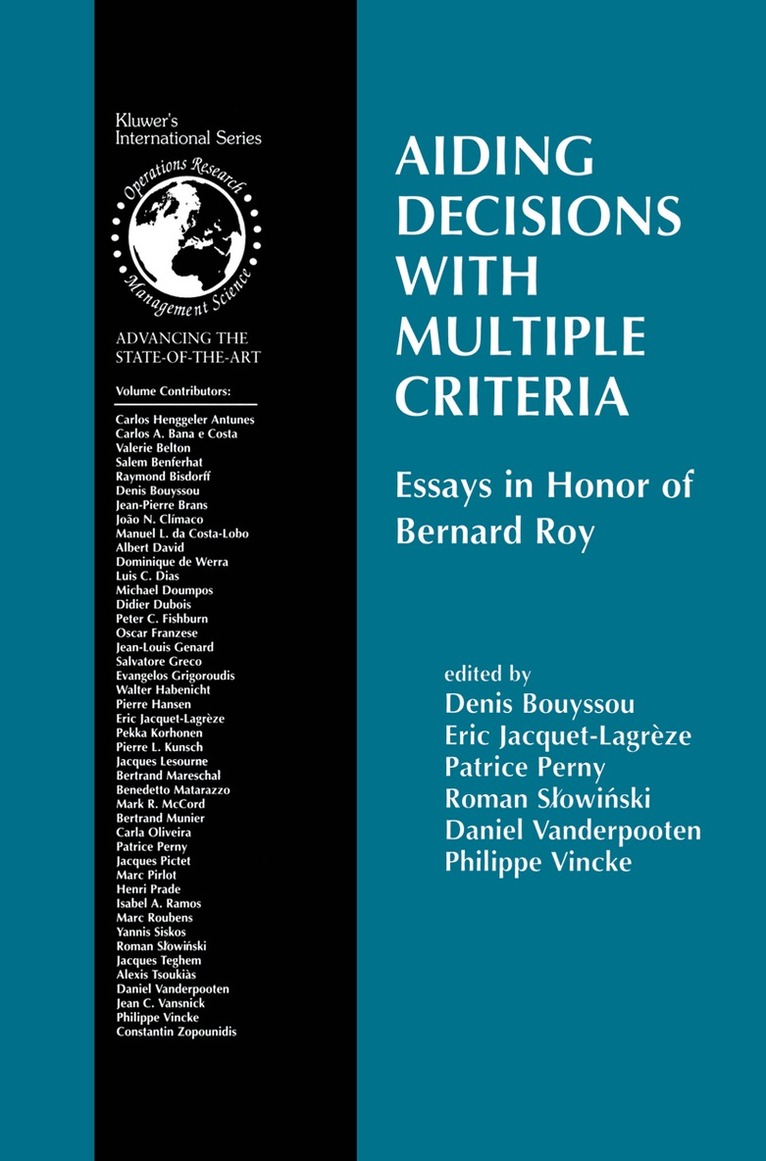
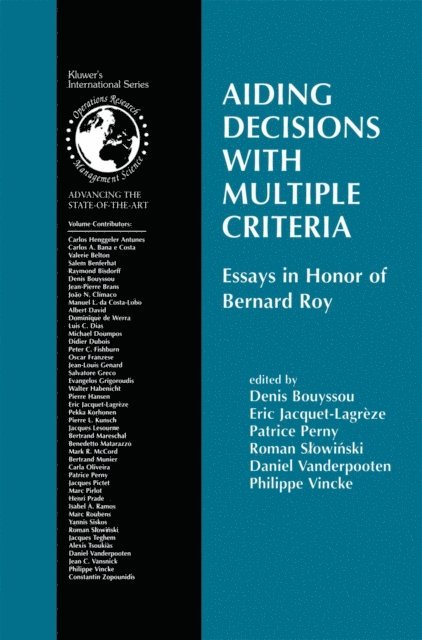
Aiding Decisions With Multiple Criteria: Essays in Honor of Bernard Roy is organized around two broad themes: * Graph Theory with path-breaking contributions on the theory of flows in networks and project scheduling, * Multiple Criteria Decision Aiding with the invention of the family of ELECTRE methods and methodological contribution to decision-aiding which lead to the creation of Multi-Criteria Decision Analysis (MCDA). Professor Bernard Roy has had considerable influence on the development of these two broad areas. GBP/LISTGBP Part one contains papers by Jacques Lesourne, and Dominique de Werra & Pierre Hansen related to the early career of Bernard Roy when he developed many new techniques and concepts in Graph Theory in order to cope with complex real-world problems. Part two of the book is devoted to Philosophy and Epistemology of Decision-Aiding with contributions from Valerie Belton & Jacques Pictet and Jean-Luis Genard & Marc Pirlot. Part three includes contributions based on Theory and Methodology of Multi-Criteria Decision-Aiding based on a general framework for conjoint measurement that allows intrasitive preferences.Denis Bouyssou & Marc Pirlot; Alexis Tsoukias, Patrice Perny & Philippe Vincke; Luis Dias & Joao Climaco; Daniel Vanderpooten; Michael Doumpos & Constantin Zopounidis; and Marc Roubens offer a considerable range of examinations of this aspect of MCDA. Part four is devoted to Perference Modeling with contributions from Peter Fishburn; Salvatore Greco, Benedetto Matarazzo & Roman Slowinski; Salem Benferhat, Didier Dubois & Henri Prade; Oscar Franzese & Mark McCord; Bertrand Munier; and Raymond Bisdorff. Part five groups Applications of Multi-Criteria Decision-Aiding, and Carlos Henggeler Antunes, Carla Oliveira & Joao Climaco; Carlos Bana e Costa, Manuel da Costa-Lobo, Isabel Ramos & Jean-Claude Vansnick; Yannis Siskos & Evangelos Grigoroudis; Jean-Pierre Brans, Pierre Kunsch & Bertrand Mareschal offer a wide variety of application problems. Finally, Part six includes contributions on Multi-Objective Mathematical Programming from Jacques Teghem, Walter Habenicht and Pekka Korhonen.
Del 44 - International Series in Operations Research & Management Science
Aiding Decisions with Multiple Criteria
Essays in Honor of Bernard Roy
Häftad, Engelska, 2012
2 160 kr
Skickas inom 10-15 vardagar
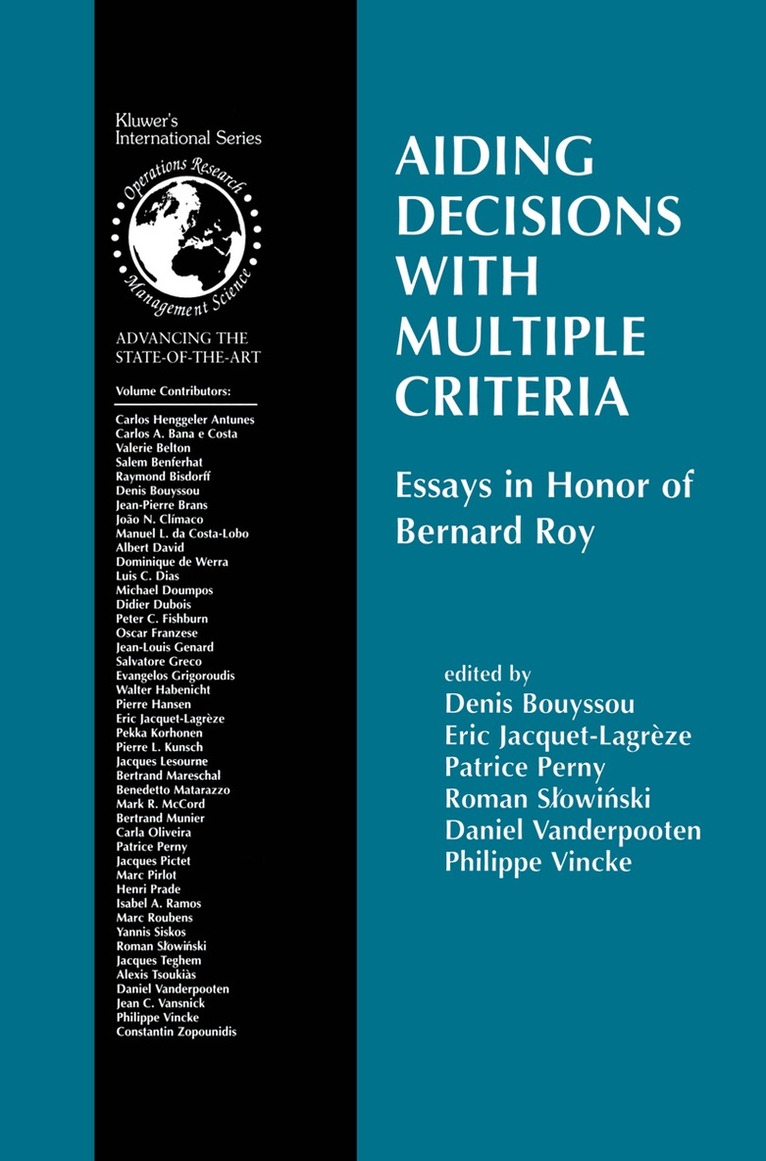
Aiding Decisions With Multiple Criteria: Essays in Honor of Bernard Roy is organized around two broad themes: * Graph Theory with path-breaking contributions on the theory of flows in networks and project scheduling, * Multiple Criteria Decision Aiding with the invention of the family of ELECTRE methods and methodological contribution to decision-aiding which lead to the creation of Multi-Criteria Decision Analysis (MCDA). Professor Bernard Roy has had considerable influence on the development of these two broad areas. GBP/LISTGBP Part one contains papers by Jacques Lesourne, and Dominique de Werra & Pierre Hansen related to the early career of Bernard Roy when he developed many new techniques and concepts in Graph Theory in order to cope with complex real-world problems. Part two of the book is devoted to Philosophy and Epistemology of Decision-Aiding with contributions from Valerie Belton & Jacques Pictet and Jean-Luis Genard & Marc Pirlot. Part three includes contributions based on Theory and Methodology of Multi-Criteria Decision-Aiding based on a general framework for conjoint measurement that allows intrasitive preferences.Denis Bouyssou & Marc Pirlot; Alexis Tsoukias, Patrice Perny & Philippe Vincke; Luis Dias & Joao Climaco; Daniel Vanderpooten; Michael Doumpos & Constantin Zopounidis; and Marc Roubens offer a considerable range of examinations of this aspect of MCDA. Part four is devoted to Perference Modeling with contributions from Peter Fishburn; Salvatore Greco, Benedetto Matarazzo & Roman Slowinski; Salem Benferhat, Didier Dubois & Henri Prade; Oscar Franzese & Mark McCord; Bertrand Munier; and Raymond Bisdorff. Part five groups Applications of Multi-Criteria Decision-Aiding, and Carlos Henggeler Antunes, Carla Oliveira & Joao Climaco; Carlos Bana e Costa, Manuel da Costa-Lobo, Isabel Ramos & Jean-Claude Vansnick; Yannis Siskos & Evangelos Grigoroudis; Jean-Pierre Brans, Pierre Kunsch & Bertrand Mareschal offer a wide variety of application problems. Finally, Part six includes contributions on Multi-Objective Mathematical Programming from Jacques Teghem, Walter Habenicht and Pekka Korhonen.
Del 32 - International Series in Operations Research & Management Science
Evaluation and Decision Models
A Critical Perspective
Häftad, Engelska, 2012
1 670 kr
Skickas inom 10-15 vardagar
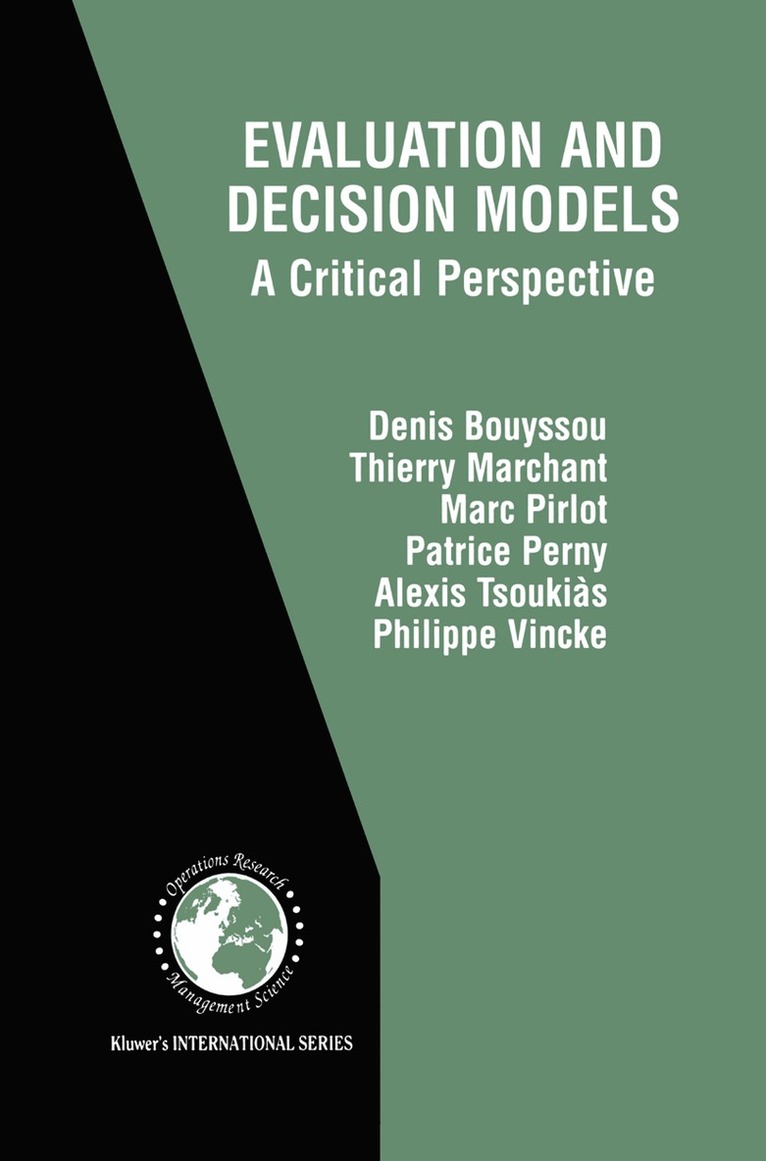
1. 1 Motivations Deciding is a very complex and difficult task. Some people even argue that our ability to make decisions in complex situations is the main feature that distinguishes us from animals (it is also common to say that laughing is the main difference). Nevertheless, when the task is too complex or the interests at stake are too important, it quite often happens that we do not know or we are not sure what to decide and, in many instances, we resort to a decision support technique: an informal one-we toss a coin, we ask an oracle, we visit an astrologer, we consult an expert, we think-or a formal one. Although informal decision support techniques can be of interest, in this book, we will focus on formal ones. Among the latter, we find some well-known decision support techniques: cost-benefit analysis, multiple criteria decision analysis, decision trees, . . . But there are many other ones, sometimes not presented as decision support techniques, that help making decisions. Let us cite but a few examples. • When the director of a school must decide whether a given student will pass or fail, he usually asks each teacher to assess the merits of the student by means of a grade. The director then sums the grades and compares the result to a threshold. • When a bank must decide whether a given client will obtain a credit or not, a technique, called credit scoring, is often used.
E-bok
PDF, Engelska, 20122 741 kr
Läs direkt efter köp
E-bok
PDF, Engelska, 20122 110 kr
Läs direkt efter köp
1. 1 Motivations Deciding is a very complex and difficult task. Some people even argue that our ability to make decisions in complex situations is the main feature that distinguishes us from animals (it is also common to say that laughing is the main difference). Nevertheless, when the task is too complex or the interests at stake are too important, it quite often happens that we do not know or we are not sure what to decide and, in many instances, we resort to a decision support technique: an informal one-we toss a coin, we ask an oracle, we visit an astrologer, we consult an expert, we think-or a formal one. Although informal decision support techniques can be of interest, in this book, we will focus on formal ones. Among the latter, we find some well-known decision support techniques: cost-benefit analysis, multiple criteria decision analysis, decision trees, . . . But there are many other ones, sometimes not presented as decision support techniques, that help making decisions. Let us cite but a few examples. • When the director of a school must decide whether a given student will pass or fail, he usually asks each teacher to assess the merits of the student by means of a grade. The director then sums the grades and compares the result to a threshold. • When a bank must decide whether a given client will obtain a credit or not, a technique, called credit scoring, is often used.
Häftad, Engelska, 2013
562 kr
Skickas inom 10-15 vardagar
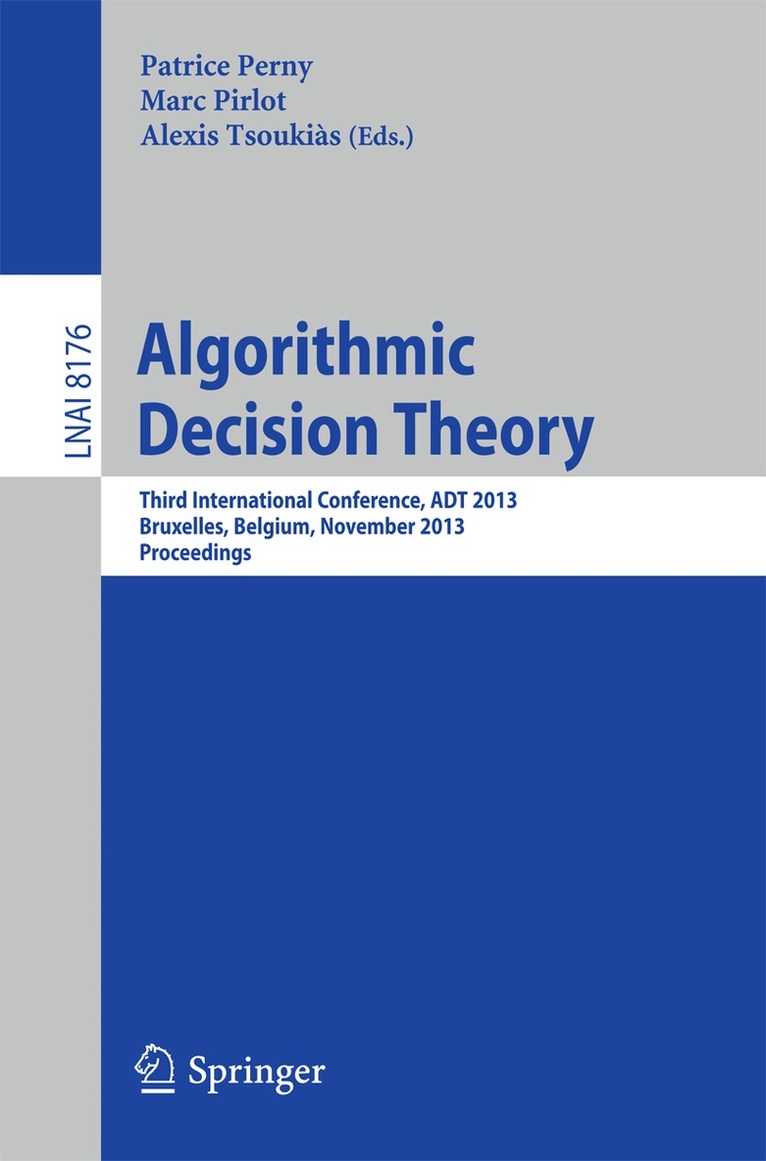
This book constitutes the thoroughly refereed conference proceedings of the Third International Conference on Algorithmic Decision Theory, ADT 2013, held in November 2013 in Bruxelles, Belgium. The 33 revised full papers presented were carefully selected from more than 70 submissions, covering preferences in reasoning and decision making, uncertainty and robustness in decision making, multi-criteria decision analysis and optimization, collective decision making, learning and knowledge extraction for decision support.
E-bok
PDF, Engelska, 2013712 kr
Läs direkt efter köp
This book constitutes the thoroughly refereed conference proceedings of the Third International Conference on Algorithmic Decision Theory, ADT 2013, held in November 2013 in Bruxelles, Belgium. The 33 revised full papers presented were carefully selected from more than 70 submissions, covering preferences in reasoning and decision making, uncertainty and robustness in decision making, multi-criteria decision analysis and optimization, collective decision making, learning and knowledge extraction for decision support.
Inbunden, Engelska, 2000
1 084 kr
Skickas inom 10-15 vardagar
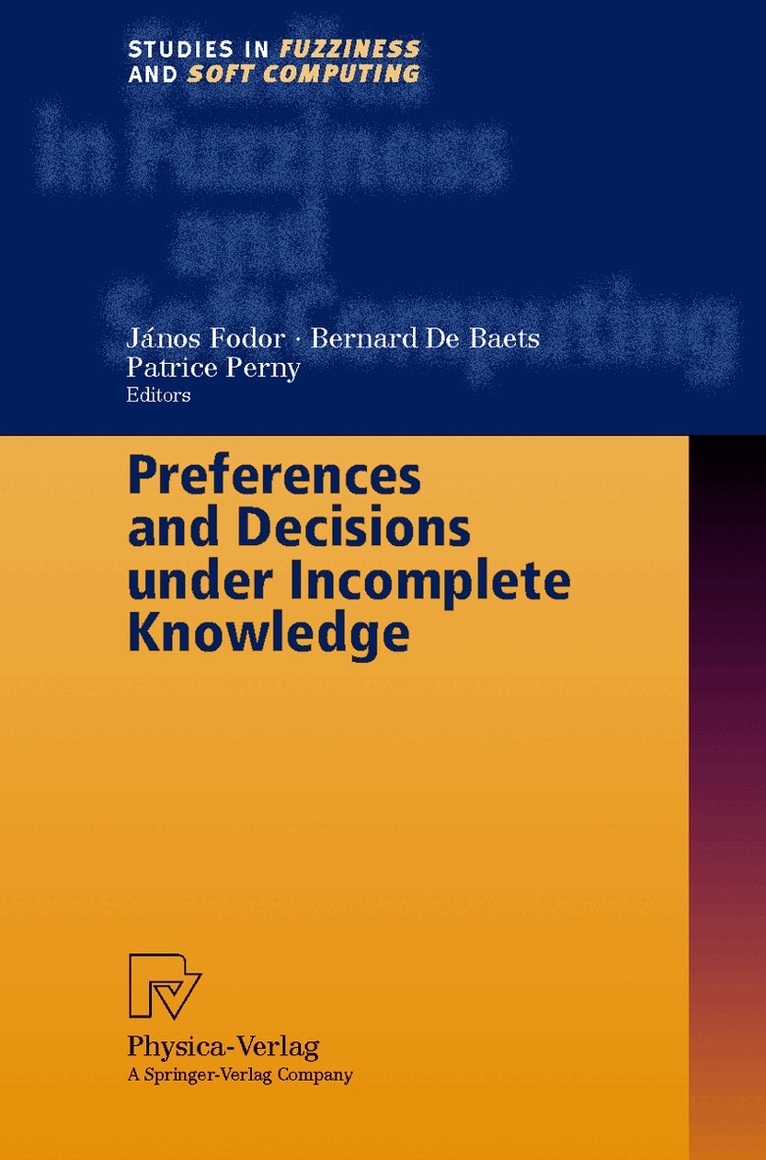
Nowadays, decision problems are pervaded with incomplete knowledge, i.e., imprecision and/or uncertain information, both in the problem description and in the preferential information. In this volume leading scientists in the field address various theoretical and practical aspects related to the handling of this incompleteness. The problems discussed are taken from multi-objective linear programming, rationality considerations in preference modelling, non-probabilistic utility theory, data fusion, group decision making and multicriteria decision aid. The book is oriented towards researchers, graduate and postgraduate students in decision analysis, fuzzy sets and fuzzy logic, and operations research/management science.
E-bok
PDF, Engelska, 20131 408 kr
Läs direkt efter köp
Nowadays, decision problems are pervaded with incomplete knowledge, i.e., imprecision and/or uncertain information, both in the problem description and in the preferential information. In this volume leading scientists in the field address various theoretical and practical aspects related to the handling of this incompleteness. The problems discussed are taken from multi-objective linear programming, rationality considerations in preference modelling, non-probabilistic utility theory, data fusion, group decision making and multicriteria decision aid. The book is oriented towards researchers, graduate and postgraduate students in decision analysis, fuzzy sets and fuzzy logic, and operations research/management science.
Del 51 - Studies in Fuzziness and Soft Computing
Preferences and Decisions under Incomplete Knowledge
Häftad, Engelska, 2010
1 116 kr
Skickas inom 10-15 vardagar
Nowadays, decision problems are pervaded with incomplete knowledge, i.e., imprecision and/or uncertain information, both in the problem description and in the preferential information. In this volume leading scientists in the field address various theoretical and practical aspects related to the handling of this incompleteness. The problems discussed are taken from multi-objective linear programming, rationality considerations in preference modelling, non-probabilistic utility theory, data fusion, group decision making and multicriteria decision aid. The book is oriented towards researchers, graduate and postgraduate students in decision analysis, fuzzy sets and fuzzy logic, and operations research/management science.