Paul K. Edwards - Böcker
Visar alla böcker från författaren Paul K. Edwards. Handla med fri frakt och snabb leverans.
4 produkter
4 produkter
2 372 kr
Skickas inom 3-6 vardagar
Work is fundamental to human society and modern organizations, and consequently has been central to the thinking of major social theorists and social science disciplines. This book offers a 'one-stop-shop' guide to classical and contemporary perspectvies of work written by leading international experts. Schools covered include: Weberian, Marxian, Durkheimian, feminist, neo-classical economics, institutional economics, ethics, Foucauldian, postmodernist, organizational sociology and economic sociology. Each chapter traces the origins of the theoretical school, reviews seminal contributions,and considers major criticisms of the approach. In addition, the book features a section on key aspects of work - professions, technology, identity and globalisation - to which these theories have been applied. The book makes a major contribution in a number of ways: · Provides systematic coverage of major social and economic theories and the way they aid our understanding of work;· Includes a section of chapters that consider, in an applied way, how social theories have helped the analysis of key substantive areas of work;· Includes contributions from leading academics from both Europe and the USA; · Each chapter can be read as free-standing summary of a particular school of theoretical approach;· In addition, the introductory and concluding chapters examine themes cross-cutting the other chapters in the book. It is an essential text for academics and advanced students concerned with the sociology of work, management, and organization studies.
1 074 kr
Skickas inom 5-8 vardagar
Work is fundamental to human society and modern organizations, and consequently has been central to the thinking of major social theorists and social science disciplines. This book offers a 'one-stop-shop' guide to classical and contemporary perspectvies of work written by leading international experts. Schools covered include: Weberian, Marxian, Durkheimian, feminist, neo-classical economics, institutional economics, ethics, Foucauldian, postmodernist, organizational sociology and economic sociology. Each chapter traces the origins of the theoretical school, reviews seminal contributions,and considers major criticisms of the approach. In addition, the book features a section on key aspects of work - professions, technology, identity and globalisation - to which these theories have been applied. The book makes a major contribution in a number of ways: · Provides systematic coverage of major social and economic theories and the way they aid our understanding of work;· Includes a section of chapters that consider, in an applied way, how social theories have helped the analysis of key substantive areas of work;· Includes contributions from leading academics from both Europe and the USA; · Each chapter can be read as free-standing summary of a particular school of theoretical approach;· In addition, the introductory and concluding chapters examine themes cross-cutting the other chapters in the book.It is an essential text for academics and advanced students concerned with the sociology of work, management, and organization studies.
1 479 kr
Skickas inom 5-8 vardagar
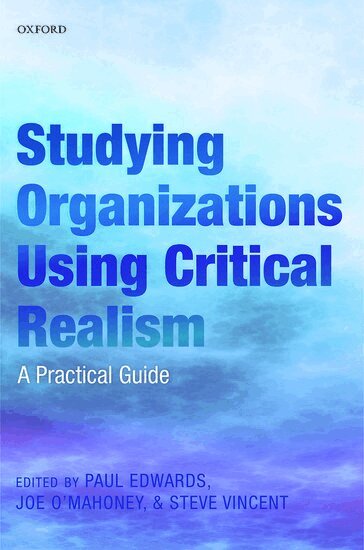
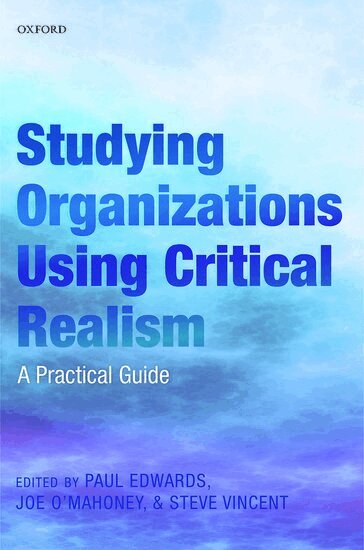
The development of Critical Realism (CR), as a philosophy of science, is generally attributed to a series of books by Roy Bhaskar. It has proven to be influential, not least because it has an affinity with many people's views about the way the world fits together, both within and outside of academia. Whilst there are numerous contributions outlining CR theory in sociological and organizational research, as well as general texts about realist ontology, work delineating the consequences of these views for research practice is an emerging area of interest.This book aims to fill a significant gap in the literature by providing a practical guide to the application of CR in empirical research projects. More specifically, it explores the methodological consequences of committing to a CR ontology--the assumptions that researchers from this tradition make about the nature of reality. These assumptions are important because ontological commitments, which relate what we believe exists, often affect our epistemological concerns, which relate to our beliefs about how whatever exists can be studied and known. Thus, for a researcher, ontology and epistemology are important because they have consequences for the possibilities and limits of the research methods, techniques, and analyses that they employ. The book explains what CR is and outlines the logic of research design. In a series of chapters on major social science research methods, purpose-written by experts in the relevant technique, the book contains extended illustration of how to conduct inquiry using CR.
726 kr
Skickas inom 7-10 vardagar
The development of Critical Realism (CR), as a philosophy of science, is generally attributed to a series of books by Roy Bhaskar. It has proven to be influential, not least because it has an affinity with many people's views about the way the world fits together, both within and outside of academia. Whilst there are numerous contributions outlining CR theory in sociological and organizational research, as well as general texts about realist ontology, work delineating the consequences of these views for research practice is an emerging area of interest.This book aims to fill a significant gap in the literature by providing a practical guide to the application of CR in empirical research projects. More specifically, it explores the methodological consequences of committing to a CR ontology--the assumptions that researchers from this tradition make about the nature of reality. These assumptions are important because ontological commitments, which relate what we believe exists, often affect our epistemological concerns, which relate to our beliefs about how whatever exists can be studied and known. Thus, for a researcher, ontology and epistemology are important because they have consequences for the possibilities and limits of the research methods, techniques, and analyses that they employ. The book explains what CR is and outlines the logic of research design. In a series of chapters on major social science research methods, purpose-written by experts in the relevant technique, the book contains extended illustration of how to conduct inquiry using CR.