Peter A. Lindsay – författare
Visar alla böcker från författaren Peter A. Lindsay. Handla med fri frakt och snabb leverans.
3 produkter
3 produkter
Häftad, Engelska, 1993
544 kr
Skickas inom 10-15 vardagar
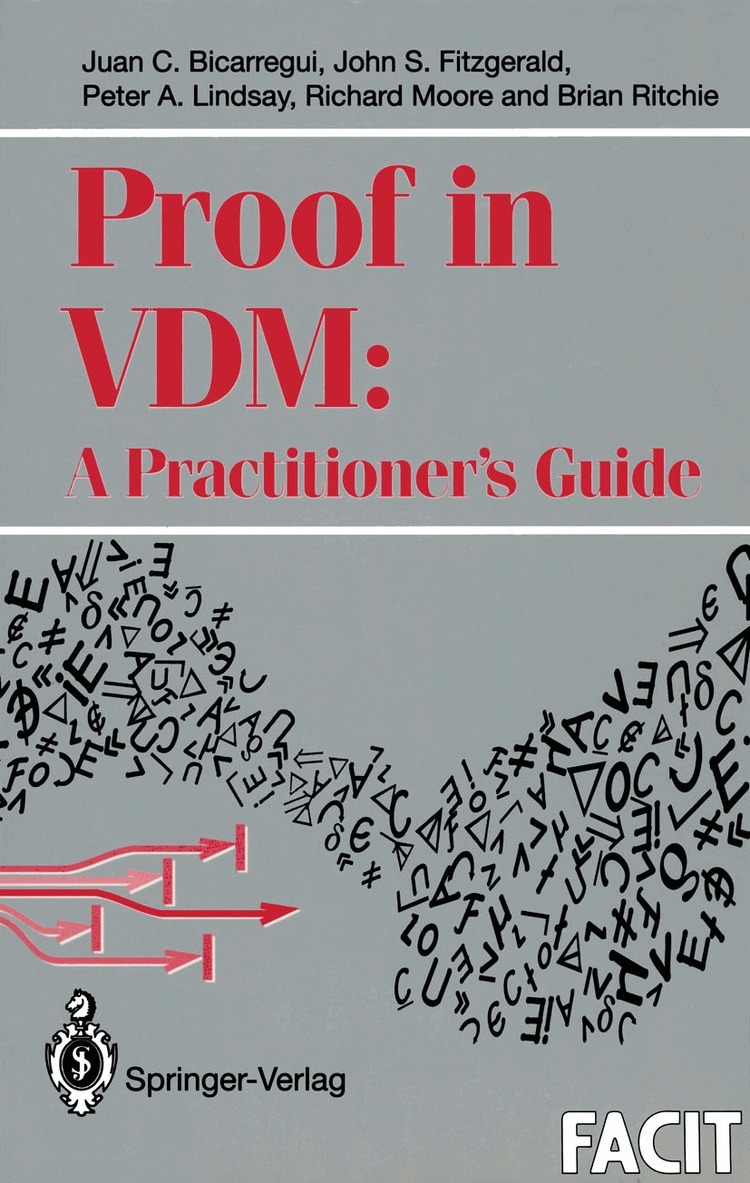
Formal specifications were first used in the description of program ming languages because of the central role that languages and their compilers play in causing a machine to perform the computations required by a programmer. In a relatively short time, specification notations have found their place in industry and are used for the description of a wide variety of software and hardware systems. A formal method - like VDM - must offer a mathematically-based specification language. On this language rests the other key element of the formal method: the ability to reason about a specification. Proofs can be empioyed in reasoning about the potential behaviour of a system and in the process of showing that the design satisfies the specification. The existence of a formal specification is a prerequisite for the use of proofs; but this prerequisite is not in itself sufficient. Both proofs and programs are large formal texts. Would-be proofs may therefore contain errors in the same way as code. During the difficult but inevitable process of revising specifications and devel opments, ensuring consistency is a major challenge. It is therefore evident that another requirement - for the successful use of proof techniques in the development of systems from formal descriptions - is the availability of software tools which support the manipu lation of large bodies of formulae and help the user in the design of the proofs themselves.
Häftad, Engelska, 2002
1 112 kr
Skickas inom 10-15 vardagar
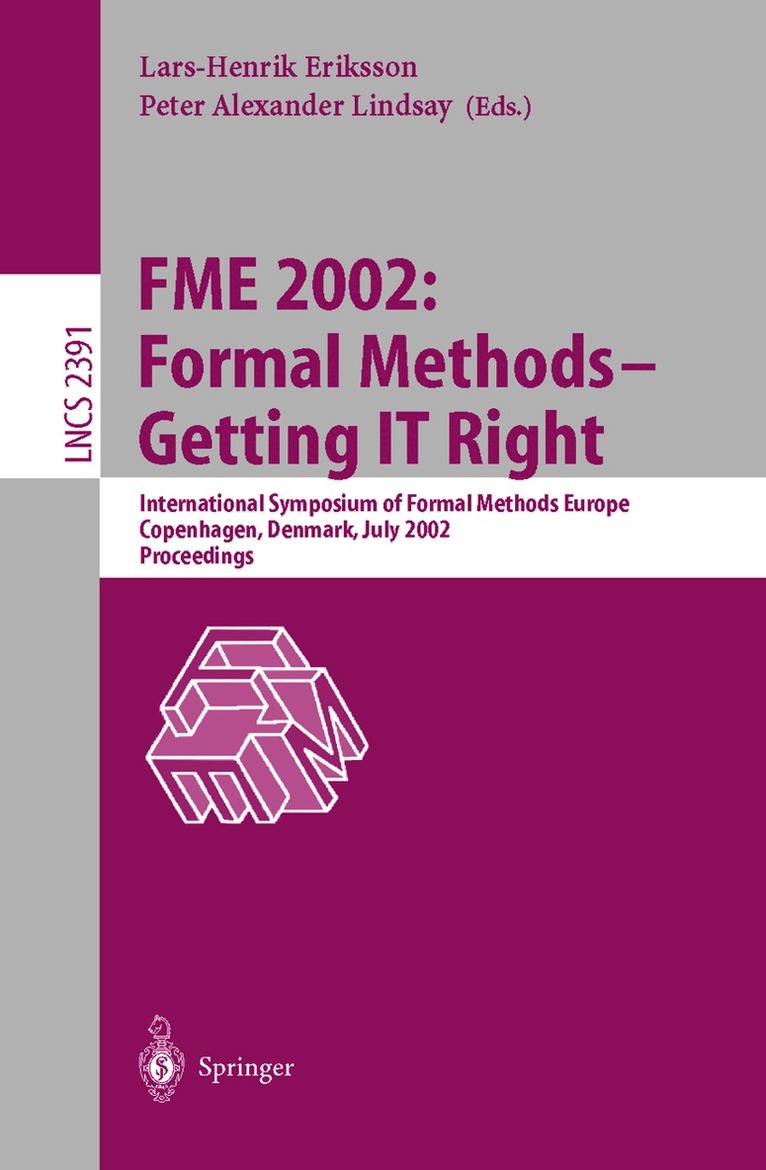
This volume contains the proceedings of the 2002 symposium Formal Methods th Europe (FME 2002). The symposium was the 11 in a series that began with a VDM Europe symposium in 1987. The symposia are traditionally held every 18 months. In 2002 the symposium was held at the University of Copenhagen, as part of the 2002 Federated Logic Conference (FLoC 2002), which brought - gether in one event seven major conferences related to logic in computer science, as well as their a?liated workshops, tutorials, and tools exhibitions. Formal Methods Europe (www.fmeurope.org) is an independent association which aims to stimulate the use of, and research on, formal methods for software development. FME symposia have been notably successful in bringing together a community of users, researchers, and developers of precise mathematical - thods for software development. The theme of FME 2002 was “Formal Methods: Getting IT Right”. The double meaning was intentional. On the one hand, the theme acknowledged the signi?cant contribution formal methods can make to Information Technology, by enabling computer systems to be described precisely and reasoned about with rigour. On the other hand, it recognized that current formal methods are not perfect, and further research and practice are required to improve their foundations, applicability, and e?ectiveness.
E-bok
PDF, Engelska, 20031 459 kr
Läs direkt efter köp
This volume contains the proceedings of the 2002 symposium Formal Methods th Europe (FME 2002). The symposium was the 11 in a series that began with a VDM Europe symposium in 1987. The symposia are traditionally held every 18 months. In 2002 the symposium was held at the University of Copenhagen, as part of the 2002 Federated Logic Conference (FLoC 2002), which brought - gether in one event seven major conferences related to logic in computer science, as well as their a?liated workshops, tutorials, and tools exhibitions. Formal Methods Europe (www.fmeurope.org) is an independent association which aims to stimulate the use of, and research on, formal methods for software development. FME symposia have been notably successful in bringing together a community of users, researchers, and developers of precise mathematical - thods for software development. The theme of FME 2002 was “Formal Methods: Getting IT Right”. The double meaning was intentional. On the one hand, the theme acknowledged the signi?cant contribution formal methods can make to Information Technology, by enabling computer systems to be described precisely and reasoned about with rigour. On the other hand, it recognized that current formal methods are not perfect, and further research and practice are required to improve their foundations, applicability, and e?ectiveness.