Peter Andrews – författare
Visar alla böcker från författaren Peter Andrews. Handla med fri frakt och snabb leverans.
18 produkter
18 produkter
Häftad, Engelska, 2009
599 kr
Skickas inom 7-10 vardagar
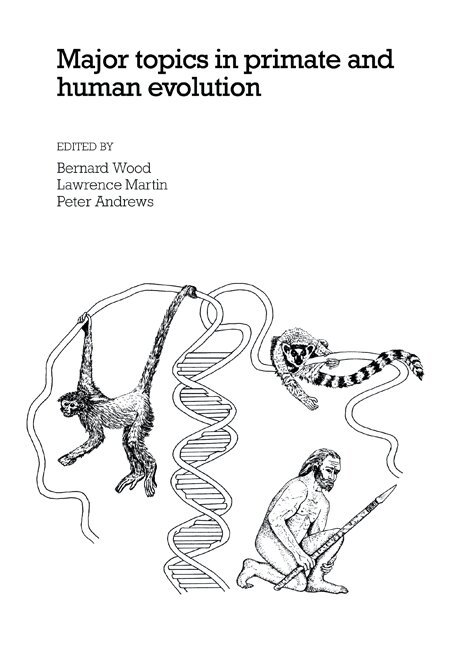
The fragmentary fossil record of primates and hominids has generated fundamental, and often well publicised, differences of opinion about their evolution. The objective of this book, based upon a joint symposium of the Anatomical Society and Primate Society of Great Britain, is to present a review of the major problem areas, emphasising both neontology and palaeontology and aimed specifically to meet the requirements of students. For some issues, leading proponents of 'rival' schools present their viewpoint; for others, distinguished contributors have reviewed a particularly important or controversial problem, presenting non-partisan objective analysis. By including papers that adopt contrasting opinions towards the reconstruction of evolutionary relationships and by incorporating the interpretations of the fossil evidence, this volume provides a valuable synthesis of the thinking about primate and human palaeontology.
Häftad, Engelska, 2007
531 kr
Skickas inom 5-8 vardagar
Inbunden, Engelska, 2013
506 kr
Skickas inom 10-15 vardagar
Exploring the lives and achievements of 36 extraordinary individuals from across 18 nations and every continent, this books champions innovators: the disruptive individuals whose heroic visions and indomitable spirits are redefining the economic and social structure of our world.
E-bok
PDF, Engelska, 2013362 kr
Läs direkt efter köp
Exploring the lives and achievements of 36 extraordinary individuals from across 18 nations and every continent, this books champions innovators: the disruptive individuals whose heroic visions and indomitable spirits are redefining the economic and social structure of our world.
E-bok
Engelska, 2016672 kr
Läs direkt efter köp
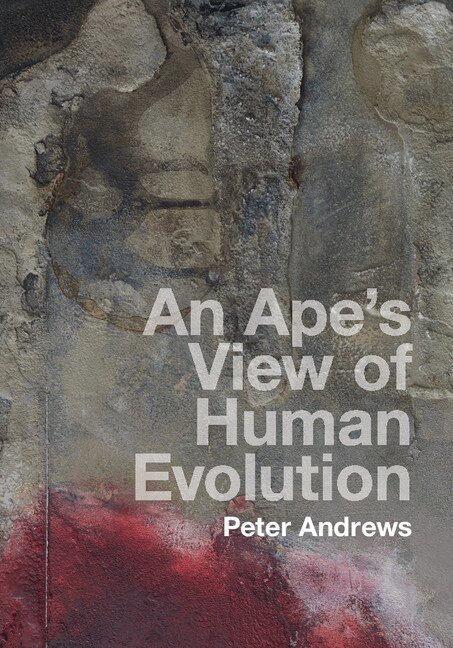
Our closest living relatives are the chimpanzee and bonobo. We share many characteristics with them, but our lineages diverged millions of years ago. Who in fact was our last common ancestor? Bringing together ecology, evolution, genetics, anatomy and geology, this book provides a new perspective on human evolution. What can fossil apes tell us about the origins of human evolution? Did the last common ancestor of apes and humans live in trees or on the ground? What did it eat, and how did it survive in a world full of large predators? Did it look anything like living apes? Andrews addresses these questions and more to reconstruct the common ancestor and its habitat. Synthesising thirty-five years of work on both ancient environments and fossil and modern ape anatomy, this book provides unique new insights into the evolutionary processes that led to the origins of the human lineage.
E-bok
PDF, Engelska, 2016697 kr
Läs direkt efter köp
Our closest living relatives are the chimpanzee and bonobo. We share many characteristics with them, but our lineages diverged millions of years ago. Who in fact was our last common ancestor? Bringing together ecology, evolution, genetics, anatomy and geology, this book provides a new perspective on human evolution. What can fossil apes tell us about the origins of human evolution? Did the last common ancestor of apes and humans live in trees or on the ground? What did it eat, and how did it survive in a world full of large predators? Did it look anything like living apes? Andrews addresses these questions and more to reconstruct the common ancestor and its habitat. Synthesising thirty-five years of work on both ancient environments and fossil and modern ape anatomy, this book provides unique new insights into the evolutionary processes that led to the origins of the human lineage.
Häftad, Engelska, 2014
306 kr
Skickas inom 10-15 vardagar
Exploring the lives and achievements of 36 extraordinary individuals from across 18 nations and every continent, this books champions innovators: the disruptive individuals whose heroic visions and indomitable spirits are redefining the economic and social structure of our world.
E-bok
Engelska, 201458 kr
Läs direkt efter köp
After a trip to the vet, a visit to school Dilys now gets into a scrape by stealing her supper! A third story about Dilys the pugalier.
E-bok
PDF, Engelska, 20191 503 kr
Läs direkt efter köp
Understanding Time in Taphonomy investigates time as it affects taphonomy. All taphonomic agents operate through time, which may be long or short, so time adds another dimension to taphonomic change. The processes and modifications recorded in fossils can tell us how long the fossils took to accumulate and the geological/biological/ environmental context in which they fossilized. Measuring time in taphonomy requires long-term studies of taphonomic processes operating at the present time. In 1976, one of the authors (PA) started a 30-year monitoring project of animals that died natural deaths at Neuadd in Wales. The study area of 680ha of upland heathland, woodland and rough grazing were monitored. Over 100 sheep, horses, foxes, badgers, rabbits and small mammals were monitored, but only 56 yielded useful results. YFJ has also begun a similar study at Riofrio in Spain, and other long-term studies are reviewed. This 30-year study highlighted several time-specific taphonomic issues. Trampling of Neuadd specimens produced pitting and superficial scratching found commonly on fossils. Longer striations mimicking cut marks are common, particularly on bones in rocky substrates. The number and morphology of these pseudo-cut-marks are compared with cut marks made during human butchery. There is only a weak relationship with exposure time. The extreme effects of water and wind at Neuadd quickly dispersed body parts. Modifications similar to trampling and butchery were produced in running water. In still water, three modification stages are identified: Stage 1, which is 3-5 years with broad flaking; stage 2, 10-12 years with extreme flaking and loss of surface bone; and stage 3, more than 18 years with deep tissue loss. Weathering at Neuadd has a time-scale that is different from the one established for tropical environments: At 0-5 years, 92% of bones are unweathered, with 8% at stage 1; at 6 to 10 years, 73% of bones are unweathered, with 27% at stage 1; at 15 to 25 years, 17% of bones are unweathered, with 63% at stage 1 and 20% of bones at stage 2; at 30 to 35 years, only one skull survived, and it is at stage 1 weathering. Monitoring of buried bones at Neuadd shows three time-scales of modifications resulting from soil corrosion: Progressive corrosion under dense vegetation cover with high humidity from 2 to 23 years; increasing root marks from 2 to 23 years; and corrosion from the action of lower plants such as moss and algae in 3 to 11 years. The extent and sizes of carnivore and herbivore chewing marks was found to have no usable timescale. Dispersal of bones is slow at Neuadd and is related strongly both to the nature of the environment and to the size of the animals. Three timescales have been identified: Dispersal over 15 years is greatest for large animals in open environments, lower for medium sized animals like sheep, and the least for small and medium size animals in dense vegetation. Future monitoring projects could use electronic marking chips on single specimens, camera traps, GPS, the Global Weathering Project, radioactive markers on bones, and aerial mapping, backed up with experimental work in controlled conditions.
Häftad, Engelska, 2016
134 kr
Skickas inom 5-8 vardagar
Häftad, Engelska, 2017
130 kr
Skickas inom 5-8 vardagar
Inbunden, Engelska, 2016
561 kr
Skickas inom 10-15 vardagar
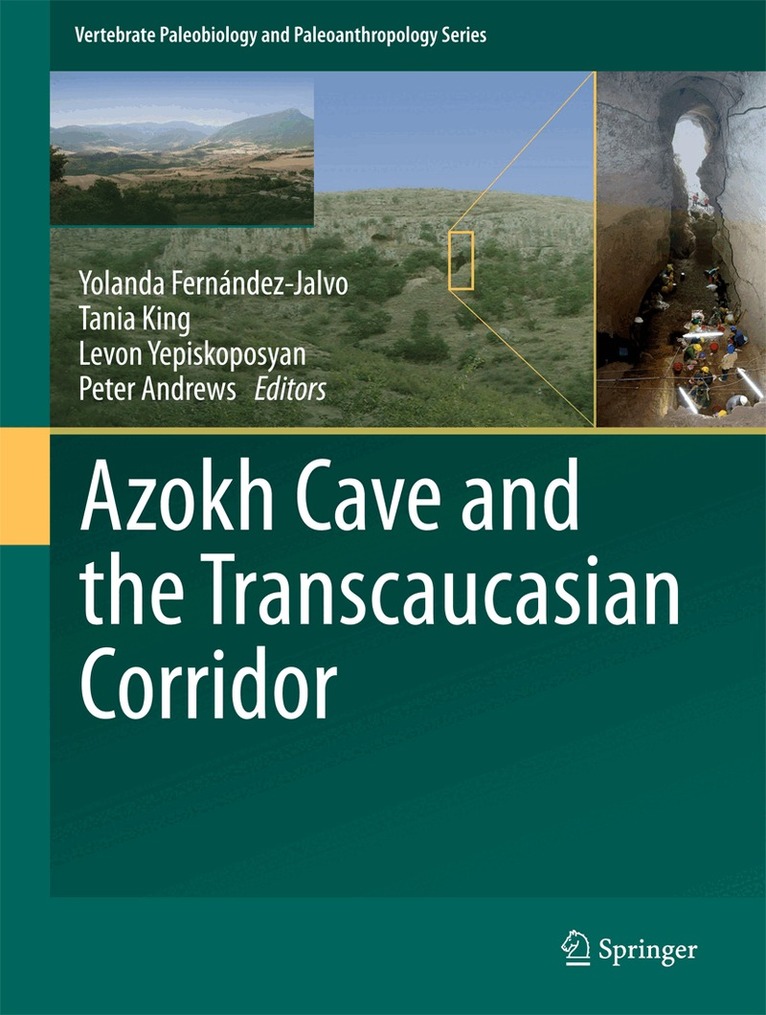
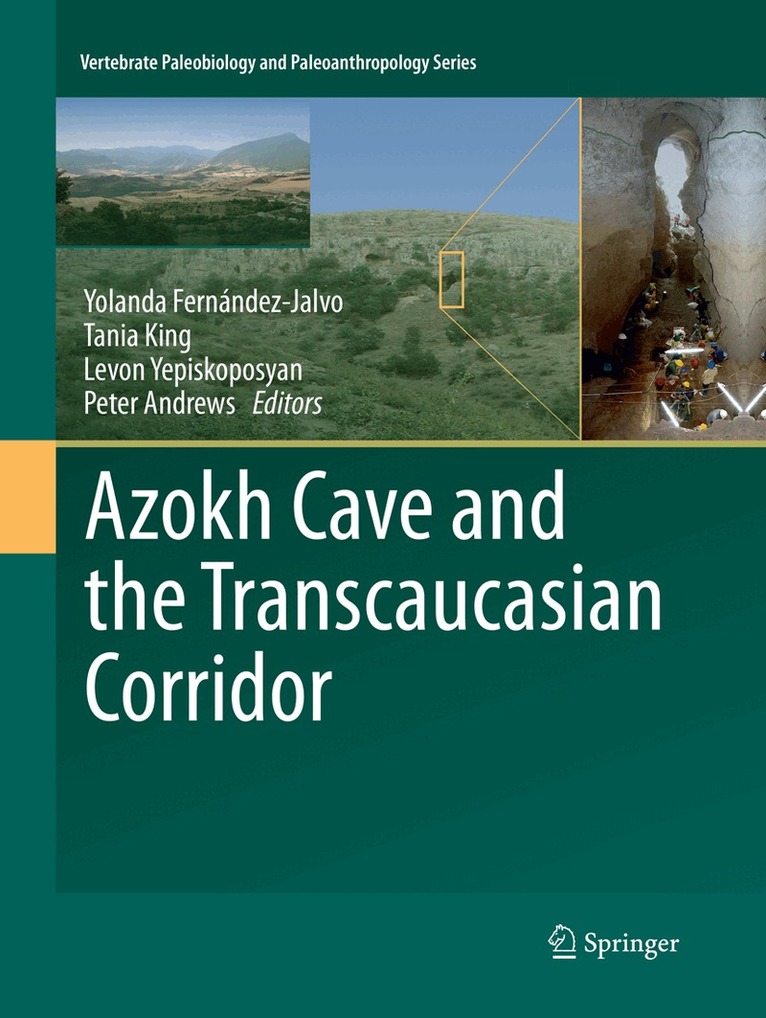
This edited volume describes the geology, stratigraphy, anthropology, archaeology, dating, taphonomy, paleobotany, paleontology and paleoecology of Azokh caves (also known as Azykh or Azikh). The chapters review exhaustively the key recent research on this limestone karstic site, which is located near the village of the same name in the region of Nagorno Karabagh in the south-eastern end of the Lesser Caucasus. The site is significant due to its geographic location at an important migratory crossroad between Africa and Eurasia. These caves contain an almost complete sedimentary sequence of the transition between H.heidelbergensis and H. neanderthalensis continuing to later Pleistocene and Holocene stratified sediment. The site is also important due to the discovery of Neanderthal remains by the current research group in addition to the Middle Pleistocene hominin fossils during a previous phase of excavation work led by M. Huseinov. At the heart of this book is the matter of how this site relates to human evolution.
E-bok
PDF, Engelska, 2016734 kr
Läs direkt efter köp
This edited volume describes the geology, stratigraphy, anthropology, archaeology, dating, taphonomy, paleobotany, paleontology and paleoecology of Azokh caves (also known as Azykh or Azikh). The chapters review exhaustively the key recent research on this limestone karstic site, which is located near the village of the same name in the region of Nagorno Karabagh in the south-eastern end of the Lesser Caucasus. The site is significant due to its geographic location at an important migratory crossroad between Africa and Eurasia. These caves contain an almost complete sedimentary sequence of the transition between H.heidelbergensis and H. neanderthalensis continuing to later Pleistocene and Holocene stratified sediment. The site is also important due to the discovery of Neanderthal remains by the current research group in addition to the Middle Pleistocene hominin fossils during a previous phase of excavation work led by M. Huseinov. At the heart of this book is the matter of how this site relates to human evolution.
Häftad, Engelska, 2018
561 kr
Skickas inom 10-15 vardagar
This edited volume describes the geology, stratigraphy, anthropology, archaeology, dating, taphonomy, paleobotany, paleontology and paleoecology of Azokh caves (also known as Azykh or Azikh). The chapters review exhaustively the key recent research on this limestone karstic site, which is located near the village of the same name in the region of Nagorno Karabagh in the south-eastern end of the Lesser Caucasus. The site is significant due to its geographic location at an important migratory crossroad between Africa and Eurasia. These caves contain an almost complete sedimentary sequence of the transition between H.heidelbergensis and H. neanderthalensis continuing to later Pleistocene and Holocene stratified sediment. The site is also important due to the discovery of Neanderthal remains by the current research group in addition to the Middle Pleistocene hominin fossils during a previous phase of excavation work led by M. Huseinov. At the heart of this book is the matter of how this site relates to human evolution.
Inbunden, Engelska, 2016
1 225 kr
Skickas inom 10-15 vardagar
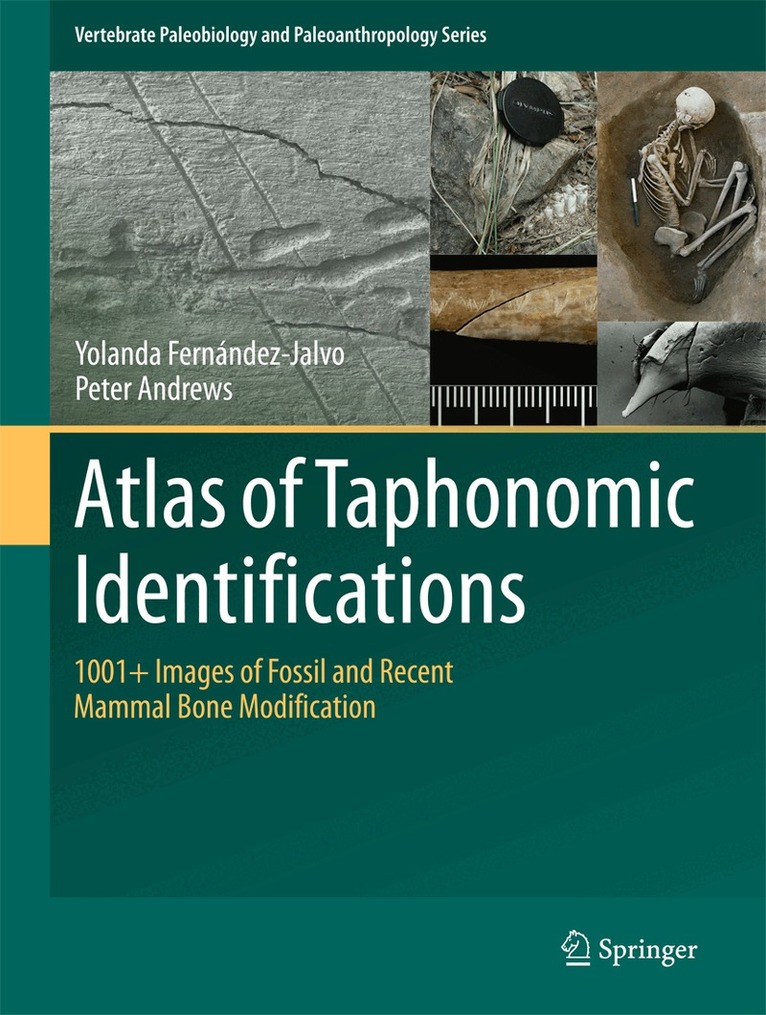
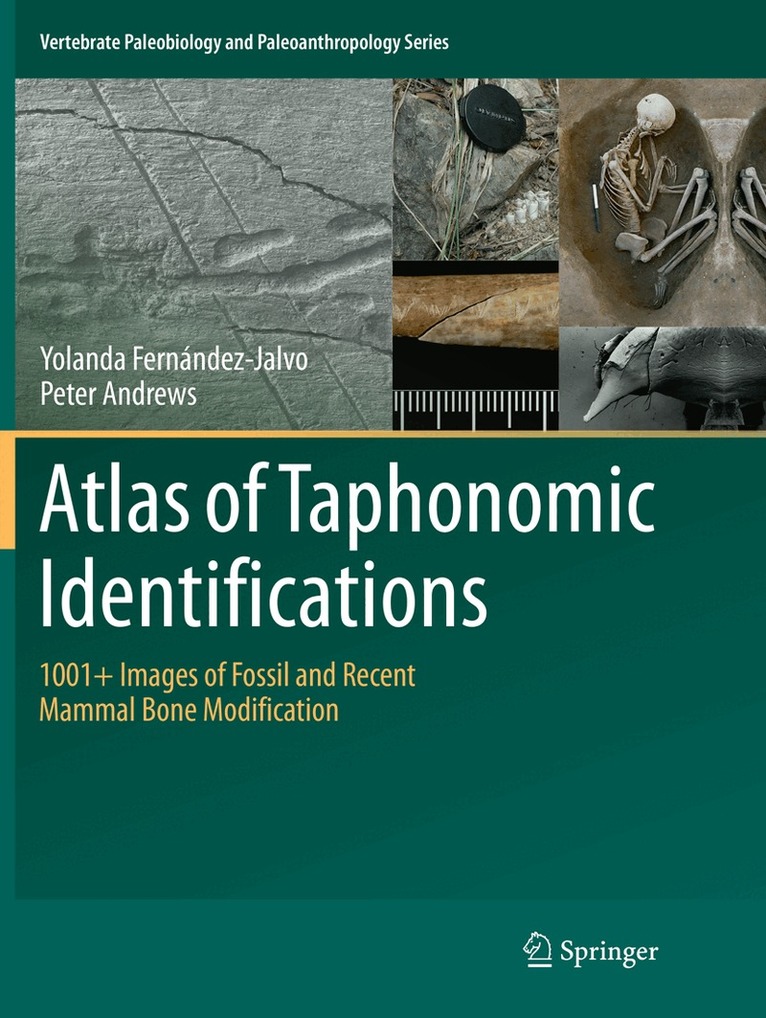
The aim of the atlas is to provide images of taphonomic modifications, making it as comprehensive as possible with evidence presently available. This volume is intended both as a field guide for identifying taphonomic modifications in the field, and for use in the laboratory when collections of fossils are being analyzed. Images in the book are a combination of scanning electron micrographs, regular photographs, cross-sections of bones and line drawings and graphs. By providing good quality illustrations of taphonomic modifications, with links between similar types of modification, the atlas provides a reference source for identifying the agents responsible for the modifications, the processes by which they were formed, and the potential bias introduced by the processes.The authors also aim to emphasize on the directions they consider taphonomic studies should be headed. Firstly, we should seek to quantify the degree of bias introduced into a fossil fauna and to take account of this bias before interpreting the palaeoecology of the fossil site. Secondly, we should recognize that taphonomic modifications increase the information encoded in fossils by identifying perimortem and postmortem contexts. This provides a more dynamic and realistic view of the past.
E-bok
PDF, Engelska, 20161 622 kr
Läs direkt efter köp
The aim of the atlas is to provide images of taphonomic modifications, making it as comprehensive as possible with evidence presently available. This volume is intended both as a field guide for identifying taphonomic modifications in the field, and for use in the laboratory when collections of fossils are being analyzed. Images in the book are a combination of scanning electron micrographs, regular photographs, cross-sections of bones and line drawings and graphs. By providing good quality illustrations of taphonomic modifications, with links between similar types of modification, the atlas provides a reference source for identifying the agents responsible for the modifications, the processes by which they were formed, and the potential bias introduced by the processes.The authors also aim to emphasize on the directions they consider taphonomic studies should be headed. Firstly, we should seek to quantify the degree of bias introduced into a fossil fauna and to take account of this bias before interpreting the palaeoecology of the fossil site. Secondly, we should recognize that taphonomic modifications increase the information encoded in fossils by identifying perimortem and postmortem contexts. This provides a more dynamic and realistic view of the past.
Häftad, Engelska, 2018
1 225 kr
Skickas inom 10-15 vardagar
The aim of the atlas is to provide images of taphonomic modifications, making it as comprehensive as possible with evidence presently available. This volume is intended both as a field guide for identifying taphonomic modifications in the field, and for use in the laboratory when collections of fossils are being analyzed. Images in the book are a combination of scanning electron micrographs, regular photographs, cross-sections of bones and line drawings and graphs. By providing good quality illustrations of taphonomic modifications, with links between similar types of modification, the atlas provides a reference source for identifying the agents responsible for the modifications, the processes by which they were formed, and the potential bias introduced by the processes.The authors also aim to emphasize on the directions they consider taphonomic studies should be headed. Firstly, we should seek to quantify the degree of bias introduced into a fossil fauna and to take account of this bias before interpreting the palaeoecology of the fossil site. Secondly, we should recognize that taphonomic modifications increase the information encoded in fossils by identifying perimortem and postmortem contexts. This provides a more dynamic and realistic view of the past.
Inbunden, Engelska, 2016
573 kr
Tillfälligt slut
Our closest living relatives are the chimpanzee and bonobo. We share many characteristics with them, but our lineages diverged millions of years ago. Who in fact was our last common ancestor? Bringing together ecology, evolution, genetics, anatomy and geology, this book provides a new perspective on human evolution. What can fossil apes tell us about the origins of human evolution? Did the last common ancestor of apes and humans live in trees or on the ground? What did it eat, and how did it survive in a world full of large predators? Did it look anything like living apes? Andrews addresses these questions and more to reconstruct the common ancestor and its habitat. Synthesising thirty-five years of work on both ancient environments and fossil and modern ape anatomy, this book provides unique new insights into the evolutionary processes that led to the origins of the human lineage.