Peter K. Manning - Böcker
Visar alla böcker från författaren Peter K. Manning. Handla med fri frakt och snabb leverans.
8 produkter
8 produkter
Policing Across Organisational Boundaries
Developments in Theory and Practice
Inbunden, Engelska, 2019
2 103 kr
Skickas inom 10-15 vardagar
This book promotes new theoretical frameworks and research questions that seek to advance knowledge of policing across internal and external organisational boundaries, specifically at the structural level of analysis. It addresses police theory, policy and practice, and also provides new directions for future research on intra- and inter-organisational policing.Analysing boundaries is of increasing global importance for policing policy and practice. Boundaries reflect the division-of-labour inherent to complex organisations and their specialist units. In order to operate effectively, however, these boundaries must be crossed, and strong and reliable linkages must be built. Intra-organisationally, it is vital to understand how specialist units form and function and interact with other units. Inter-organisationally, it is fundamental to recognise the place of boundaries in contexts such as international police cooperation.Chapters 3 and 4 of this book are freely available as downloadable Open Access PDFs at http://www.taylorfrancis.com under a Creative Commons Attribution-Non Commercial-No Derivatives (CC-BY-NC-ND) 4.0 license.
621 kr
Skickas inom 10-15 vardagar
This book promotes new theoretical frameworks and research questions that seek to advance knowledge of policing across internal and external organisational boundaries, specifically at the structural level of analysis. It addresses police theory, policy and practice, and also provides new directions for future research on intra- and inter-organisational policing.Analysing boundaries is of increasing global importance for policing policy and practice. Boundaries reflect the division-of-labour inherent to complex organisations and their specialist units. In order to operate effectively, however, these boundaries must be crossed, and strong and reliable linkages must be built. Intra-organisationally, it is vital to understand how specialist units form and function and interact with other units. Inter-organisationally, it is fundamental to recognise the place of boundaries in contexts such as international police cooperation.Chapters 3 and 4 of this book are freely available as downloadable Open Access PDFs at http://www.taylorfrancis.com under a Creative Commons Attribution-Non Commercial-No Derivatives (CC-BY-NC-ND) 4.0 license.
804 kr
Skickas inom 3-6 vardagar
Ethnographic fieldwork and formal linguistic analysis have traditionally been thought to be diametric opposites. But in this provocative analysis, these diverse methods of qualitative research are demonstrated to be complementary. The author reveals that the formalism of semiotics adds breadth and depth to the particularism of traditional fieldwork; similarly, the many details of ethnographic description give semiotic analysis a more realistic perspective. After examining the potential benefits and limitations of each method of analysis, the author shows how the synthesis of the two is potentially more powerful that either alone. "This book succeeds in bringing together two branches of science that are rather different with respect to traditions and levels of abstraction." --Methodika "Provides a brief and useful statement of the method....It is both a summary of what has been said and a commentary on the simultaneous deformalization and formalization of American life." --Social Forces
Technology of Policing
Crime Mapping, Information Technology, and the Rationality of Crime Control
Inbunden, Engelska, 2008
1 162 kr
Skickas inom 10-15 vardagar
With the rise of surveillance technology in the last decade, police departments now have an array of sophisticated tools for tracking, monitoring, even predicting crime patterns. In particular crime mapping, a technique used by the police to monitor crime by the neighborhoods in their geographic regions, has become a regular and relied-upon feature of policing. Many claim that these technological developments played a role in the crime drop of the 1990s, and yet no study of these techniques and their relationship to everyday police work has been made available.Noted scholar Peter K. Manning spent six years observing three American police departments and two British constabularies in order to determine what effects these kinds of analytic tools have had on modern police management and practices. While modern technology allows the police to combat crime in sophisticated, detail-oriented ways, Manning discovers that police strategies and tactics have not been altogether transformed as perhaps would be expected. In The Technology of Policing, Manning untangles the varying kinds of complex crime-control rhetoric that underlie much of today's police department discussion and management, and provides valuable insight into which are the most effectiveand which may be harmful—in successfully tracking criminal behavior.The Technology of Policing offers a new understanding of the changing world of police departments and information technology's significant and undeniable influence on crime management.
Technology of Policing
Crime Mapping, Information Technology, and the Rationality of Crime Control
Häftad, Engelska, 2011
404 kr
Skickas inom 7-10 vardagar
With the rise of surveillance technology in the last decade, police departments now have an array of sophisticated tools for tracking, monitoring, even predicting crime patterns. In particular crime mapping, a technique used by the police to monitor crime by the neighborhoods in their geographic regions, has become a regular and relied-upon feature of policing. Many claim that these technological developments played a role in the crime drop of the 1990s, and yet no study of these techniques and their relationship to everyday police work has been made available.Noted scholar Peter K. Manning spent six years observing three American police departments and two British constabularies in order to determine what effects these kinds of analytic tools have had on modern police management and practices. While modern technology allows the police to combat crime in sophisticated, detail-oriented ways, Manning discovers that police strategies and tactics have not been altogether transformed as perhaps would be expected. In The Technology of Policing, Manning untangles the varying kinds of complex crime-control rhetoric that underlie much of today's police department discussion and management, and provides valuable insight into which are the most effectiveand which may be harmful—in successfully tracking criminal behavior.The Technology of Policing offers a new understanding of the changing world of police departments and information technology's significant and undeniable influence on crime management.
372 kr
Skickas inom 3-6 vardagar
The increasing reliance on private security services raises questions about the effects of privatization on the quality of public police forces, particularly in high-crime, low-income areas. In an effective pro-and-con format, two experts on policing offer two strikingly different perspectives on this trend towards privatization. In the process, they provide an unusually thoughtful discussion of the origins of both the public police and the private security sectors, the forces behind the recent growth of private security operations, and the risks to public safety posed by privatization. In his critique of privatization, Peter K. Manning focuses on issues of free market theory and management practices such as Total Quality Management that he believes are harmful to the traditional police mandate to control crime. He questions the appropriateness of strategies that emphasize service to consumers. For Brian Forst, the free market paradigm and economic incentives do not carry the same stigma.He argues that neither public nor private policing should have a monopoly on law enforcement activities, and he predicts an even more varied mix of public and private police activities than are currently available. Following the two main sections of the book, each author assesses the other's contribution, reflecting on not just their points of departure but also on the areas in which they agree. The breadth and depth of the discussion makes this book essential for both scholars and practitioners interested in policing generally and privatization in particular.
2 711 kr
Skickas inom 10-15 vardagar
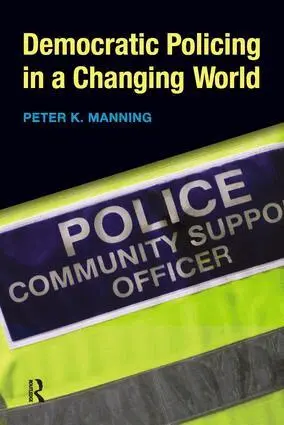
Democratic policing today is a widely used approach to policing not only in Western societies but increasingly around the world. Yet it is rarely defined and it is little understood by the public and even by many of its practitioners. Peter K. Manning draws on political philosophy, sociology and criminal justice to develop a widely applicable fundamental conception of democratic policing. In the process he delineates today's relationship between democracy and policing. Democratic Policing in a Changing World documents the failure of police reform, showing that each new approach - such as crime mapping and 'hot spots' policing - fails to alter any fundamental practice and has in fact increased social inequalities. He offers a new and better approach for scholars, policy makers, police, governments and societies.
676 kr
Democratic policing today is a widely used approach to policing not only in Western societies but increasingly around the world. Yet it is rarely defined and it is little understood by the public and even by many of its practitioners. Peter K. Manning draws on political philosophy, sociology and criminal justice to develop a widely applicable fundamental conception of democratic policing. In the process he delineates today's relationship between democracy and policing. Democratic Policing in a Changing World documents the failure of police reform, showing that each new approach - such as crime mapping and 'hot spots' policing - fails to alter any fundamental practice and has in fact increased social inequalities. He offers a new and better approach for scholars, policy makers, police, governments and societies.