Peter Kinget - Böcker
Visar alla böcker från författaren Peter Kinget. Handla med fri frakt och snabb leverans.
6 produkter
6 produkter
1 696 kr
Skickas inom 10-15 vardagar
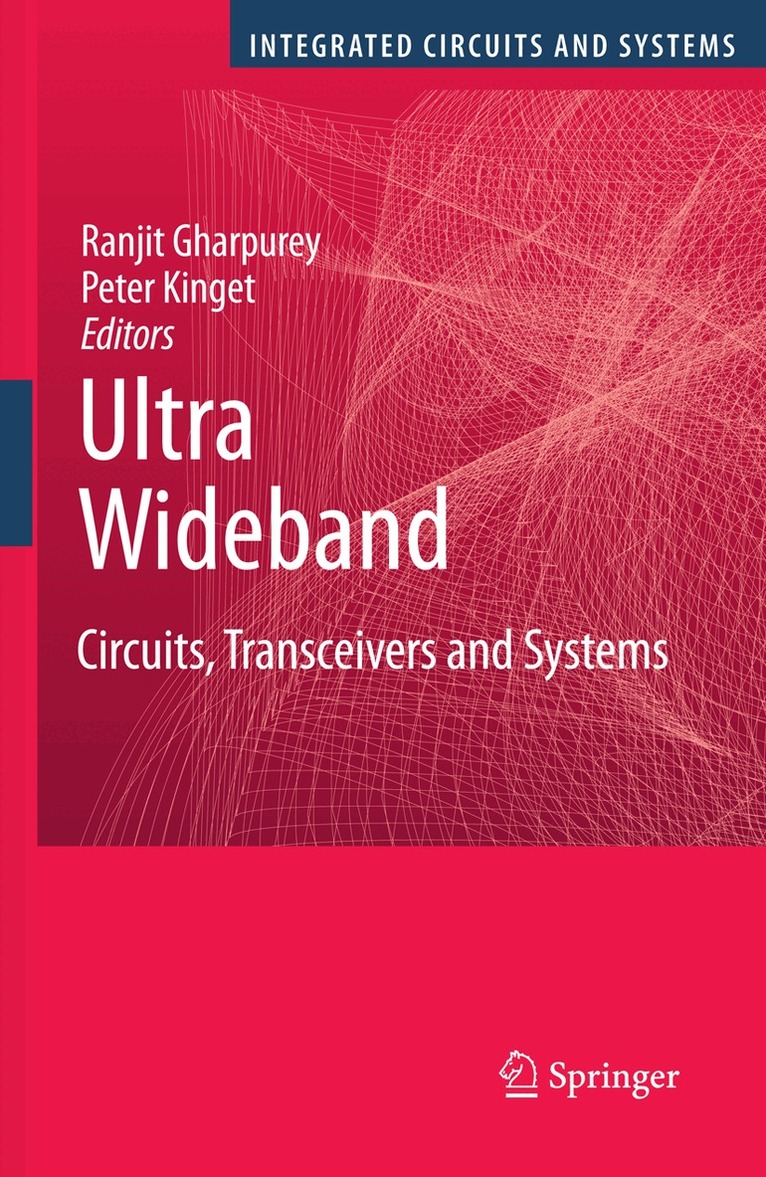
Recent advances in wireless communication technologies have had a transfor- tive impact on society and have directly contributed to several economic and social aspects of daily life. Increasingly, the untethered exchange of information between devices is becoming a prime requirement for further progress, which is placing an ever greater demand on wireless bandwidth. The ultra wideband (UWB) system marks a major milestone in this progress. Since 2002, when the FCC allowed the unlicensed use of low-power, UWB radio signals in the 3. 1–10. 6GHz frequency band, there has been signi?cant synergistic advance in this technology at the c- cuits, architectural and communication systems levels. This technology allows for devices to communicate wirelessly, while coexisting with other users by ensuring that its power density is suf?ciently low so that it is perceived as noise to other users. UWB is expected to address existing needs for high data rate short-range c- munication applications between devices, such as computers and peripherals or consumer electronic devices. In the long term, it makes available spectrum to - periment with new signaling formats such as those based on very short pulses of radio-frequency (RF) energy. As such it represents an opportunity to design fun- mentally different wireless systems which rely on the bandwidth of the signals to enhance the data rate or which use the available bandwidth for diverse applications such as ranging and biomedical instrumentation.
1 073 kr
Skickas inom 10-15 vardagar
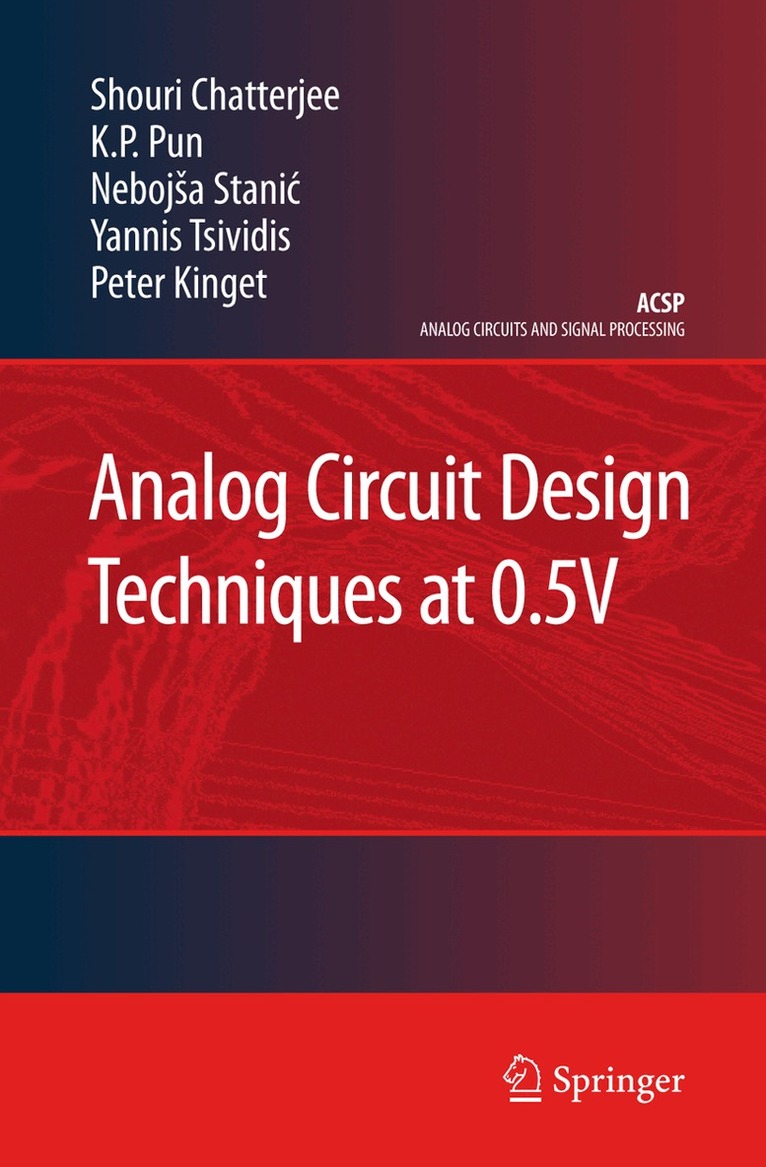
Analog design at ultra-low supply voltages is an important challenge for the semiconductor research community and industry.Analog Circuit Design Techniques at 0.5V covers challenges for the design of MOS analog and RF circuits at a 0.5 V power supply voltage. All design techniques presented are true low voltage techniques - all nodes in the circuits are within the power supply rails. The circuit implementations of body and gate input fully differential amplifiers are also discussed. These building blocks enable us to build continuous-time filters, track-and-hold circuits, and continuous-time sigma delta modulators.Current books on low voltage analog design typically cover techniques for supply voltages down to approximately 1V. This book presents novel ideas and results for operation from much lower supply voltages and the techniques presented are basic circuit techniques that are widely applicable beyond the scope of the presented examples.Analog Circuit Design Techniques at 0.5V is written for analog circuit designers and researchers as well as graduate students studying semiconductors and integrated circuit design.
1 582 kr
Skickas inom 10-15 vardagar
When comparing conventional computing architectures to the architectures of biological neural systems, there are several striking differences. Conventional computers use a low number of high performance computing elements that are programmed with algorithms to perform tasks in a time sequenced way; they are very successful in administrative applications, in scientific simulations, and in certain signal processing applications. However, the biological systems still significantly outperform conventional computers in perception tasks, sensory data processing and motory control. Biological systems use a completely different computing paradigm: a massive network of simple processors that are (adaptively) interconnected and operate in parallel. This massively parallel processing seems the key aspect to their success. The advent of VLSI technologies has provided us with the technological means to implement very complicated systems on a silicon die. Analog VLSI circuits in standard digital technologies open the way for the implementation of massively parallel analog signal processing systems for sensory signal processing applications and for perception tasks.This text describes in depth the theory and practice of designing these massively parallel analog signal processing systems. Techniques are described which overcome the device and transistor mismatches which limit performance of the system. The book also shows how such a system can be efficiently implemented using cellular Neural Networks. 4
1 487 kr
Skickas inom 10-15 vardagar
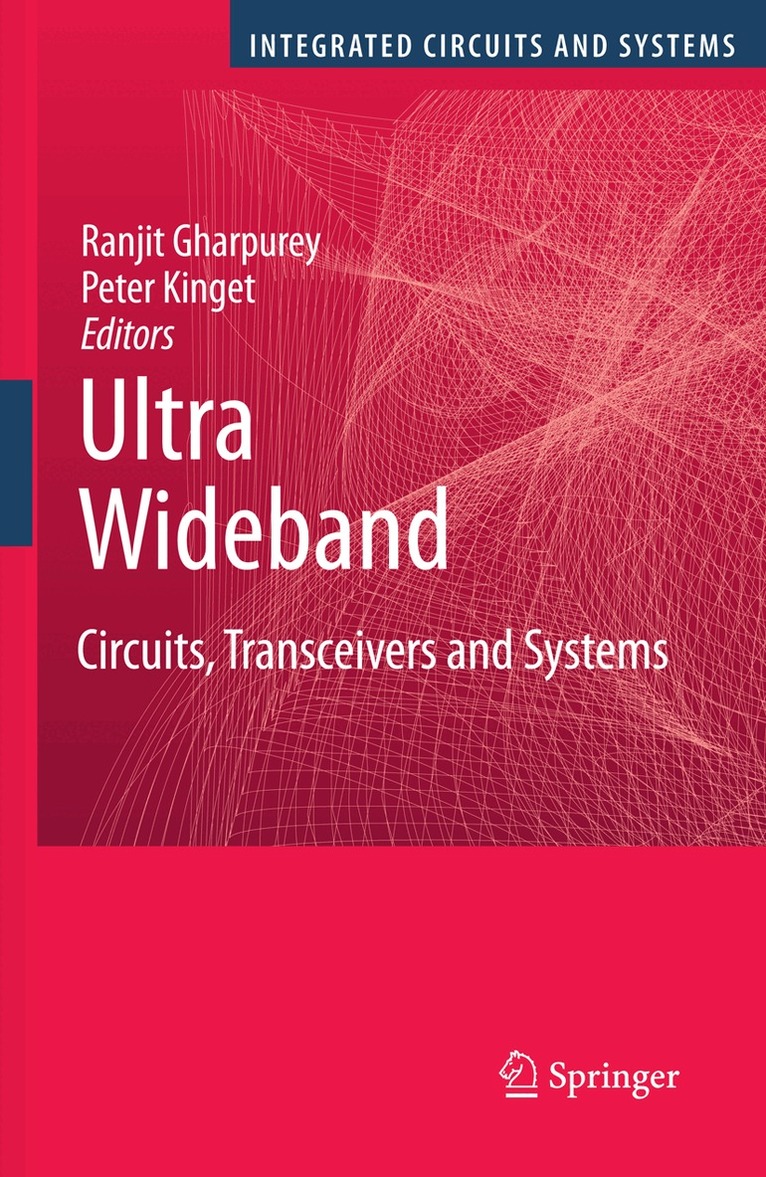
Recent advances in wireless communication technologies have had a transfor- tive impact on society and have directly contributed to several economic and social aspects of daily life. Increasingly, the untethered exchange of information between devices is becoming a prime requirement for further progress, which is placing an ever greater demand on wireless bandwidth. The ultra wideband (UWB) system marks a major milestone in this progress. Since 2002, when the FCC allowed the unlicensed use of low-power, UWB radio signals in the 3. 1–10. 6GHz frequency band, there has been signi?cant synergistic advance in this technology at the c- cuits, architectural and communication systems levels. This technology allows for devices to communicate wirelessly, while coexisting with other users by ensuring that its power density is suf?ciently low so that it is perceived as noise to other users. UWB is expected to address existing needs for high data rate short-range c- munication applications between devices, such as computers and peripherals or consumer electronic devices. In the long term, it makes available spectrum to - periment with new signaling formats such as those based on very short pulses of radio-frequency (RF) energy. As such it represents an opportunity to design fun- mentally different wireless systems which rely on the bandwidth of the signals to enhance the data rate or which use the available bandwidth for diverse applications such as ranging and biomedical instrumentation.
1 073 kr
Skickas inom 10-15 vardagar
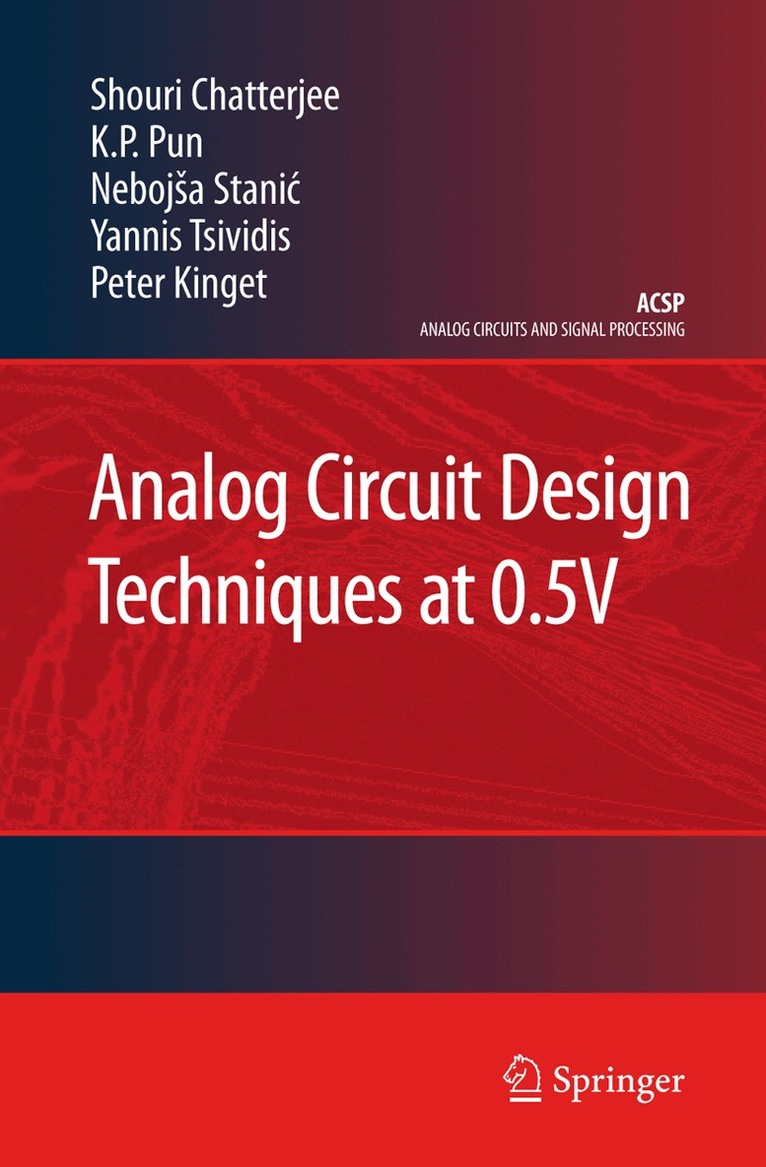
Analog design at ultra-low supply voltages is an important challenge for the semiconductor research community and industry.Analog Circuit Design Techniques at 0.5V covers challenges for the design of MOS analog and RF circuits at a 0.5 V power supply voltage. All design techniques presented are true low voltage techniques - all nodes in the circuits are within the power supply rails. The circuit implementations of body and gate input fully differential amplifiers are also discussed. These building blocks enable us to build continuous-time filters, track-and-hold circuits, and continuous-time sigma delta modulators.Current books on low voltage analog design typically cover techniques for supply voltages down to approximately 1V. This book presents novel ideas and results for operation from much lower supply voltages and the techniques presented are basic circuit techniques that are widely applicable beyond the scope of the presented examples.Analog Circuit Design Techniques at 0.5V is written for analog circuit designers and researchers as well as graduate students studying semiconductors and integrated circuit design.
1 590 kr
Skickas inom 10-15 vardagar
When comparing conventional computing architectures to the architectures of biological neural systems, there are several striking differences. Conventional computers use a low number of high performance computing elements that are programmed with algorithms to perform tasks in a time sequenced way; they are very successful in administrative applications, in scientific simulations, and in certain signal processing applications. However, the biological systems still significantly outperform conventional computers in perception tasks, sensory data processing and motory control. Biological systems use a completely different computing paradigm: a massive network of simple processors that are (adaptively) interconnected and operate in parallel. This massively parallel processing seems the key aspect to their success. The advent of VLSI technologies has provided us with the technological means to implement very complicated systems on a silicon die. Analog VLSI circuits in standard digital technologies open the way for the implementation of massively parallel analog signal processing systems for sensory signal processing applications and for perception tasks.Analog VLSI Integration of Massive Parallel Processing Systems describes in depth the theory and practice of designing these massively parallel analog signal processing systems. Techniques are described which overcome the device and transistor mismatches which limit performance of the system. The book also shows how such a system can be efficiently implemented using cellular Neural Networks. Analog VLSI Integration of Massive Parallel Processing Systems is essential reading for practicing analog design engineers and researchers in the field. It is also suitable as a text for an advanced course on the subject.