Philip Oldenburg – författare
Visar alla böcker från författaren Philip Oldenburg. Handla med fri frakt och snabb leverans.
21 produkter
India Briefing, 1993
Inbunden, 2019
2506 kr
Lägg i varukorg
A common theme in the India Briefing series has been India’s resilience in the face of turmoil and tragedy. This year’s volume demonstrates that India is under greater stress than ever before. In the country’s severest test, India’s secular foundations were shaken by the storming and destruction of …
India Briefing, 1991
Inbunden, 2019
1563 kr
Lägg i varukorg
This book examines India's perception of its international role in relation to post-Cold War global realignment, describes social and literary movements among India's "Untouchables," and reviews the ongoing struggle over Kashmir. It presents comprehensive analyses of politics and the economy.
India Briefing, 1993
Häftad, 2020
692 kr
Lägg i varukorg
This book offers a long-term perspective on the eruption in Ayodhya, showing its connection to the perennial question of Indian national identity. It explores the growing momentum of economic reform, despite the Bombay stock market scandal and the riots and bombings of early 1993.
India Briefing, 1991
Häftad, 2021
518 kr
Lägg i varukorg
This book examines India's perception of its international role in relation to post-Cold War global realignment, describes social and literary movements among India's "Untouchables," and reviews the ongoing struggle over Kashmir. It presents comprehensive analyses of politics and the economy.
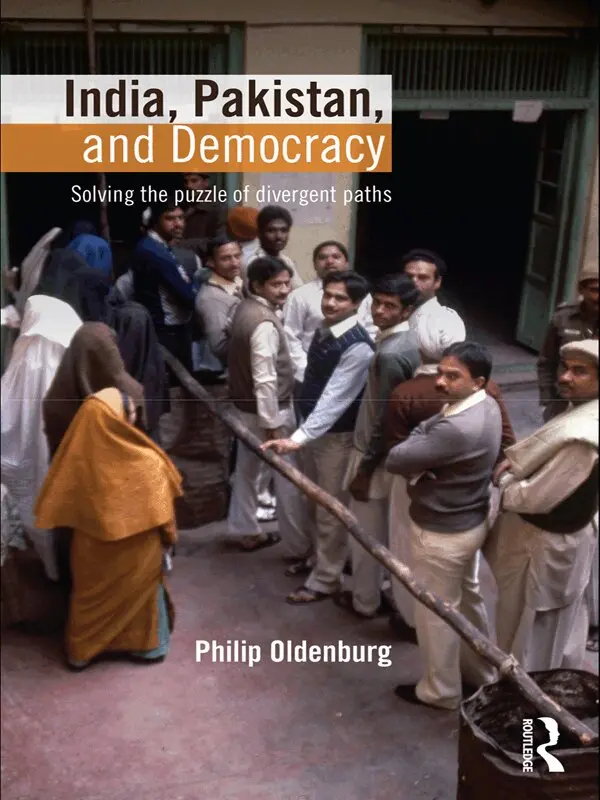
India, Pakistan, and Democracy
Solving the Puzzle of Divergent Paths
Inbunden, 2010
3070 kr
Lägg i varukorg
The question of why some countries have democratic regimes and others do not is a significant issue in comparative politics. This book looks at India and Pakistan, two countries with clearly contrasting political regime histories, and presents an argument on why India is a democracy and Pakistan is …
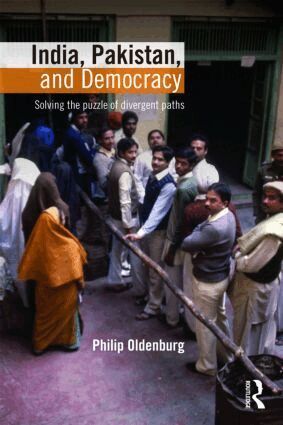
India, Pakistan, and Democracy
Solving the Puzzle of Divergent Paths
Häftad, 2010
911 kr
Lägg i varukorg
The question of why some countries have democratic regimes and others do not is a significant issue in comparative politics. This book looks at India and Pakistan, two countries with clearly contrasting political regime histories, and presents an argument on why India is a democracy and Pakistan is …
India Briefing, 1993
E-bok, 2019
802 kr
Lägg i varukorg
A common theme in the India Briefing series has been India''s resilience in the face of turmoil and tragedy. This year''s volume demonstrates that India is under greater stress than ever before. In the country''s severest test, India''s secular foundations were shaken by the storming and …
India Briefing, 1991
E-bok, 2019
581 kr
Lägg i varukorg
This book examines India''s perception of its international role in relation to post-Cold War global realignment, describes social and literary movements among India''s "Untouchables," and reviews the ongoing struggle over Kashmir. It presents comprehensive analyses of politics and the economy.
India Briefing, 1993
E-bok, 2019
802 kr
Lägg i varukorg
A common theme in the India Briefing series has been India''s resilience in the face of turmoil and tragedy. This year''s volume demonstrates that India is under greater stress than ever before. In the country''s severest test, India''s secular foundations were shaken by the storming and …
India Briefing, 1991
E-bok, 2019
564 kr
Lägg i varukorg
This book examines India''s perception of its international role in relation to post-Cold War global realignment, describes social and literary movements among India''s "Untouchables," and reviews the ongoing struggle over Kashmir. It presents comprehensive analyses of politics and the economy.
India Briefing
2001
Av Alyssa Ayres, Philip Oldenburg
Inbunden, 2001
2590 kr
Lägg i varukorg
In the time between 1998 and the publication of this text, India held two national elections and began the second phase of economic reforms. This work examines these political, economic, social and cultural developments in India from 1998 to the end of 2000.
India Briefing
2001
Av Alyssa Ayres, Philip Oldenburg
Häftad, 2001
743 kr
Lägg i varukorg
In the time between 1998 and the publication of this text, India held two national elections and began the second phase of economic reforms. This work examines these political, economic, social and cultural developments in India from 1998 to the end of 2000.
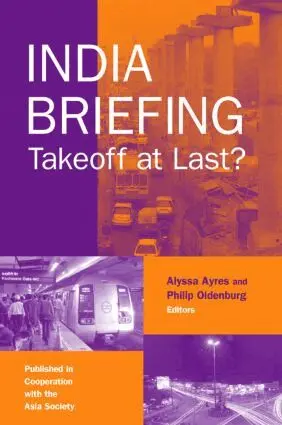
India Briefing
Takeoff at Last?
Av Alyssa Ayres, Philip Oldenburg
Inbunden, 2005
2479 kr
Lägg i varukorg
Since 2001, India has gained new attention as an emerging world power with a rapidly growing economy, a world-class science and technology sector, and a huge English-speaking labor pool. After a period of escalating tension with neighbor Pakistan, wide-ranging peace talks are underway. Within …
India Briefing
Takeoff at Last?
Av Alyssa Ayres, Philip Oldenburg
Häftad, 2005
740 kr
Lägg i varukorg
Since 2001, India has gained new attention as an emerging world power with a rapidly growing economy, a world-class science and technology sector, and a huge English-speaking labor pool. After a period of escalating tension with neighbor Pakistan, wide-ranging peace talks are underway. Within …
India, Pakistan, and Democracy
Solving the Puzzle of Divergent Paths
E-bok, 2010
1074 kr
Lägg i varukorg
The question of why some countries have democratic regimes and others do not is a significant issue in comparative politics. This book looks at India and Pakistan, two countries with clearly contrasting political regime histories, and presents an argument on why India is a democracy and Pakistan is …
India, Pakistan, and Democracy
Solving the Puzzle of Divergent Paths
E-bok, 2010
1074 kr
Lägg i varukorg
The question of why some countries have democratic regimes and others do not is a significant issue in comparative politics. This book looks at India and Pakistan, two countries with clearly contrasting political regime histories, and presents an argument on why India is a democracy and Pakistan is …
India Briefing
Takeoff at Last?
Av Philip Oldenburg, Alyssa Ayres
E-bok, 2016
883 kr
Lägg i varukorg
Since 2001, India has gained new attention as an emerging world power with a rapidly growing economy, a world-class science and technology sector, and a huge English-speaking labor pool. After a period of escalating tension with neighbor Pakistan, wide-ranging peace talks are underway. Within …
India Briefing
Takeoff at Last?
Av Philip Oldenburg, Alyssa Ayres
E-bok, 2016
883 kr
Lägg i varukorg
Since 2001, India has gained new attention as an emerging world power with a rapidly growing economy, a world-class science and technology sector, and a huge English-speaking labor pool. After a period of escalating tension with neighbor Pakistan, wide-ranging peace talks are underway. Within …
India Briefing
2001
Av Philip Oldenburg, Alyssa Ayres
E-bok, 2016
818 kr
Lägg i varukorg
In the time between 1998 and the publication of this text, India held two national elections and began the second phase of economic reforms. This work examines these political, economic, social and cultural developments in India from 1998 to the end of 2000.
India Briefing
2001
Av Philip Oldenburg, Alyssa Ayres
E-bok, 2016
874 kr
Lägg i varukorg
In the time between 1998 and the publication of this text, India held two national elections and began the second phase of economic reforms. This work examines these political, economic, social and cultural developments in India from 1998 to the end of 2000.
India Briefing
Staying the Course
Av Alyssa Ayres, Philip Oldenburg
Inbunden, 1995
2513 kr
Lägg i varukorg
In the mid-1990s, India established an economic reform programme, initiated and sustained by a skilled yet quiet political leadership. This text provides an analysis of India's recent foreign policy, especially towards the United States.