Philippe Colomban - Böcker
Visar alla böcker från författaren Philippe Colomban. Handla med fri frakt och snabb leverans.
5 produkter
5 produkter
Del 2 - Chemistry of Solid State Materials
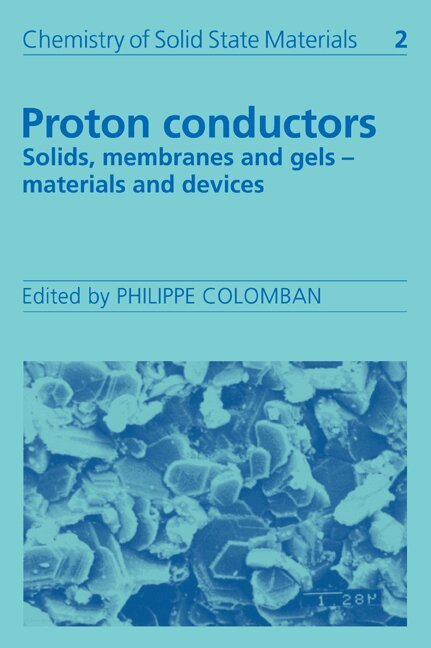
Proton Conductors
Solids, Membranes and Gels - Materials and Devices
Häftad, Engelska, 2008
1 376 kr
Skickas inom 7-10 vardagar
Protonic conduction in liquid electrolytes is commonplace but is relatively rare in solids. There is much interest worldwide in proton conducting solids, both from the scientific aspect, as materials with novel properties, but also for their possible applications in high-density solid-state batteries, sensors and other electrochemical devices. This book gives a comprehensive review of proton conductors, including theory, techniques, the materials themselves and applications.
Del 2 - Chemistry of Solid State Materials
Proton Conductors
Solids, Membranes and Gels - Materials and Devices
Inbunden, Engelska, 1992
2 588 kr
Skickas inom 7-10 vardagar
Protonic conduction in liquid electrolytes is commonplace but is relatively rare in solids. There is much interest worldwide in proton conducting solids, both from the scientific aspect, as materials with novel properties, but also for their possible applications in high-density solid-state batteries, sensors and other electrochemical devices. This book gives a comprehensive review of proton conductors, including theory, techniques, the materials themselves and applications.
1 314 kr
Skickas inom 10-15 vardagar
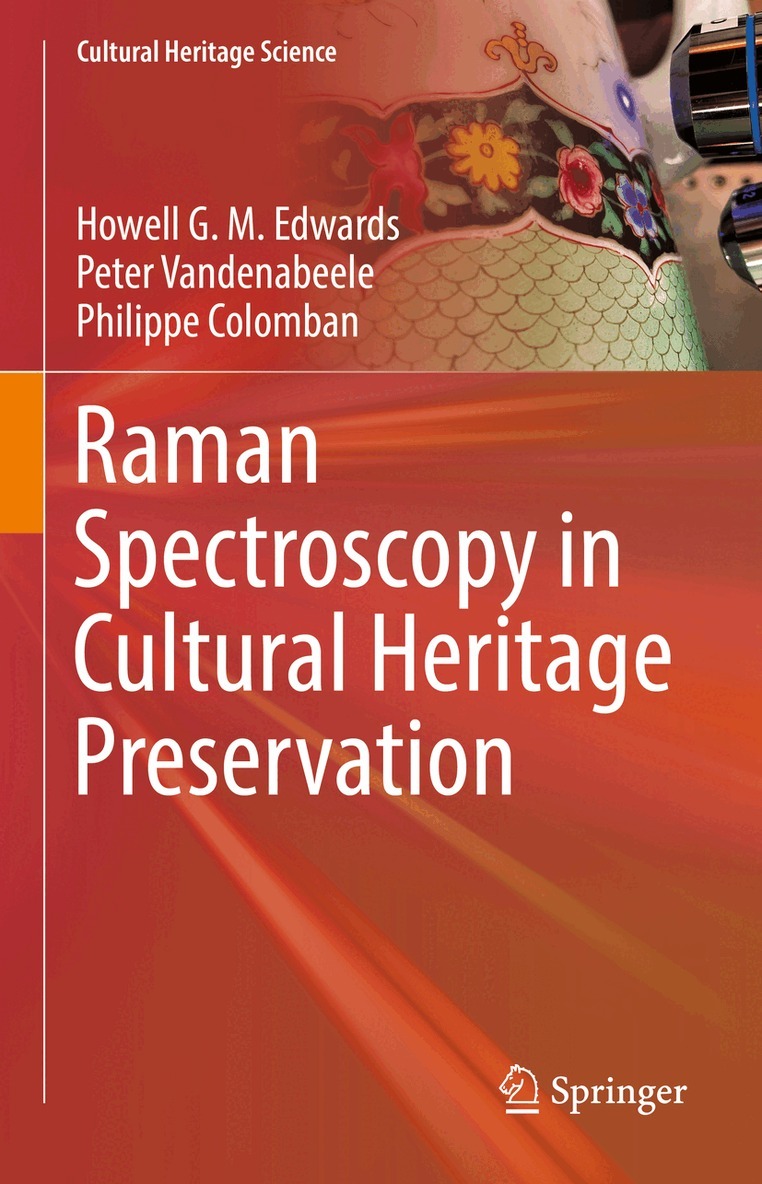
This book addresses the application of Raman spectroscopic techniques to a range of diverse problems which arise in the study, conservation and restoration of artefacts and sites closely related to our cultural heritage as well as in authentication. These themes are naturally wider than what at first might be considered as artworks and archaeological artefacts and the topics include pigments, paintings, ceramics, glass, sculpture and patination / corrosion, textiles, industrial archaeology, the degradation and preservation of biomaterials, mummies and human skeletal remains. An interesting feature is the inclusion of modern case studies which describe specific problems and approaches to the Raman spectral analysis of items important to our cultural heritage. The text is prefaced with an introduction to the important parameters used in nondestructive Raman measurements and also highlights some future applications based upon novel miniaturised instrumentation for in-field studies andpotential screening work which will identify specimens which would repay further studies in the laboratory. An attempt is made to give a snapshot of the state-of-the-art evolution since the beginning of the technique (1970s) and to point out potential further development. The book is co-edited by three international experts with many years' experience in the application of Raman spectroscopy to artworks, archaeological artefacts and in the investigation of materials and sites for cultural heritage preservation and each editor has undertaken to write individual chapters and different topics personally. The adopted approach is designed to convey the sort of information which has become available from the adoption of analytical Raman spectroscopy to different problems in the field of cultural heritage preservation through the spectral interrogation of artefacts and how the interpretation of the spectral data can assist museum curators, archaeologists and cultural heritage historians in the preservation and conservation of ancient materials and sites : a particular advantage in this respect is the ability of Raman spectroscopy to determine –generally in a strictly noninvasive procedure - at the laboratory or on-site with mobile instruments, the presence of both organic and inorganic components in a particular specimen together nondestructively without any chemical and mechanical pretreatment being undertaken, which is an essential requirement for rare and valuable samples . An important aside from this work is the means of spectral identification of ongoing biodeterioration and biological colonisation in specimens in storage and the effects of environmental deterioration such as humidity and temperature upon their integrity.
1 314 kr
Skickas inom 10-15 vardagar
This book addresses the application of Raman spectroscopic techniques to a range of diverse problems which arise in the study, conservation and restoration of artefacts and sites closely related to our cultural heritage as well as in authentication. These themes are naturally wider than what at first might be considered as artworks and archaeological artefacts and the topics include pigments, paintings, ceramics, glass, sculpture and patination / corrosion, textiles, industrial archaeology, the degradation and preservation of biomaterials, mummies and human skeletal remains. An interesting feature is the inclusion of modern case studies which describe specific problems and approaches to the Raman spectral analysis of items important to our cultural heritage. The text is prefaced with an introduction to the important parameters used in nondestructive Raman measurements and also highlights some future applications based upon novel miniaturised instrumentation for in-field studies andpotential screening work which will identify specimens which would repay further studies in the laboratory. An attempt is made to give a snapshot of the state-of-the-art evolution since the beginning of the technique (1970s) and to point out potential further development. The book is co-edited by three international experts with many years' experience in the application of Raman spectroscopy to artworks, archaeological artefacts and in the investigation of materials and sites for cultural heritage preservation and each editor has undertaken to write individual chapters and different topics personally. The adopted approach is designed to convey the sort of information which has become available from the adoption of analytical Raman spectroscopy to different problems in the field of cultural heritage preservation through the spectral interrogation of artefacts and how the interpretation of the spectral data can assist museum curators, archaeologists and cultural heritage historians in the preservation and conservation of ancient materials and sites : a particular advantage in this respect is the ability of Raman spectroscopy to determine –generally in a strictly noninvasive procedure - at the laboratory or on-site with mobile instruments, the presence of both organic and inorganic components in a particular specimen together nondestructively without any chemical and mechanical pretreatment being undertaken, which is an essential requirement for rare and valuable samples . An important aside from this work is the means of spectral identification of ongoing biodeterioration and biological colonisation in specimens in storage and the effects of environmental deterioration such as humidity and temperature upon their integrity.
1 625 kr
Skickas inom 10-15 vardagar
The use of natural mineral and synthetic blue pigments in antiquity for wall paintings and illuminated manuscript historiation evolved into the most suitable blue pigments for the decoration of glazed and enamelled wares (ceramics, glass and metal) which required a stability at the high temperatures of the kilns used for glazing and firing.