Piero Olivo - Böcker
Visar alla böcker från författaren Piero Olivo. Handla med fri frakt och snabb leverans.
4 produkter
4 produkter
3 178 kr
Skickas inom 10-15 vardagar
Most of the applications of electronics require non-volatile memories, which can keep stored information when the power supply is switched off. Flash memories (in which a single cell can be electrically programmed and a large number of cells are usually electrically erased at the same time) are the most versatile non-volatile memories. They are widely used to store the basic input-output system (BIOS) of personal computers, the software and personal data of cellular phones, identification codes in smart cards and many other applications. Flash memories allow software updates, change of passwords and codes, and reconfiguration of the system in the field. They can be designed and optimized to create large-size memories which can successfully substitute hard disks for specific applications, having lower power consumption and weight, shorter access times, and far better robustness. This book is devoted entirely to flash memories and has been designed to provide comprehensive information on basic memory cell structures, device physics and technology, simulation circuit architecture, system issues, testing and reliability.It also provides data on advanced subjects related to multi-level storage cells, embedded memories and system applications of flash memories.
3 168 kr
Skickas inom 10-15 vardagar
A Flash memory is a Non Volatile Memory (NVM) whose "unit cells" are fabricated in CMOS technology and programmed and erased electrically. In 1971, Frohman-Bentchkowsky developed a folating polysilicon gate tran sistor [1, 2], in which hot electrons were injected in the floating gate and removed by either Ultra-Violet (UV) internal photoemission or by Fowler Nordheim tunneling. This is the "unit cell" of EPROM (Electrically Pro grammable Read Only Memory), which, consisting of a single transistor, can be very densely integrated. EPROM memories are electrically programmed and erased by UV exposure for 20-30 mins. In the late 1970s, there have been many efforts to develop an electrically erasable EPROM, which resulted in EEPROMs (Electrically Erasable Programmable ROMs). EEPROMs use hot electron tunneling for program and Fowler-Nordheim tunneling for erase. The EEPROM cell consists of two transistors and a tunnel oxide, thus it is two or three times the size of an EPROM. Successively, the combination of hot carrier programming and tunnel erase was rediscovered to achieve a single transistor EEPROM, called Flash EEPROM. The first cell based on this concept has been presented in 1979 [3]; the first commercial product, a 256K memory chip, has been presented by Toshiba in 1984 [4]. The market did not take off until this technology was proven to be reliable and manufacturable [5].
1 593 kr
Skickas inom 10-15 vardagar
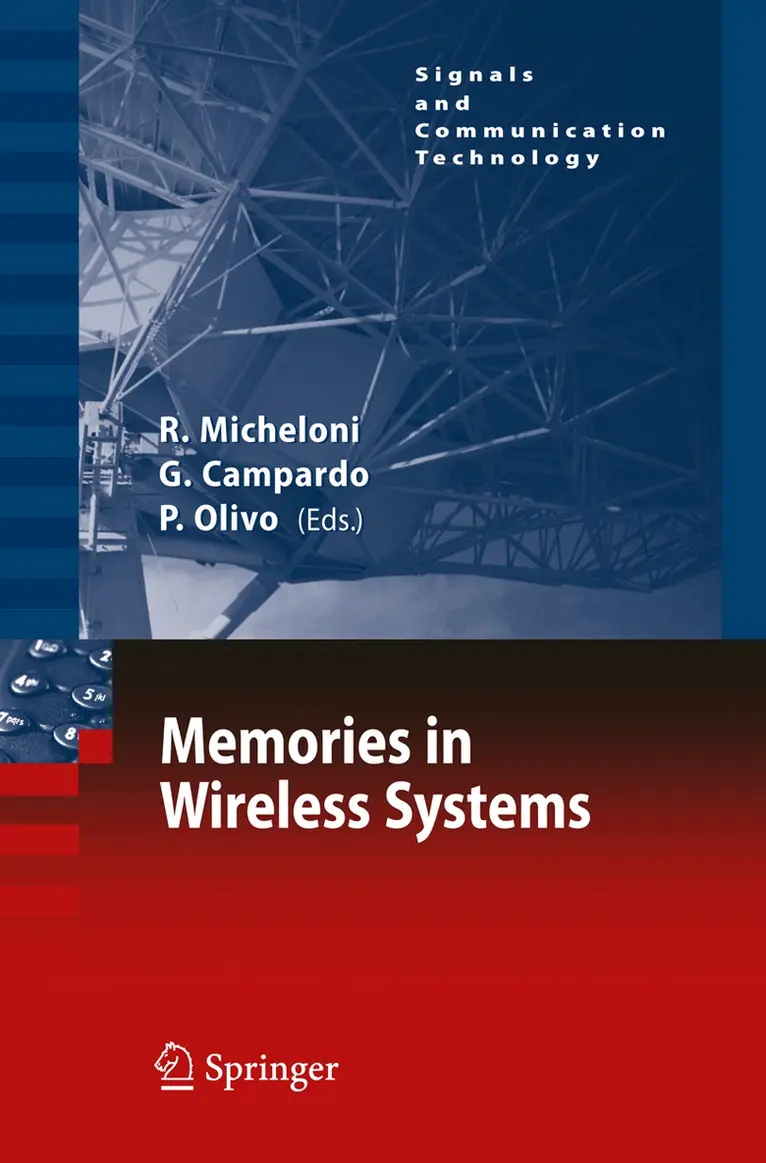
For the technological progress in communication technology it is necessary that the advanced studies in circuit and software design are accompanied with recent results of the technological research and physics in order to exceed its limitations.This book is a guide which treats many components used in mobile communications, and in particular focuses on non-volatile memories. It emerges following the conducting line of the non-volatile memory in the wireless system: On the one hand it develops the foundations of the interdisciplinary issues needed for design analysis and testing of the system. On the other hand it deals with many of the problems appearing when the systems are realized in industrial production. These cover the difficulties from the mobile system to the different types of non-volatile memories. The book explores memory cards, multichip technologies, and algorithms of the software management as well as error handling. It also presents techniques of assurance for the single components and a guide through the Datasheet lectures.
1 170 kr
Skickas inom 10-15 vardagar
For the technological progress in communication technology it is necessary that the advanced studies in circuit and software design are accompanied with recent results of the technological research and physics in order to exceed its limitations.This book is a guide which treats many components used in mobile communications, and in particular focuses on non-volatile memories. It emerges following the conducting line of the non-volatile memory in the wireless system: On the one hand it develops the foundations of the interdisciplinary issues needed for design analysis and testing of the system. On the other hand it deals with many of the problems appearing when the systems are realized in industrial production. These cover the difficulties from the mobile system to the different types of non-volatile memories. The book explores memory cards, multichip technologies, and algorithms of the software management as well as error handling. It also presents techniques of assurance for the single components and a guide through the Datasheet lectures.