Pietro Maria Navarra - Böcker
Visar alla böcker från författaren Pietro Maria Navarra. Handla med fri frakt och snabb leverans.
4 produkter
4 produkter
3 616 kr
Skickas inom 7-10 vardagar
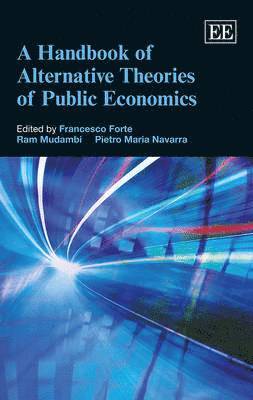
This comprehensive and thought-provoking Handbook reviews public sector economics from pluralist perspectives that either complement or reach beyond mainstream views.The book takes a comprehensive interdisciplinary approach, drawing on economic elements in the fields of philosophy, sociology, psychology, history and law. The expert contributors present new methodological approaches across these disciplines in five distinct sections:'Revisiting the Theoretical Foundations' compares and contrasts Austrians, Marxists, public choice theorists and Keynesians'Revisiting the Values' is concerned with justice, welfare, religions and civil rights'Beyond Rationalistic Rational Choice' includes chapters devoted to memory, information and group motivationThe final sections on 'Optimal Government and Government Failure' and 'Public Economics of Public Bads' deal with competition among governments, their suboptimal size, regulation, corruption, the informal economy, cognitive dissonance, rent seeking, the UN and criminal cycles.Academics, researchers and students with an interest in economics - particularly public sector economics and Austrian economics - and public policy will find this Handbook to be an invaluable reference tool.Contributors: F. Acacia, J. Alm, G. Brady, G. Brosio, M. Caputo, M. Casson, G. Coco, M. Cubel Sanchez, S. Fedeli, M. Florio, F. Forte, N. Goldschmit, A. Habisch, M. Holler, J. Huerta de Soto, J.P. Jimenez, A. Koziashvili, M.A. Leroch, C. Magazzino, M. Mantovani, D. Montolio, R. Mudami, D.C. Mueller, S. Nitzan, D.M.A. Patti, P. Salin, P. Salmon, F. Sobbrio, V. Tanzi, Y. Tobol, B.A. Wickström, R. Zanola
778 kr
Skickas inom 7-10 vardagar
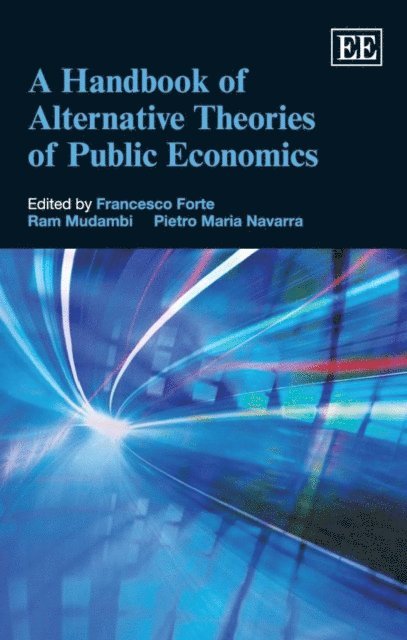
This comprehensive and thought-provoking Handbook reviews public sector economics from pluralist perspectives that either complement or reach beyond mainstream views.The book takes a comprehensive interdisciplinary approach, drawing on economic elements in the fields of philosophy, sociology, psychology, history and law. The expert contributors present new methodological approaches across these disciplines in five distinct sections:'Revisiting the Theoretical Foundations' compares and contrasts Austrians, Marxists, public choice theorists and Keynesians'Revisiting the Values' is concerned with justice, welfare, religions and civil rights'Beyond Rationalistic Rational Choice' includes chapters devoted to memory, information and group motivationThe final sections on 'Optimal Government and Government Failure' and 'Public Economics of Public Bads' deal with competition among governments, their suboptimal size, regulation, corruption, the informal economy, cognitive dissonance, rent seeking, the UN and criminal cycles.Academics, researchers and students with an interest in economics - particularly public sector economics and Austrian economics - and public policy will find this Handbook to be an invaluable reference tool.Contributors: F. Acacia, J. Alm, G. Brady, G. Brosio, M. Caputo, M. Casson, G. Coco, M. Cubel Sanchez, S. Fedeli, M. Florio, F. Forte, N. Goldschmit, A. Habisch, M. Holler, J. Huerta de Soto, J.P. Jimenez, A. Koziashvili, M.A. Leroch, C. Magazzino, M. Mantovani, D. Montolio, R. Mudami, D.C. Mueller, S. Nitzan, D.M.A. Patti, P. Salin, P. Salmon, F. Sobbrio, V. Tanzi, Y. Tobol, B.A. Wickström, R. Zanola
1 719 kr
Skickas inom 7-10 vardagar
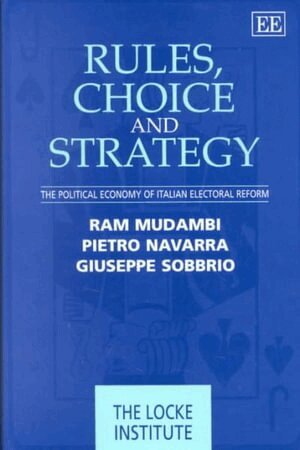
The design of an electoral system is fundamental to any democracy. It is through electoral systems that the commitment of a society to a political system is achieved. The peculiarities of an electoral system assume significant importance in periods in which democratic polities seem caught between a crisis of confidence in their representative systems and mass apathy over the product of government - as has recently occurred in Italy.Electoral rules constrain available choice alternatives and therefore have profound effects on governance of a country since different electoral rules generate different outcome patterns even with no change in the identity of candidates. The two most common electoral schemes are proportional representation and plurality. The theoretical debate concerning these two systems is of intense interest not least because of the importance of finding a stable, democratic and representative institutional structure that can be employed worldwide. This topical book analyses the change of electoral rules in Italy from proportional representation toward plurality. While Italy is used as the illustrative case, the analysis has far-ranging theoretical and practical implications, and will therefore be of interest to academics and researchers of political economy, constitutionalism and public choice.
2 402 kr
Skickas inom 7-10 vardagar
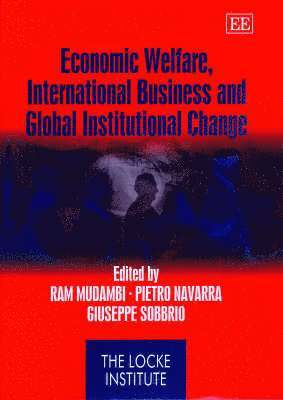
Global economic progress in the twentieth century, while generally encouraging, was neither continuous nor uniform. With the exception of some Asian nations, countries that were more developed at the beginning of the twentieth century still rank amongst the wealthiest nations, while countries that were poorer, still lag behind. The distinguished authors in this volume address the fundamental causes for such heterogeneous international experiences, placing particular emphasis on the role of institutions.They demonstrate how the study of economic development is increasingly linked to the development of institutions, which allow for more complex exchanges to occur in markets and societies. Institutions can be understood as rules or constraints that channel individuals' actions in specific directions, and can be formal or informal depending on their genesis. The book highlights the connection between institutions and economic welfare by examining countries at different stages of development. Although the authors' study material effects, they also look at individual well-being which is more strongly influenced by the non-material products of institutions such as opportunity, freedom and relationships. They move on to highlight the role of institutions in global business, in terms of innovation, entrepreneurship and foreign direct investment. In the concluding chapters they focus on the actual process of transition from one institutional framework to another. Amongst other examples, they examine reforms to international financial institutions and constitutional adjustments in transition countries. This varied yet highly topical book will be invaluable to institutional and public-choice economists, students and researchers of the theory and policy of international business, and social and political scientists interested in the role and evolution of institutions.