Pronob K. Mitter – författare
Visar alla böcker från författaren Pronob K. Mitter. Handla med fri frakt och snabb leverans.
5 produkter
5 produkter
Del 364 - NATO Science Series B:
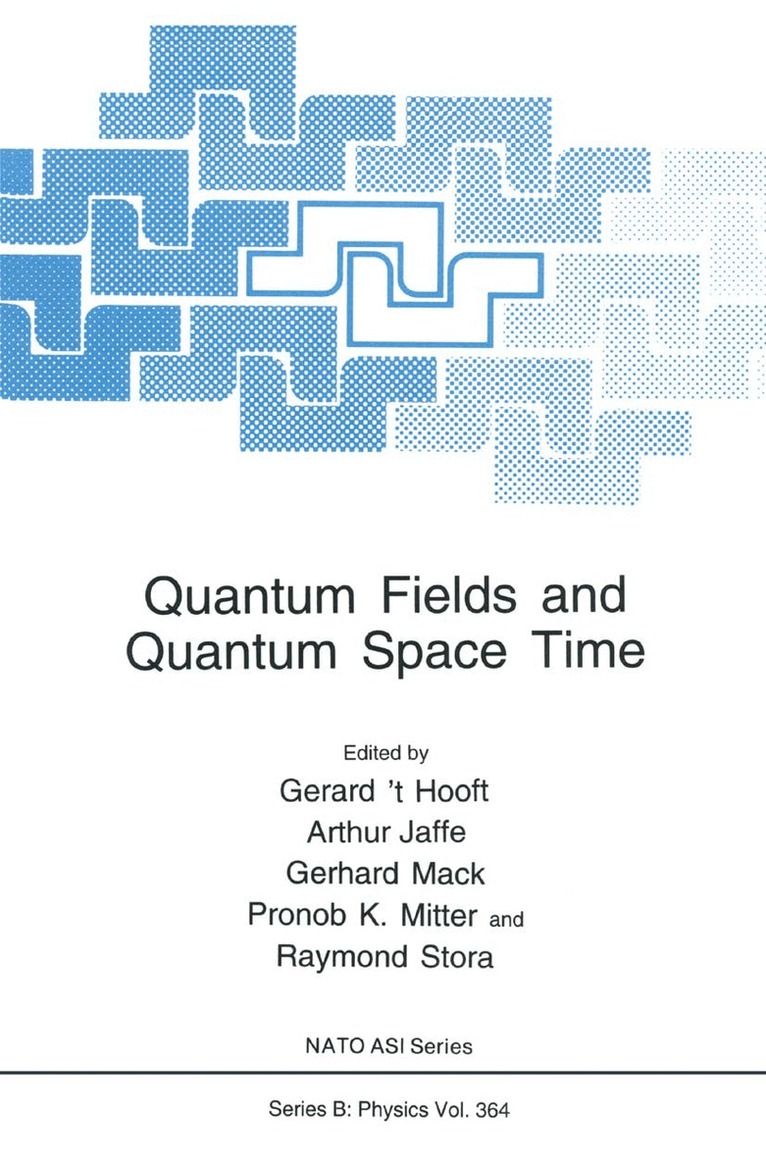
Quantum Fields and Quantum Space Time
Inbunden, Engelska, 1997
2 173 kr
Skickas inom 10-15 vardagar
The 1996 NATO Advanced Study Institute (ASI) followed the international tradi tion of the schools held in Cargese in 1976, 1979, 1983, 1987 and 1991. Impressive progress in quantum field theory had been made since the last school in 1991. Much of it is connected with the interplay of quantum theory and the structure of space time, including canonical gravity, black holes, string theory, application of noncommutative differential geometry, and quantum symmetries. In addition there had recently been important advances in quantum field theory which exploited the electromagnetic duality in certain supersymmetric gauge theories. The school reviewed these developments. Lectures were included to explain how the "monopole equations" of Seiberg and Witten can be exploited. They were presented by E. Rabinovici, and supplemented by an extra 2 hours of lectures by A. Bilal. Both the N = 1 and N = 2 supersymmetric Yang Mills theory and resulting equivalences between field theories with different gauge group were discussed in detail. There are several roads to quantum space time and a unification of quantum theory and gravity. There is increasing evidence that canonical gravity might be a consistent theory after all when treated in. a nonperturbative fashion. H. Nicolai presented a series of introductory lectures. He dealt in detail with an integrable model which is obtained by dimensional reduction in the presence of a symmetry.
Häftad, Engelska, 2012
548 kr
Skickas inom 10-15 vardagar
Soon after the discovery of quantum mechanics, group theoretical methods were used extensively in order to exploit rotational symmetry and classify atomic spectra. And until recently it was thought that symmetries in quantum mechanics should be groups. But it is not so. There are more general algebras, equipped with suitable structure, which admit a perfectly conventional interpretation as a symmetry of a quantum mechanical system. In any case, a "trivial representation" of the algebra is defined, and a tensor product of representations. But in contrast with groups, this tensor product needs to be neither commutative nor associative. Quantum groups are special cases, in which associativity is preserved. The exploitation of such "Quantum Symmetries" was a central theme at the Ad vanced Study Institute. Introductory lectures were presented to familiarize the participants with the al gebras which can appear as symmetries and with their properties. Some models of local field theories were discussed in detail which have some such symmetries, in par ticular conformal field theories and their perturbations. Lattice models provide many examples of quantum theories with quantum symmetries. They were also covered at the school. Finally, the symmetries which are the cause of the solubility of inte grable models are also quantum symmetries of this kind. Some such models and their nonlocal conserved currents were discussed.
E-bok
PDF, Engelska, 2012687 kr
Läs direkt efter köp
Soon after the discovery of quantum mechanics, group theoretical methods were used extensively in order to exploit rotational symmetry and classify atomic spectra. And until recently it was thought that symmetries in quantum mechanics should be groups. But it is not so. There are more general algebras, equipped with suitable structure, which admit a perfectly conventional interpretation as a symmetry of a quantum mechanical system. In any case, a "trivial representation" of the algebra is defined, and a tensor product of representations. But in contrast with groups, this tensor product needs to be neither commutative nor associative. Quantum groups are special cases, in which associativity is preserved. The exploitation of such "Quantum Symmetries" was a central theme at the Ad vanced Study Institute. Introductory lectures were presented to familiarize the participants with the al gebras which can appear as symmetries and with their properties. Some models of local field theories were discussed in detail which have some such symmetries, in par ticular conformal field theories and their perturbations. Lattice models provide many examples of quantum theories with quantum symmetries. They were also covered at the school. Finally, the symmetries which are the cause of the solubility of inte grable models are also quantum symmetries of this kind. Some such models and their nonlocal conserved currents were discussed.
E-bok
PDF, Engelska, 20132 741 kr
Läs direkt efter köp
The 1996 NATO Advanced Study Institute (ASI) followed the international tradi tion of the schools held in Cargese in 1976, 1979, 1983, 1987 and 1991. Impressive progress in quantum field theory had been made since the last school in 1991. Much of it is connected with the interplay of quantum theory and the structure of space time, including canonical gravity, black holes, string theory, application of noncommutative differential geometry, and quantum symmetries. In addition there had recently been important advances in quantum field theory which exploited the electromagnetic duality in certain supersymmetric gauge theories. The school reviewed these developments. Lectures were included to explain how the "monopole equations" of Seiberg and Witten can be exploited. They were presented by E. Rabinovici, and supplemented by an extra 2 hours of lectures by A. Bilal. Both the N = 1 and N = 2 supersymmetric Yang Mills theory and resulting equivalences between field theories with different gauge group were discussed in detail. There are several roads to quantum space time and a unification of quantum theory and gravity. There is increasing evidence that canonical gravity might be a consistent theory after all when treated in. a nonperturbative fashion. H. Nicolai presented a series of introductory lectures. He dealt in detail with an integrable model which is obtained by dimensional reduction in the presence of a symmetry.
Häftad, Engelska, 2013
2 389 kr
Skickas inom 10-15 vardagar
The 1996 NATO Advanced Study Institute (ASI) followed the international tradi tion of the schools held in Cargese in 1976, 1979, 1983, 1987 and 1991. Impressive progress in quantum field theory had been made since the last school in 1991. Much of it is connected with the interplay of quantum theory and the structure of space time, including canonical gravity, black holes, string theory, application of noncommutative differential geometry, and quantum symmetries. In addition there had recently been important advances in quantum field theory which exploited the electromagnetic duality in certain supersymmetric gauge theories. The school reviewed these developments. Lectures were included to explain how the "monopole equations" of Seiberg and Witten can be exploited. They were presented by E. Rabinovici, and supplemented by an extra 2 hours of lectures by A. Bilal. Both the N = 1 and N = 2 supersymmetric Yang Mills theory and resulting equivalences between field theories with different gauge group were discussed in detail. There are several roads to quantum space time and a unification of quantum theory and gravity. There is increasing evidence that canonical gravity might be a consistent theory after all when treated in. a nonperturbative fashion. H. Nicolai presented a series of introductory lectures. He dealt in detail with an integrable model which is obtained by dimensional reduction in the presence of a symmetry.