Rabin Chakrabortty – författare
1 725 kr
Läs direkt efter köp
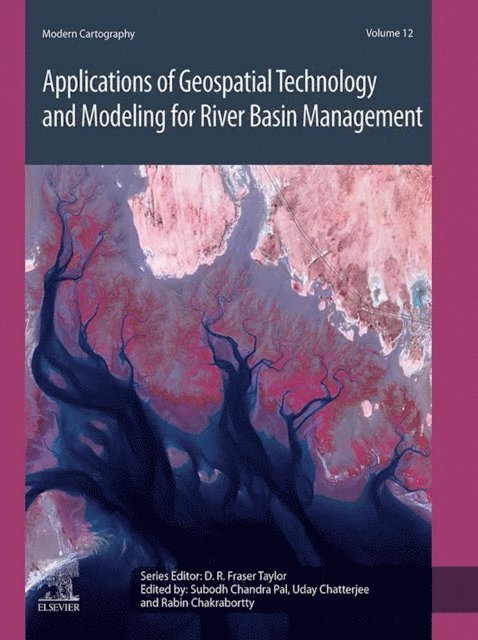
Applications of Geospatial Technology and Modeling for River Basin Management
1 366 kr
Skickas inom 10-15 vardagar
Applications of Geospatial Technology and Modeling for River Basin Management, Volume Twelve covers the use of multi-temporal satellite data for accurate estimations of different watershed features. It includes methods and case studies of the use of geographic information systems (GIS) as a valuable tool for criteria-based spatial analysis to manage natural resources and accurately simulate natural phenomena such as the hydrologic response of a watershed to precipitation and susceptibility to water erosion. The book also provides direction on many types of modelling and mapping techniques in geospatial environments based on river basin management challenges. This book will be a useful guide for academics, researchers, and practitioners involved in the use of geospatial technologies for river basin management, as well as those interested in environmental management and Earth surface geomorphology.
Covers the use of geospatial technologies and modeling for effective management of river basinsIncludes methodology and detailed case studies showing real-world applications at a variety of scalesEmphasizes the importance of integrating geospatial tools in decision-making processes for sustainable water resource management1 619 kr
Skickas inom 10-15 vardagar
1 533 kr
Läs direkt efter köp
This work focuses on the potential impact of climate change on soil erosion in a monsoon-dominated sub-tropical region. Water-induced soil erosion due to extreme rainfall during the monsoon period is a major problem worldwide, from different environmental and socio-economic perspectives. This study region covered (South Bengal) is one of the fertile agricultural belts that produces a good amount of produce and contributes to the country''s GDP. However, the rate of agricultural output has decreased rapidly in recent times due to a decline in soil fertility.
The monsoon-dominated sub-tropical region has unique characteristics in terms of seasonal temperature fluctuations and the availability of rainfall events. The sub-tropical region is densely populated, with the majority of the population relying on rain-fed agricultural production systems. The declining rate of agricultural production has also established that soil fertility is declining and soil erosion is increasing. Numerous studies show that soil erosion is the major cause of the region''s rapidly increasing trend of land degradation. A homeostatic mechanism cannot replace soil erosion, and a gap arises between soil erosion and regolith formation. Extreme changes in land use and land cover, population growth and the lacking support for traditional agricultural practices and management practices can accelerate the rate of soil erosion and its associated reservoir sedimentation in most countries of the tropical and sub-tropical environment. Quantitative information with maximum possible accuracy through validation regarding soil loss can be an essential part of the appropriate and sustainable soil and water conservation planning. The precise aspects of modern day management strategies are soil erosion susceptibility mapping using empirical and semi-empirical models in a GIS platform or the use of probability statistics.
The main objective of this work is to propose the most suitable developmentstrategies considering the amount of soil erosion for the present and future periods. Extensive field research has been done to identify the support practice factor that the local stakeholders adopt in this region.
1 189 kr
Skickas inom 10-15 vardagar