Rachel Washburn - Böcker
Visar alla böcker från författaren Rachel Washburn. Handla med fri frakt och snabb leverans.
3 produkter
3 produkter
675 kr
Skickas inom 10-15 vardagar
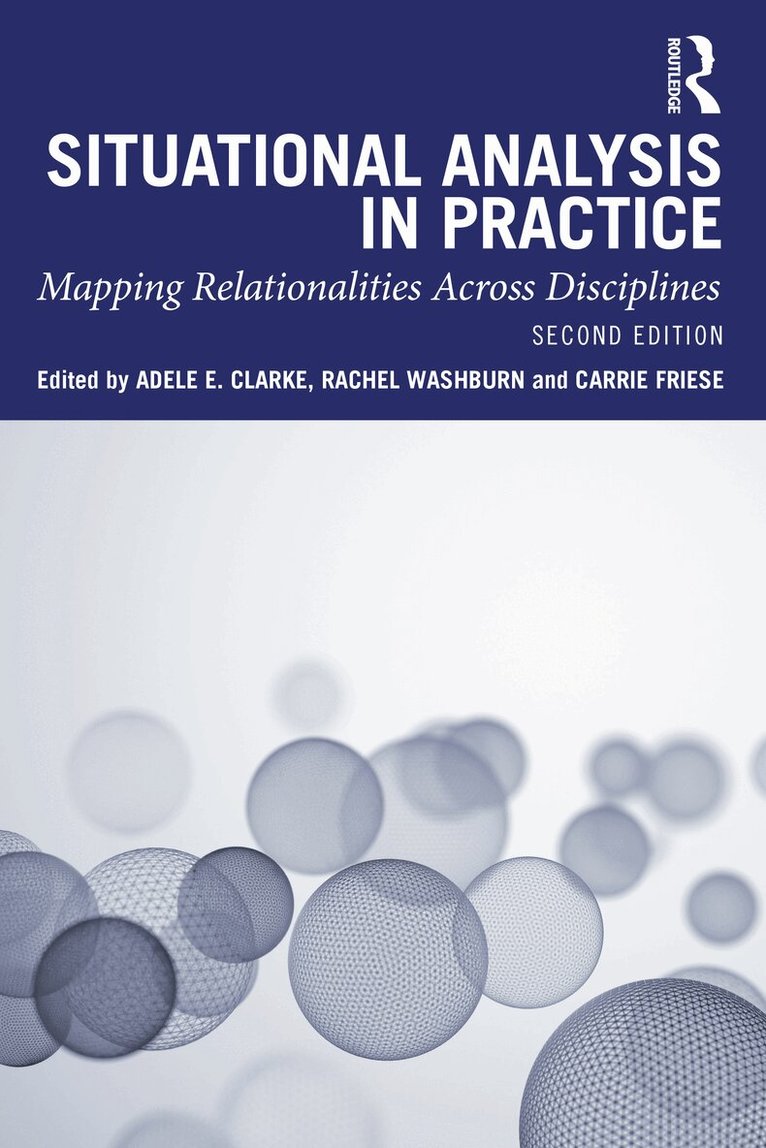
Situational Analysis (SA) uses analytic maps of the situation, processes and relations identified using approaches pioneered in Grounded Theory. Creator of the method, award-winning sociologist Adele E. Clarke, with Rachel Washburn and Carrie Friese, show how the method can be, and has been, used in a variety of critical qualitative studies.The entirely new second edition of this book offers several chapters on the method and new introductory material from the editors about developments in using SA in qualitative inquiry. Part I introduces readers to the method of SA, discussing recent developments in the field. Part II offers five new chapters about various facets of the SA method, including a history of Grounded Theory and Situational Analysis, SA as critical pragmatist interactionism, using SA in managing a mixed-methods project, and SA mapping in the social policy classroom and in clinical counseling as innovatively collaborative analysis. Part III offers six new exemplary research articles drawn from energy research and international relations, public health research methods, disabled access to public transportation, participation in conservation in a biosphere reserve, and PTSD and the military. Authors’ reflections on their experiences in using the method are also included.These carefully selected new readings vividly demonstrate how widely this method has travelled, successfully meeting the needs of diverse researchers seeking an innovative relational approach to critically analyzing a wide array of data. Situational Analysis in Practice will be of interest to undergraduate and graduate students practicing the SA method across the social sciences, including sociology and healthcare among other disciplines, as well as research scholars interested in qualitative inquiry.
2 058 kr
Skickas inom 10-15 vardagar
Situational Analysis (SA) uses analytic maps of the situation, processes and relations identified using approaches pioneered in Grounded Theory. Creator of the method, award-winning sociologist Adele E. Clarke, with Rachel Washburn and Carrie Friese, show how the method can be, and has been, used in a variety of critical qualitative studies.The entirely new second edition of this book offers several chapters on the method and new introductory material from the editors about developments in using SA in qualitative inquiry. Part I introduces readers to the method of SA, discussing recent developments in the field. Part II offers five new chapters about various facets of the SA method, including a history of Grounded Theory and Situational Analysis, SA as critical pragmatist interactionism, using SA in managing a mixed-methods project, and SA mapping in the social policy classroom and in clinical counseling as innovatively collaborative analysis. Part III offers six new exemplary research articles drawn from energy research and international relations, public health research methods, disabled access to public transportation, participation in conservation in a biosphere reserve, and PTSD and the military. Authors’ reflections on their experiences in using the method are also included.These carefully selected new readings vividly demonstrate how widely this method has travelled, successfully meeting the needs of diverse researchers seeking an innovative relational approach to critically analyzing a wide array of data. Situational Analysis in Practice will be of interest to undergraduate and graduate students practicing the SA method across the social sciences, including sociology and healthcare among other disciplines, as well as research scholars interested in qualitative inquiry.
1 234 kr
Skickas inom 3-6 vardagar
The Second Edition of Situational Analysis: Grounded Theory After the Interpretive Turn offers an innovative extension of grounded theory useful in qualitative research projects that draws on interviews, observations, and visual, narrative, and historical discourse materials. To engage the dense complexities of real world situations, Situational Analysis (SA) braids together Strauss's ecological social worlds/arenas theory, Foucault’s discourse analysis, and Deleuze and Guattari’s rhizomes and assemblages. In SA, the situation itself becomes the fundamental unit of analysis. Using extensive examples, the authors discuss getting started, how to create three kinds of maps emphasizing differences and relationality (situational maps, social world/arena maps, and positional maps), the kinds of analytic work they accomplish, and how to write up the results centered on the distinctive strengths of the method. The book will serve as an invaluable resource for advanced undergraduate and graduate-level students, as well as professional researchers and consultants from diverse backgrounds pursuing qualitative projects.