Rais Akhtar – författare
727 kr
Läs direkt efter köp
This engaging book presents an insightful look into the contributing factors that have shaped the modern public health system in Jammu & Kashmir and Ladakh. Reflecting on the historical, socio-economic, and contemporary scenario of environment and public health, this book presents chapters that discuss the role of spatial patterns of diseases, health-risk patterns, contributions of medical missionaries in health services in Kashmir, changing disease ecology of Leh, and traditional medical therapy in Ladakh, among others.
This book also examines the cholera ecology in Kashmir during the 19th century, and the significance of Kangri ・ a portable traditional heat source ・ in cultural studies, economics, and cancer research. It investigates the role of traditional knowledge in the medical therapy of rural areas of Ladakh and the impact of urbanization on the quality of human health in Srinagar City. Besides, this book examines iodine deficiency disorders and the extension of vector-borne diseases. The essays also probe into the rising mental health concerns in post-pandemic Kashmir.
This book will be useful for students, researchers, and teachers of physical geography, human geography, environmental studies, public health, and health sciences. It will also be of interest to political geographers, sociologists, policymakers, and those interested in the issues related to health and environment in the region.
702 kr
Läs direkt efter köp
This engaging book presents an insightful look into the contributing factors that have shaped the modern public health system in Jammu & Kashmir and Ladakh. Reflecting on the historical, socio-economic, and contemporary scenario of environment and public health, this book presents chapters that discuss the role of spatial patterns of diseases, health-risk patterns, contributions of medical missionaries in health services in Kashmir, changing disease ecology of Leh, and traditional medical therapy in Ladakh, among others.
This book also examines the cholera ecology in Kashmir during the 19th century, and the significance of Kangri ・ a portable traditional heat source ・ in cultural studies, economics, and cancer research. It investigates the role of traditional knowledge in the medical therapy of rural areas of Ladakh and the impact of urbanization on the quality of human health in Srinagar City. Besides, this book examines iodine deficiency disorders and the extension of vector-borne diseases. The essays also probe into the rising mental health concerns in post-pandemic Kashmir.
This book will be useful for students, researchers, and teachers of physical geography, human geography, environmental studies, public health, and health sciences. It will also be of interest to political geographers, sociologists, policymakers, and those interested in the issues related to health and environment in the region.
2 250 kr
Skickas inom 10-15 vardagar
615 kr
Skickas inom 10-15 vardagar
1 793 kr
Skickas inom 10-15 vardagar
2 290 kr
Läs direkt efter köp
This edited book assesses the impacts of various extreme weather events on human health and development from a global perspective, and includes several case studies in various geographical regions around the globe.
Covering all continents, it describes the impact of extreme weather conditions such as flash floods, heatwaves, cold waves, droughts, forest fires, strong winds and storms in both developing and developed countries. The contributing authors also investigate the spread of diseases and the risk to food security caused by drought and flooding.Further, the book discusses the economic damage resulting from natural disasters including hurricanes. It has been estimated that in 2017 natural disasters and climate change resulted in economic losses of 309 billion US dollars. Scientists also predict that if nothing is done to curb the effects of climate change, in Europe the death toll due to weather disasters could rise 50-fold by the end of the21st century, with extreme heat alone causing more than 150,000 deaths a year, as the report on global warming of 1.5°C warns that China, Russia and Canada’s current climate policies would steer the world above a catastrophic 5°C of warming by the end of 2100. As such, the book highlights how the wellbeing of different populations is threatened by extreme events now and in the foreseeable future.
1 793 kr
Skickas inom 10-15 vardagar
1 242 kr
Läs direkt efter köp
This book covers over 24 country studies on various dimensions associated with the geographical spread of COVID-19. The chapters in the book, from geographically diversified countries, assert the need to undertake intensive regional research in order to understand the global pattern of Coronavirus focusing on infection migration, and indigenous origin that has caused tremendous global economic, social and health disaster. The book contends that understanding of peoples’ behaviour is crucial towards safety measures against infection, as COVID-19 impacted to a greater extent social wellbeing of population because of lockdowns in all corners of the world.
Some of the countries featured are USA, France, Italy, Hong Kong, South Korea, Canada, Australia, Pacific Islands, Russia, Taiwan, Thailand, Malaysia, Indonesia, India, South Africa, Nigeria, Mexico, Peru and Brazil.
1 012 kr
Skickas inom 10-15 vardagar
1 123 kr
Skickas inom 10-15 vardagar
1 408 kr
Läs direkt efter köp
1 123 kr
Skickas inom 10-15 vardagar
1 458 kr
Skickas inom 10-15 vardagar
1 722 kr
Läs direkt efter köp
The objective of the present edited book is to encompass studies from both developed and developing countries of Asia, Africa Europe, and Americas, to understand and present a comparative scenario of the climate change and other environmental determinants of health and disease in geographically diversified countries. Environment and health perspective dates back to Hippocrates treatise written 400 B.C.E. In his book On Airs, Waters and Places, Hippocrates described diseases as associated with environmental conditions, “Whoever wishes to investigate medicine properly, should proceed thus: in the first place to consider the seasons of the year, and what effects each of them produces for they are not at all alike, but differ much from themselves in regard to their changes. Then the winds, the hot and the cold, especially such as are common to all countries, and then such as are peculiar to each locality. We must also consider the qualities of the waters, for as they differ fromone another in taste and weight, so also do they differ much in their qualities. In the same manner, when one comes into a city to which he is a stranger, he ought to consider its situation, how it lies as to the winds and the rising of the sun; for its influence is not the same whether it lies to the north or the south, to the rising or to the setting sun”.
There has been a greater emphasis in the last four decades on understanding environmental factors which affect human health, after United Nations established Intergovernmental Panel on Climate Change (IPCC) in 1988 aimed at to evaluate research on changing environmental condition, particularly climate change and its impacts on human wellbeing, including human health, as consequences of extreme heat waves conditions, sea level rise, forced migration, air pollution, droughts, and wildfires. From these studies, risk levels of vulnerable populations and regions can be assessed and level of resilience of healthcare infrastructure that may be used in environmental health policy and equity of these countries.
1 458 kr
Skickas inom 10-15 vardagar
1 784 kr
Skickas inom 5-8 vardagar
2 273 kr
Läs direkt efter köp
1 123 kr
Skickas inom 10-15 vardagar
1 408 kr
Läs direkt efter köp
This book is the first to present a regional analysis of climate change and human health, focusing on geographically and socio-economically distinct countries of South and Southeast Asia. It has a major focus on India, Indonesia, Bangladesh, Malaysia, Thailand, Nepal and Taiwan. Climate change is a significant and emerging threat to human health. lt represents a range of environmental hazards and will affect populations in both the developed and developing countries. In particular, it affects the regions where the current burden of climate-sensitive diseases are high, which is the case in South and Southeast Asian countries.
1 958 kr
Skickas inom 10-15 vardagar
2 524 kr
Läs direkt efter köp
This book discusses regional and international climate-change, air- pollution and human-health scenarios. The research, from both industrialized and developing countries, focuses on region-specific perspectives of climate change impacts on air pollution. After analyzing the variations of climate data over recent decades, the authors consider the different effects of climate change on air pollution and health. As stressed by the IPCC, “pollen, smoke and ozone levels are likely to increase in a warming world, affecting the health of residents of major cities. Rising temperatures will worsen air quality through a combination of more ozone in cities, bigger wild fires and worse pollen outbreaks,” according to a major UN climate report. The report follows the World Health Organization in finding that air pollution is the world’s greatest environmental health risk, killing 7 million people in 2014 (compared to 0.4 million deaths due to malaria). Deteriorating air quality will most affect the elderly, children, people with chronic ill-health and expectant mothers. Another report suggests that more than 5.5 million people die prematurely each year due to air pollution with over half of those deaths occurring in China and India. A study on the air pollution in the USA,suggests that more than half of US population lives in areas with potentially dangerous air pollution, and about six out of 10 of the top cities for air pollution in the USA are located in the state of California.
In the face of future climate change, scientists have urged stronger emission controls to avoid worsening air pollution and the associated exacerbation of health problems, especially in more populated regions of the world. It is hoped that the implementation of the Paris Climate Agreement will help minimize air pollution.
Additionally the authors consider the various measures that different countries and groups of countries, like the European Union, have adopted to mitigate the problems arising from climate change and to safeguard the health of population. The book examines the increasing incidence of diseases largely caused by climate change. The countries/regions covered in this study include the USA, Northern Europe (U.K).,Southern Europe ( Italy), Canada, Australia, East Asia, Russia, Hong Kong, Taiwan, Thailand, Malaysia, Indonesia, India, South Africa, Mexico, Brazil, Caribbean countries, and Argentina.
1 123 kr
Skickas inom 10-15 vardagar
1 958 kr
Skickas inom 10-15 vardagar
1 123 kr
Skickas inom 10-15 vardagar
1 408 kr
Läs direkt efter köp
534 kr
Läs direkt efter köp
3 041 kr
Läs direkt efter köp
Medical geography or geography of health utilizes the concepts and techniques of geography to investigate health-related issues. It employs spatial analysis, the study of the distribution of discrete variables or indicators. Geoecology of Ebola and Zika are contemporary examples that show the regional variation in disease distribution. The analysis of the 'areal or spatial patterns of disease and health care provisions' may often based on mapping of various indicators of disease and health care provisions. Such maps using GIS techniques are utilized as analytical tool to understand the environmental framework of the occurrence of disease, and spatial distribution of health care provision of and access to health services ,identifying inequalities it their distribution and suggesting ideal locations for future health care provisions. The aims of the book is to throw light on the present status of research in medical geography in India and understanding the geomedical processes of different geographical regions. It also aimed at stimulating as much as possible researches, to explore new dimensions and wider horizon in this field of medical geography covering various diversified regions in India.
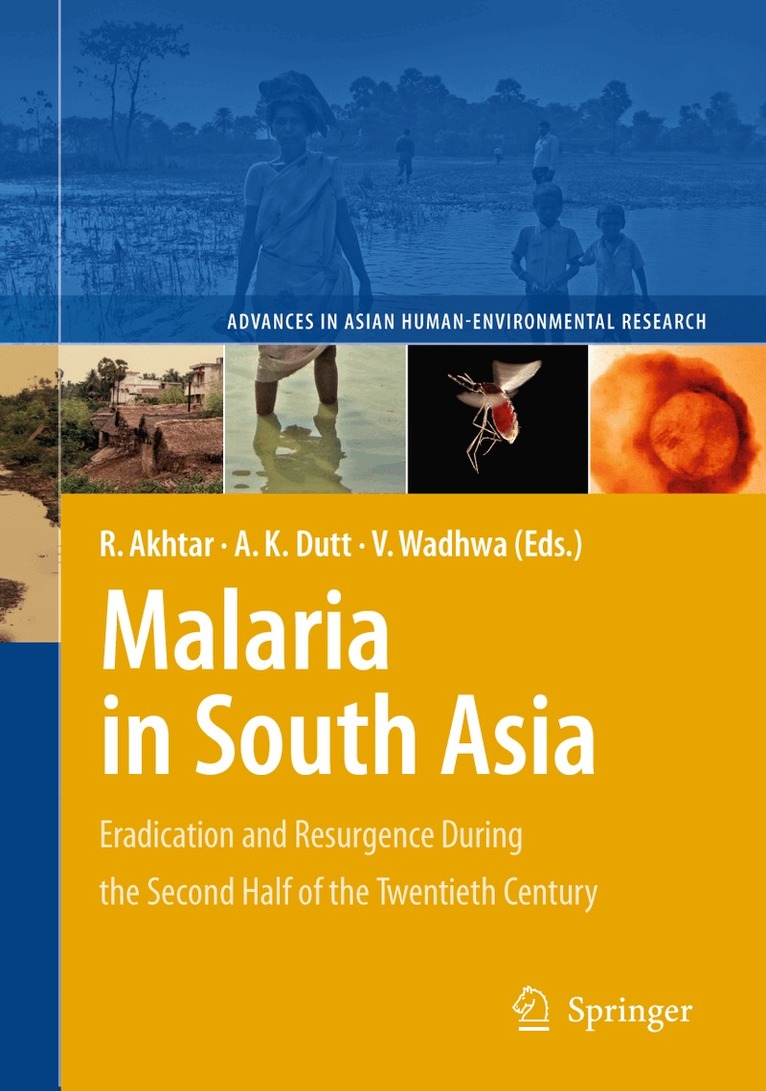
Malaria in South Asia
Eradication and Resurgence During the Second Half of the Twentieth Century
1 123 kr
Skickas inom 10-15 vardagar
1 123 kr
Skickas inom 10-15 vardagar
1 459 kr
Läs direkt efter köp
This book discusses the natural and anthropogenic determinants of the environment and their impact on human health. It throws light on the perspectives of climate change with case studies from Australia, India, Italy, and Latin America. Themes covered are ecology of antibiotic resistant microorganisms, pesticide and heavy metal (arsenic) problems in natural environment; molecular advances in understanding of microbial interactions; ecological studies of human/animal health and diseases; food security, technological developments and more. The various chapters incorporate both theoretical and applied aspects and may serve as baseline information for future research through which significant development is possible.