Rajmund Pietkiewicz – författare
Visar alla böcker från författaren Rajmund Pietkiewicz. Handla med fri frakt och snabb leverans.
5 produkter
5 produkter
Inbunden, Engelska, 2024
1 782 kr
Skickas inom 11-20 vardagar
Inbunden, Engelska, 2025
1 164 kr
Skickas inom 3-6 vardagar
Was the Cistercian abbey in Krzeszów really a European center of art and theological thought? This study in eight chapters tries to answer this question. The first chapter shows how deep the foundations of the Krzeszów Abbey go. The next three chapters are devoted to various works, initiatives and architecture of the Baroque era. First, the unique painting of Our Lady of Mercy in the Mater Misericordiae type, which was created in 1624, was presented. Then, the sculptural foundations of Abbot Geyer in the area of the Krzeszów abbey and in its latifundia were discussed. Finally, the architecture of the baroque abbey church, unique on a European scale, was presented. Grace of the Blessed Virgin Mary. This proves what an extraordinary center Krzeszów was in terms of the art created there.In the next two chapters, the reader finds the answer to the question: Was Krzeszów also a significant theological center in Europe at that time? First in terms of Catholic dogmatic, and then in terms of biblical linguistics.The study ends with two chapters, the first of which focuses on the sacralization of the landscape by introducing modern forms of imitation of the Holy Land and the cult of saints. The second one presents the baroque iconography of the Cistercian monastery in Krzeszów from the end of the 17th century to the beginning of the 20th century, which shows the changes in its social function over the centuries.
E-bok
PDF, Engelska, 20241 372 kr
Läs direkt efter köp
The collective book by Lithuanian researchers presents research conducted in Lithuania on the historical and socio-cultural contexts of the Bible and the ways in which it functioned in Lithuanian writing from its beginning to the 18th century. The ways of religious communication, the dissemination of religious and social ideas in the works of theologians, the functioning of biblical texts and the ways of their transmission are shown. The articles review the problems of translating the Bible into Lithuanian and Slavic languages, consider the influence of other languages and cultures on the formation of the Lithuanian language in its early development, and address issues of editing and publishing religious writings.
E-bok
PDF, Engelska, 20251 050 kr
Läs direkt efter köp
Was the Cistercian abbey in Krzeszów really a European center of art and theological thought? This study in eight chapters tries to answer this question. The first chapter shows how deep the foundations of the Krzeszów Abbey go. The next three chapters are devoted to various works, initiatives and architecture of the Baroque era. First, the unique painting of Our Lady of Mercy in the Mater Misericordiae type, which was created in 1624, was presented. Then, the sculptural foundations of Abbot Geyer in the area of the Krzeszów abbey and in its latifundia were discussed. Finally, the architecture of the baroque abbey church, unique on a European scale, was presented. Grace of the Blessed Virgin Mary. This proves what an extraordinary center Krzeszów was in terms of the art created there.In the next two chapters, the reader finds the answer to the question: Was Krzeszów also a significant theological center in Europe at that time? First in terms of Catholic dogmatic, and then in terms of biblical linguistics.The study ends with two chapters, the first of which focuses on the sacralization of the landscape by introducing modern forms of imitation of the Holy Land and the cult of saints. The second one presents the baroque iconography of the Cistercian monastery in Krzeszów from the end of the 17th century to the beginning of the 20th century, which shows the changes in its social function over the centuries.
E-bok
PDF, Engelska, 20201 180 kr
Läs direkt efter köp
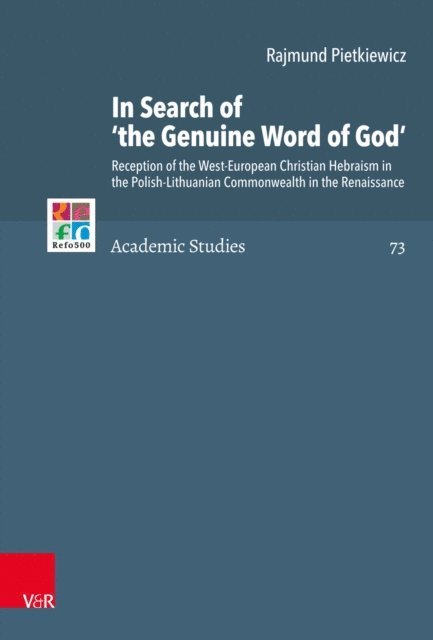
The Polish-Lithuanian Commonwealth familiarized itself with Christian Hebraism in the first half of the 16th century. "In Search of ''the Genuine Word of God''" sketches out the process in three chapters. The first one deals with the development of modern Hebrew studies in Western Europe, the second gives an account of the academic and religious level of Hebrew scholarship in the Commonwealth in the 16th century and at the beginning of the 17th century, and the third is devoted to Polish translations of the Hebrew Bible, which were the most significant consequences of the reception of the West-European Christian Hebraism in the Polish-Lithuanian Commonwealth in Renaissance.Knowledge of Hebrew would be spread in the Polish-Lithuanian Commonwealth through personal contacts of magnates and church dignitaries with the Western European Hebrew experts, through Jewish converts teaching Semitic languages, through foreign studies at European universities and through books. Polish Christian Hebraism was not creative; local humanists and reformers who communicated with adherents of Judaism contributed but little to domestic Hebrew studies. Only scholarly trends occasioned by different Christian confessions come to our notice. Hebrew studies were undertaken within universities or religious movements. The purpose was practical: to have direct access to the original Hebrew Bible for the sake of theological disputes or to have proper translation tools for rendering the Scripture in Polish.