Ralf Portner – författare
1 579 kr
Läs direkt efter köp
2 036 kr
Läs direkt efter köp
Animal Cell Biotechnology: Methods and Protocols, Second Edition constitutes a comprehensive manual of state-of-the-art and new techniques for setting up mammalian cell lines for production of biopharmaceuticals, and for optimizing critical parameters for cell culture considering the whole cascade from lab to final production. The volume is divided into five parts that reflect the processes required for different stages of production. In Part I, basic techniques for establishment of production cell lines are addressed, especially transduction techniques, cells for gene therapy and antibody production. Part II addresses basic cultivation techniques, such as microcarrier culture and encapsulation.
Part III covers cell characterization and analysis, including flow cytometric applications, NMR-based techniques, and biochemical and cytometric techniques. Part IV details cultivation techniques, such as disposable bioreactors, hollow fiber cell culture, fixed bed reactors, and configuration of bioreactors. Part V covers downstream techniques such as membrane filtration techniques, while Part VI describes special applications, including retroviral vectors.
Animal Cell Biotechnology: Methods and Protocols, Second Edition provides a compendium of techniques for scientists in industrial and research laboratories that use mammalian cells for biotechnology purposes.
1 519 kr
Läs direkt efter köp
Animal Cell Biotechnology: Methods and Protocols, Third Edition constitutes a comprehensive manual of state-of-the-art and new techniques for setting up mammalian cell lines for production of biopharmaceuticals, and for optimizing critical parameters for cell culture from lab to final production. The volume is divided into five parts that reflect the processes required for different stages of production. In Part I, basic techniques for establishment of production cell lines are addressed, especially high-throughput synchronization, insect cell lines, transient gene and protein expression, DNA Profiling and Characterisation. Part II addresses tools for process and medium optimization as well as microcarrier technology while Part III covers monitoring of cell growth, viability and apoptosis, metabolic flux estimation, quenching methods as well as NMR-based techniques. Part IV details cultivation techniques, and Part V describes special applications, including vaccine production, baculovirus protein expression, chromatographic techniques for downstream as well as membrane techniques for virus separation. Written in the successful Methods in Molecular Biology series format, chapters include introductions to their respective topics, lists of the necessary materials and reagents, step-by-step, readily reproducible protocols, and notes on troubleshooting and avoiding known pitfalls.
Animal Cell Biotechnology: Methods and Protocols, Third Edition provides a compendium of techniques for scientists in industrial and research laboratories that use mammalian cells for biotechnology purposes.
3 809 kr
Läs direkt efter köp
This is the second of two volumes that together provide an overview of the latest advances in the generation and application of digital twins in bioprocess design and optimization.
Both processes have undergone significant changes over the past few decades, moving from data-driven approaches into the 21st-century digitalization of the bioprocess industry. Moreover, the high demand for biotechnological products calls for efficient methods during research and development, as well as during tech transfer and routine manufacturing.
In this regard, one promising tool is the use of digital twins, which offer a virtual representation of the bioprocess. They reflect the mechanistics of the biological system and the interactions between process parameters, key performance indicators and product quality attributes in the form of a mathematical process model. Furthermore, digital twins allow us to use computer-aided methods to gain an improved process understanding, to test and plan novel bioprocesses, and to efficiently monitor them.
This book focuses on the application of digital twins in various contexts, e.g. computer-aided experimental design, seed train prediction, and lifeline analysis. Covering fundamentals as well as applications, the two volumes offers the ideal introduction to the topic for researchers in academy and industry alike.
3 809 kr
Läs direkt efter köp
Both processes have undergone significant changes over the past few decades, moving from data-driven approaches into the 21st-century digitalization of the bioprocess industry. Moreover, the high demand for biotechnological products calls for efficient methods during research and development, as well as during tech transfer and routine manufacturing.
In this regard, one promising tool is the use of digital twins, which offer a virtual representation of the bioprocess. They reflect the mechanistics of the biological system and the interactions between process parameters, key performance indicators and product quality attributes in the form of a mathematical process model. Furthermore, digital twins allow us to use computer-aided methods to gain an improved process understanding, to test and plan novel bioprocesses, and to efficiently monitor them.
This book explains the mathematical structure of digital twins, their development and the model’s respective parts, as well as concepts for the knowledge-driven generation and structural variability of digital twins.
Covering fundamentals as well as applications, the two volumes offer the ideal introduction to the topic for researchers in academy and industry alike.
1 579 kr
Läs direkt efter köp
This contributed volume is dedicated towards the progress achieved within the last years in all areas of Cell Culture Engineering and Technology. It comprises contributions of active researchers in the field of cell culture development for the production of recombinant proteins, cell line development, cell therapy and gene therapy, with consideration of media development, process scale-up, reactor design, monitoring and control and model-assisted strategies for process design. The knowledge and expertise of the authors cover disciplines like cell biology, engineering, biotechnology and biomedical sciences.
This book is conceived for graduate students, postdoctoral fellows and researchers interested in the latest developments in Cell Engineering.
2 508 kr
Läs direkt efter köp
This volume “Cell Engineerring 11 - Biopharmaceutical Manufacturing: Progress, Trends and Challenges” is a source of the latest innovative research and technical development in biomanufacturing systems. It is organised into 2 parts: 1) Manufacturing of recombinant therapeutic proteins (e.g. therapeutic antibodies, biosimilars/biogenerics) and 2) Manufacturing aspects of cell and gene therapy. Each with selected chapters on the following topics for both up- and downstream, such as: Advanced process strategies, especially continuous manufacturing, Advanced culture techniques, especially single-use systems, Process transfer, scale-up/scale-down models, Processing advances/Manufacturing productivity/efficiency, Model-assisted process understanding and development/Digital Twins, Process controls and analytics, Quality control, Quality by design, Facility design and full-scale commercial systems, manufacturing technology innovation.
The book comprises contributions of experts from academia and industry active in the field of cell culture development for the production of recombinant proteins, cell therapy and gene therapy, with consideration of Digital Twin´s and facility design. The knowledge and expertise of the authors cover disciplines like cell biology, engineering, biotechnology and biomedical sciences. Inevitably, some omissions will occur in the test, but the authors have sought to avoid duplications by extensive cross-referencing to chapters in other volumes of this series and elsewhere. We hope the volume provides a useful compendium of techniques for scientists in industrial and research laboratories active in this field.
1 458 kr
Läs direkt efter köp
Dies ist der erste von zwei Bänden, die zusammen einen Überblick über die neuesten Fortschritte bei der Erzeugung und Anwendung digitaler Zwillinge in der Bioprozessentwicklung und -optimierung geben.
Bioprozesse haben sich in den letzten Jahrzehnten stark entwickelt, von datengetriebenen Ansätzen hin zur Digitalisierung der Bioprozessindustrie im 21. Jahrhundert. Darüber hinaus erfordert die hohe Nachfrage nach biotechnologischen Produkten effiziente Methoden, sowohl in der Forschung und Entwicklung als auch im Technologietransfer und in der Routineproduktion.
Ein vielversprechendes Werkzeug ist in diesem Zusammenhang der Einsatz von digitalen Zwillingen als virtuelle Darstellung des Bioprozesses. Sie spiegeln die Mechanik des biologischen Systems, die Wechselwirkungen zwischen Prozessparametern, Kennzahlen und Produktqualitätsmerkmalen in Form eines mathematischen Prozessmodells wider. Darüber hinaus ermöglichen digitale Zwillinge den Einsatz computergestützter Methoden, um ein besseres Prozessverständnis zu erlangen, neuartige Bioprozesse zu testen und zu planen sowie diese effizient zu überwachen.
Dieses Buch erläutert die mathematische Struktur digitaler Zwillinge, ihre Entwicklung und die einzelnen Teile des Modells sowie Konzepte zur wissensbasierten Erzeugung und strukturellen Variabilität digitaler Zwillinge.
Die beiden Bände decken sowohl Grundlagen als auch Anwendungen ab und bieten damit den idealen Einstieg in das Thema für Forscher und Entwickler in Wissenschaft und Industrie gleichermaßen.
1 458 kr
Läs direkt efter köp
Dies ist der zweite von zwei Bänden, die zusammen einen Überblick über die neuesten Fortschritte bei der Erzeugung und Anwendung digitaler Zwillinge in der Bioprozessentwicklung und -optimierung geben.
Bioprozesse haben sich in den letzten Jahrzehnten stark entwickelt, von datengetriebenen Ansätzen hin zur Digitalisierung der Bioprozessindustrie im 21. Jahrhundert. Darüber hinaus erfordert die hohe Nachfrage nach biotechnologischen Produkten effiziente Methoden, sowohl in der Forschung und Entwicklung als auch im Technologietransfer und in der Routineproduktion.
Ein vielversprechendes Werkzeug ist in diesem Zusammenhang der Einsatz von digitalen Zwillingen als virtuelle Darstellung des Bioprozesses. Sie spiegeln die Mechanik des biologischen Systems, die Wechselwirkungen zwischen Prozessparametern, Kennzahlen und Produktqualitätsmerkmalen in Form eines mathematischen Prozessmodells wider. Darüber hinaus ermöglichen digitale Zwillinge den Einsatz computergestützter Methoden, um ein besseres Prozessverständnis zu erlangen, neuartige Bioprozesse zu testen und zu planen sowie diese effizient zu überwachen.
Dieses Buch konzentriert sich auf die Anwendung digitaler Zwillinge in verschiedenen Kontexten, z.B. computergestützte Versuchsplanung, Seed-Train-Vorhersage und Lifeline-Analyse.
Die beiden Bände behandeln sowohl die Grundlagen als auch die Anwendungen und bieten damit eine ideale Einführung in das Thema für Forscher und Entwickler in Wissenschaft und Industrie.
2 435 kr
Läs direkt efter köp
1 565 kr
Läs direkt efter köp
5 181 kr
Läs direkt efter köp
3 923 kr
Läs direkt efter köp
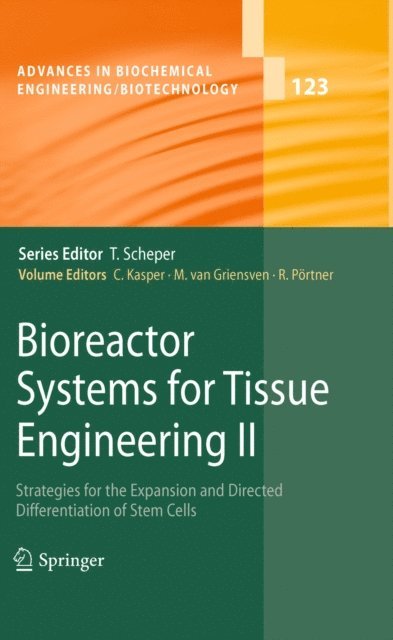
Alternative Sources of Adult Stem Cells: Human Amniotic Membrane, by S. Wolbank, M. van Griensven, R. Grillari-Voglauer, and A. Peterbauer-Scherb; *Mesenchymal Stromal Cells Derived from Human Umbilical Cord Tissues: Primitive Cells with Potential for Clinical and Tissue Engineering Applications, by P. Moretti, T. Hatlapatka, D. Marten, A. Lavrentieva, I. Majore, R. Hass and C. Kasper; *Isolation, Characterization, Differentiation, and Application of Adipose-Derived Stem Cells, by J. W. Kuhbier, B. Weyand, C. Radtke, P. M. Vogt, C. Kasper and K. Reimers; *Induced Pluripotent Stem Cells: Characteristics and Perspectives, by T. Cantz and U. Martin; *Induced Pluripotent Stem Cell Technology in Regenerative Medicine and Biology, by D. Pei, J. Xu, Q. Zhuang, H.-F. Tse and M. A. Esteban; *Production Process for Stem Cell Based Therapeutic Implants: Expansion of the Production Cell Line and Cultivation of Encapsulated Cells, by C. Weber, S. Pohl, R. Poertner, P. Pino-Grace, D. Freimark, C. Wallrapp, P. Geigle and P. Czermak;*Cartilage Engineering from Mesenchymal Stem Cells, by C. Goepfert, A. Slobodianski, A.F. Schilling, P. Adamietz and R. Poertner;*Outgrowth Endothelial Cells: Sources, Characteristics and Potential Applications in Tissue Engineering and Regenerative Medicine, by S. Fuchs, E. Dohle, M. Kolbe, C. J. Kirkpatrick;*Basic Science and Clinical Application of Stem Cells in Veterinary Medicine, by I. Ribitsch, J. Burk, U. Delling, C. Geißler, C. Gittel, H. Jülke, W. Brehm;*Bone Marrow Stem Cells in Clinical Application: Harnessing Paracrine Roles and Niche Mechanisms, by R. M. El Backly, R. Cancedda;*Clinical Application of Stem Cells in the Cardiovascular System, C. Stamm, K. Klose, Y.-H. Choi
3 809 kr
Läs direkt efter köp