Ralph D. Lorenz – författare
761 kr
Skickas inom 10-15 vardagar
712 kr
Läs direkt efter köp
More frisbees are sold each year than baseballs, basketballs and footballs combined. Yet these familiar flying objects have subtle and clever aerodynamic and gyrodynamic properties which are only recently being documented by wind tunnel and other studies. In common with other rotating bodies discussed in this readily accessible book, they are typically not treated in textbooks of aeronautics and the literature is scattered in a variety of places. This book develops the theme of disc-wings and spinning aerospace vehicles in parallel. Since many of the examples are recreational, anyone who enjoys these activities will likely find it profitable and enjoyable. In addition to spinning objects of various shapes, several exotic manned aircraft with disc planforms have been proposed and a prototypes built – these include a Nazi ‘secret weapon’ and the De Havilland Avrocar, also discussed in the book. Boomerangs represent another category of spinning aerodynamic body whose behavior can only be understood by coupling aerodynamics with gyrodynamics. The narrative, supported by equations and graphs, explains how the shape and throw of a boomerang relates to its trajectory. The natural world presents still other examples, namely the samaras or ‘seed-wings’ of many tree species, which autorotate during their descent, like a helicopter whose engine has failed. The flight performance of these spinning wings directly affects the dispersal and thus the evolutionary competitiveness of the trees concerned. Samara-type configurations are also considered for instrumentation and other payload dispersal applications. In short, the book discusses a range of familiar, connected, but largely undeveloped, topics in an accessible, but complete, manner.
From the reviews of the first edition:
"In his fascinating book Spinning Flight, Ralph Lorenz provides a rich feast of … examples of spinning bodies … . The book is well organized … . The discussion in the book … should be accessible to readers with some elementary understanding of aerodynamic principles. For the expert, the book is full of open problems … . Its scope is extensive … . In this respect, there may be something for everyone within its attractively designed cover … ." (H. K. Moffatt, Nature, Vol. 444, December, 2006)
"If you liked physics at school, then this book is for you. It concerns itself with flying objects that spin through the air, and even tells you how to impress your friends with the biomechanics of Frisbees. … there is plenty of information at all levels, and the book has a wealth of detail that only an aerospace engineer like Lorenz could have come up with." (Len Fisher, BBC Focus, February, 2007)
721 kr
Skickas inom 7-10 vardagar
871 kr
Läs direkt efter köp
871 kr
Läs direkt efter köp
546 kr
Skickas inom 10-15 vardagar
1 623 kr
Skickas inom 10-15 vardagar
1 084 kr
Skickas inom 10-15 vardagar
1 416 kr
Läs direkt efter köp
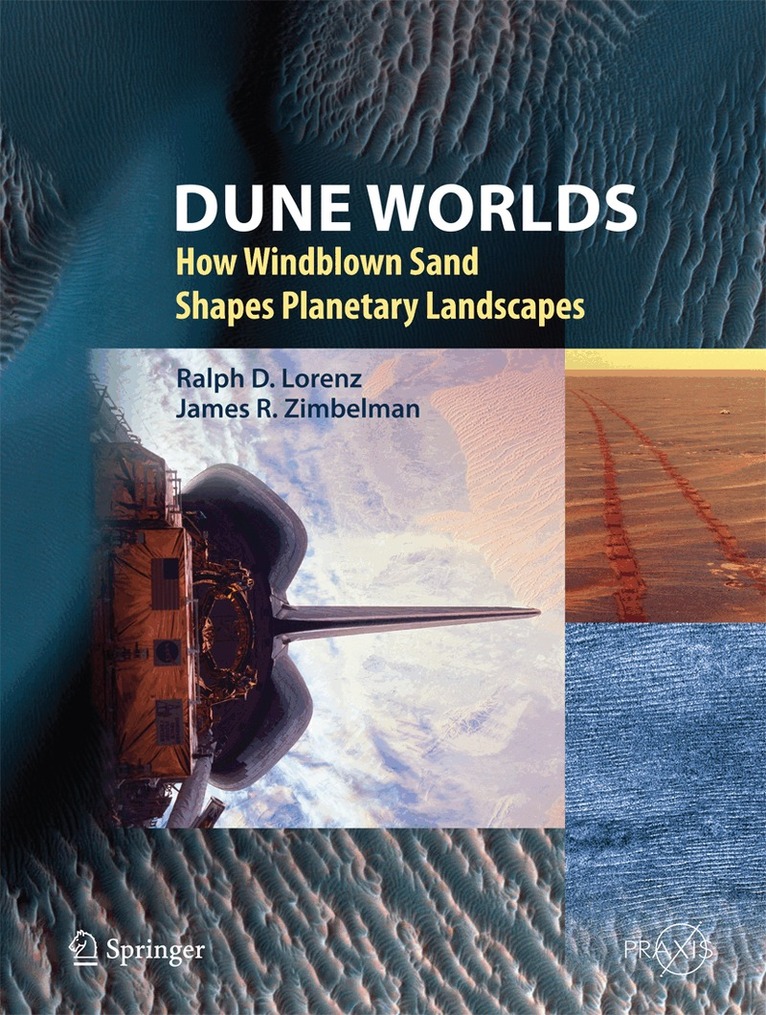
This book describes how sand dunes work, why they are the way they are in different settings, and how they are being studied. Particular attention is paid to their formation and appearance elsewhere in the solar system. New developments in knowledge about dunes make for an interesting story – like the dunes themselves, dune science is dynamic – and the visual appeal of Aeolian geomorphology ensures that this is an attractive volume.
The book is divided into 4 parts, the first of which introduces dunes as a planetary phenomenon, showing a landscape reflecting the balance of geological processes – volcanism, impact, tectonics, erosion, deposition of sediments. Dunes are then considered as emergent dynamical systems: the interaction of sand and wind conspires to generate very characteristic and reproducible shapes. Analogies are given with other emergent structures such as patterned ground before the influence of dunes on desert peoples and infrastructure is studied, together with their use as forensic climatological indicators.
Dune Physics is looked at with regard to the mechanics of sand, the physics of wind, saltation – interaction of sand and air – dunes versus ripples and transverse Aeolian ridges, the classification of dune morphology and the sources and sinks of sand. Dune Trafficability considers soil mechanics, effects on mobility on Earth, Mars and elsewhere.
In the second part, Earth, Mars, Titan and other moons and planets are examined, beginning with a survey of the major deserts and dunefields on Earth. The authors then turn to Mars and its environment, sediment type, dune stratigraphy, sediment source and sinks and the association of dunes with topographic features. Titan follows - its thick, cold atmosphere, methane dampness, low gravity, morphology – interaction with topography and the implications of dunes for climate and winds. Dunes elsewhere conclude this part. There are few dunefields on Venus, but there is a .possibility ofAeolian transport on Triton and volcanic-related windstreaks on Io.
1 623 kr
Skickas inom 10-15 vardagar
1 084 kr
Skickas inom 10-15 vardagar