Randolph Vigne – författare
Visar alla böcker från författaren Randolph Vigne. Handla med fri frakt och snabb leverans.
5 produkter
5 produkter
Inbunden, Engelska, 2013
1 764 kr
Skickas inom 5-8 vardagar
Scholars from France and from countries of the Huguenot Refuge examine the situation of French Protestants before and after the Revocation of the Edict of Nantes, in France and in the countries to which many of them fled during the great exodus which followed the Edict of Fontainebleau. Covering a period from the end of the sixteenth to the beginning of the nineteenth century, the volume examines aspects of life in France, from the debate on church unity to funeral customs, but its primary focus is on departure from France and its consequences -- both before and after the Revocation. It offers insights into individuals and groups, from grandees such as Henri de Ruvigny, depute general and later Earl of Galway, to converted Catholic priests and from businessmen and communities choosing their destination for economic as well as religious reasons, to women and children moving across European frontiers or groups seeking refuge in the islands of the Indian Ocean. The information-gathering activities of the French authorities and the reception of problematic groups such as the Camisard prophets among exile communities are examined, as well as the significant contributions which Huguenots began to make, in a variety of domains, to the countries in which they had settled. The refugees were extremely interested in the history of their diaspora and of the individuals of which it was composed, and this theme too is explored. Finally, the Napoleonic period brought some of the refugees up against France in a more immediate way, raising further questions of identity and aspiration for the Huguenot community in Germany.
Häftad, Engelska, 2014
556 kr
Skickas inom 5-8 vardagar
Scholars from France and from countries of the Huguenot Refuge examine the situation of French Protestants before and after the Revocation of the Edict of Nantes, in France and in the countries to which many of them fled during the great exodus which followed the Edict of Fontainebleau. Covering a period from the end of the sixteenth to the beginning of the nineteenth century, the volume examines aspects of life in France, from the debate on church unity to funeral customs, but its primary focus is on departure from France and its consequences -- both before and after the Revocation. It offers insights into individuals and groups, from grandees such as Henri de Ruvigny, depute general and later Earl of Galway, to converted Catholic priests and from businessmen and communities choosing their destination for economic as well as religious reasons, to women and children moving across European frontiers or groups seeking refuge in the islands of the Indian Ocean. The information-gathering activities of the French authorities and the reception of problematic groups such as the Camisard prophets among exile communities are examined, as well as the significant contributions which Huguenots began to make, in a variety of domains, to the countries in which they had settled. The refugees were extremely interested in the history of their diaspora and of the individuals of which it was composed, and this theme too is explored. Finally, the Napoleonic period brought some of the refugees up against France in a more immediate way, raising further questions of identity and aspiration for the Huguenot community in Germany.
Inbunden, Engelska, 2001
1 816 kr
Skickas inom 5-8 vardagar
Between 1550 and 1750 tens of thousands of immigrants, many of them religious refugees escaping persecution on the Continent, settled in Britain and its colonies, and in Ireland. They brought with them their formidable energies and talents and quickly assimilated themselves into the host society. The essays range from general considerations of trends towards integration in the immigrant communities to detailed case-studies of the movement into British society of individual immigrants; from studies of popular attitudes and government policy towards the newcomers to examinations of relations within the immigrant communities themselves and their structures for self-sufficiency. The immigrants' contributions to art, scholarship, manufacturing, theology and politics are also explored.
Inbunden, Engelska, 2009
538 kr
Tillfälligt slut
The French Hospital for poor French Protestants and their descendants residing in Great Britain was incorporated in 1718. Affectionately known as La Providence, it was one of the earliest foundations to cater for London's needy immigrants, and one of the first in Britain to provide sympathetic care for the mentally ill. This book charts the hospital's history from its early days in Finsbury to its present location in the cathedral city of Rochester, Kent, where it provides sheltered housing for elderly people of Huguenot descent. Over the years many distinguished Huguenot settlers or their descendants have been associated with the hospital, among them the soldiers Henri, Earl of Galway, and John, Earl Ligonier, the lawyer Sir Samuel Romilly and the archaeologist Sir Austen Henry Layard. The ivory carver David Le Marchand died there in 1726. The architect Robert Lewis Roumieu designed the spectacular new building in Victoria Park, Hackney, which was the French Hospital's home from the late 1860s to the early 1940s. More than a hundred new photographs of the hospital's collections of paintings, engravings, silver, furniture and memorabilia provide a unique visual record.Portraits featured include the eighteenth-century Huguenot merchants Jean-Henri Guinand and Pierre Ogier. The early hospital records held at the Huguenot Library include tradesmen's bills, portraits of inmates and hospital staff. An eighteenth-century steward's diary records that one inmate hid over half a hundredweight of the hospital's coal supply under her bed. Heraldic shields and book-plates record some of the principal Huguenot families who have served as directors, and a transcription of the 1742 inventory compiled in French lends historical colour. This richly illustrated account will appeal to a wide audience including social and art historians and all who are interested in Huguenot heritage.

Inbunden, Engelska, 2012
602 kr
Tillfälligt slut
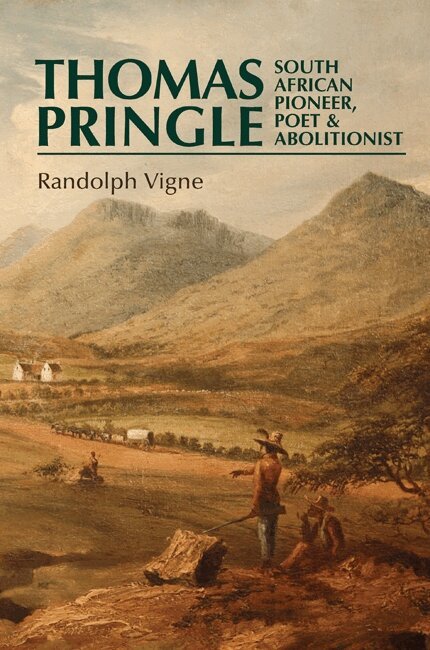
A fine biography. [It] is a most satisfying book and an important contribution to South African scholarship. CAPE TIMESScottish poet, fighter for human rights in the Cape Colony, and abolitionist, reveals the role this key Enlightenment figure played in Africa and Britain.This biography of Thomas Pringle (1789-1834), poet, fighter for human rights in the Cape Colony, and abolitionist, reveals the role this key Enlightenment figure played in Africa and Britain. Honoured in South Africa as 'the father of South African English poetry', for his part in achieving a free press, for his fight for the settlers' rights in the colony, in Scotland as the founding editor of Blackwood's Magazine, and in England as instrumental inbringing in abolition, Thomas Pringle has not yet had the attention he deserves.Born on the Scottish Borders, Pringle entered literary life in late Englightenment Edinburgh, but in 1820 led a party of settlers to theCape Colony. After running a school, launching a literary journal and co-editing the Cape's first independent newspaper, he formed a group to fight for democratic rights for both the settlers and the dispossessed indigenous people. His biography reveals the important part he played in the literary and political world across two continents, and in championing the Khoisan and the increasingly dispossessed Nguni people. On returning to England he became Secretary of the Anti-Slavery Society, and on 15 June 1834 announced the implementation of abolition.After actively opposing the apartheid government in South Africa Randolph Vigne worked in exile as a London publisher andlatterly, in Britain and South Africa, as author and editor of European and African historical studies.Southern Africa (South Africa, Botswana, Namibia, Lesotho, Swaziland, Zambia and Zimbabwe): UCT Press