Ranulfo Romo – författare
Visar alla böcker från författaren Ranulfo Romo. Handla med fri frakt och snabb leverans.
6 produkter
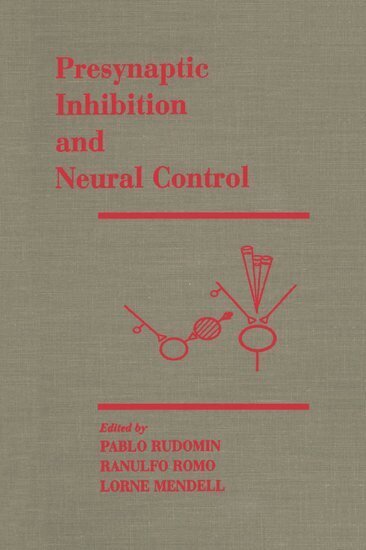
Presynaptic Inhibition and Neural Control
Av Pablo Rudomin, Ranulfo Romo m. fl.
Inbunden, 1998
1383 kr
Lägg i varukorg
This is a timely review of the mechanisms underlying presynaptic control of synaptic transmission and the role they play in sensory and motor behavior. It will be of particular interest to neuroscientists studying synaptic transmission or sensorimotor control.
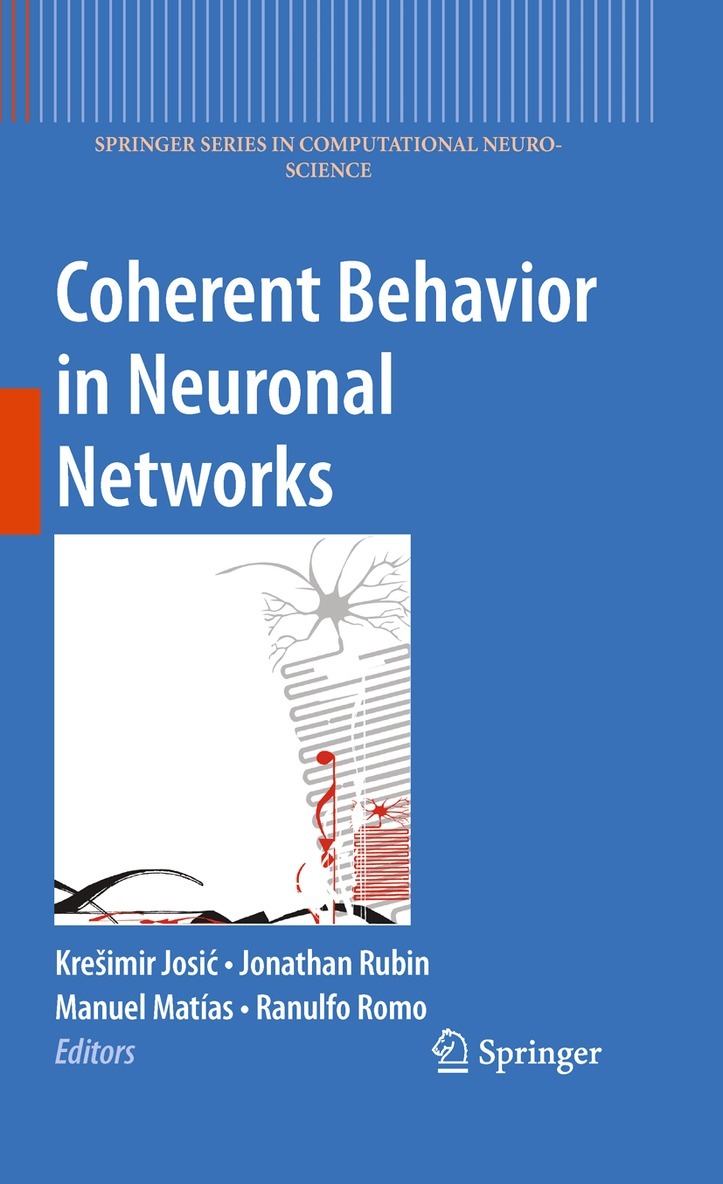
Coherent Behavior in Neuronal Networks
Av Krešimir Josic, Jonathan Rubin m. fl.
Inbunden, 2009
2245 kr
Lägg i varukorg
Recent experimental research advances have led to increasingly detailed descriptions of how networks of interacting neurons process information. With these developments, it has become clear that dynamic network behaviors underlie information processing, and that the observed activity patterns …
Coherent Behavior in Neuronal Networks
Av Ranulfo Romo, Manuel Matias m. fl.
E-bok, 2009
3013 kr
Lägg i varukorg
Recent experimental research advances have led to increasingly detailed descriptions of how networks of interacting neurons process information. With these developments, it has become clear that dynamic network behaviors underlie information processing, and that the observed activity patterns …
Coherent Behavior in Neuronal Networks
Av Krešimir Josic, Jonathan Rubin m. fl.
Häftad, 2012
2245 kr
Lägg i varukorg
Recent experimental research advances have led to increasingly detailed descriptions of how networks of interacting neurons process information. With these developments, it has become clear that dynamic network behaviors underlie information processing, and that the observed activity patterns …
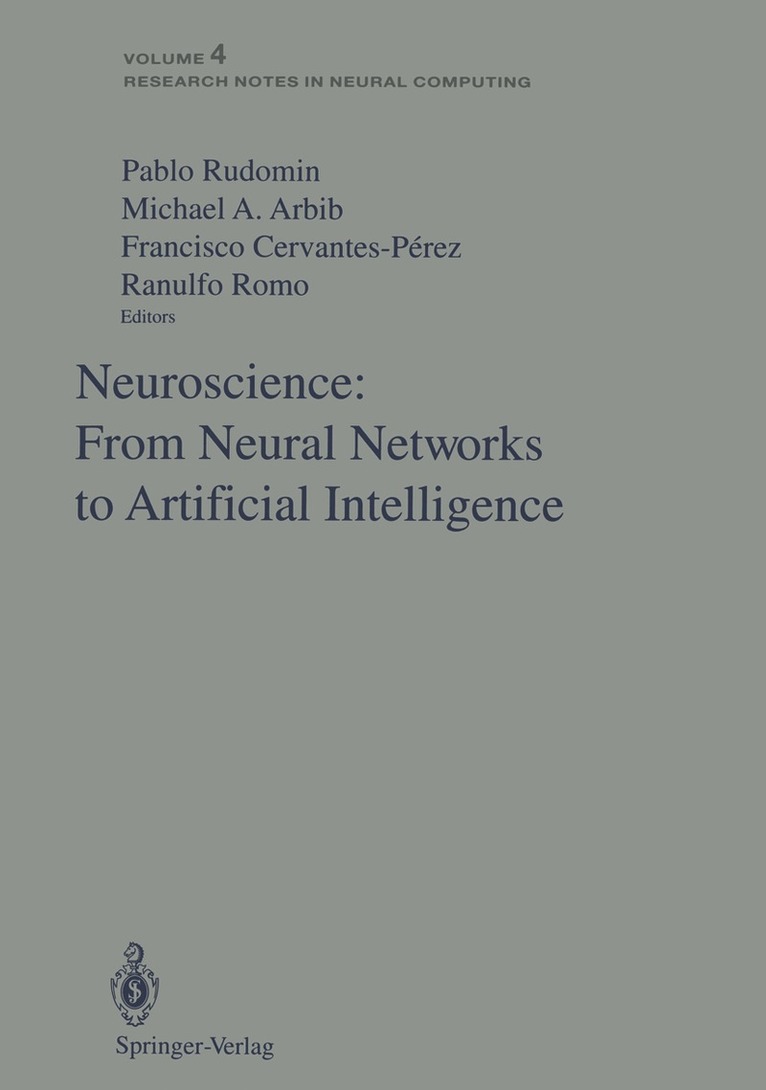
Neuroscience: From Neural Networks to Artificial Intelligence
Proceedings of a U.S.-Mexico Seminar held in the city of Xalapa in the state of Veracruz on December 9–11, 1991
Av Pablo Rudomin, Michael A. Arbib m. fl.
Häftad, 1993
1129 kr
Lägg i varukorg
The Central Nervous System can be considered as an aggregate of neurons specialized in both the transmission and transformation of information. Information can be used for many purposes, but probably the most important one is to generate a representation of the "external" world that allows the …
Neuroscience: From Neural Networks to Artificial Intelligence
Proceedings of a U.S.-Mexico Seminar held in the city of Xalapa in the state of Veracruz on December 9–11, 1991
Av Ranulfo Romo, Francisco Cervantes-Perez m. fl.
E-bok, 2012
1502 kr
Lägg i varukorg
The Central Nervous System can be considered as an aggregate of neurons specialized in both the transmission and transformation of information. Information can be used for many purposes, but probably the most important one is to generate a representation of the "external" world that allows the …