Raymond Geuss – författare
156 kr
Skickas inom 5-8 vardagar
305 kr
Skickas inom 5-8 vardagar
303 kr
Skickas inom 7-10 vardagar
213 kr
Skickas inom 7-10 vardagar
736 kr
Skickas inom 7-10 vardagar
933 kr
Skickas
417 kr
Skickas inom 7-10 vardagar
288 kr
Skickas inom 7-10 vardagar
1 540 kr
Skickas inom 7-10 vardagar
1 292 kr
Skickas inom 7-10 vardagar
364 kr
Skickas inom 10-15 vardagar
219 kr
Skickas inom 10-15 vardagar
280 kr
Skickas inom 5-8 vardagar
209 kr
Skickas inom 5-8 vardagar
408 kr
Skickas inom 10-15 vardagar
346 kr
Skickas inom 5-8 vardagar
487 kr
Skickas inom 5-8 vardagar
379 kr
Skickas inom 5-8 vardagar
346 kr
Skickas inom 5-8 vardagar
462 kr
Skickas inom 5-8 vardagar
272 kr
Skickas inom 5-8 vardagar
545 kr
Skickas inom 7-10 vardagar
200 kr
Skickas inom 7-10 vardagar
238 kr
Läs direkt efter köp
238 kr
Läs direkt efter köp
468 kr
Läs direkt efter köp
Much political thinking today, particularly that influenced by liberalism, assumes a clear distinction between the public and the private, and holds that the correct understanding of this should weigh heavily in our attitude to human goods. It is, for instance, widely held that the state may address human action in the ''''public'''' realm but not in the ''''private.'''' In Public Goods, Private Goods Raymond Geuss exposes the profound flaws of such thinking and calls for a more nuanced approach. Drawing on a series of colorful examples from the ancient world, he illustrates some of the many ways in which actions can in fact be understood as public or private. The first chapter discusses Diogenes the Cynic, who flouted conventions about what should be public and what should be private by, among other things, masturbating in the Athenian marketplace. Next comes an analysis of Julius Caesar''s decision to defy the Senate by crossing the Rubicon with his army; in doing so, Caesar asserted his dignity as a private person while acting in a public capacity. The third chapter considers St. Augustine''s retreat from public life to contemplate his own, private spiritual condition. In the fourth, Geuss goes on to examine recent liberal views, questioning, in particular, common assumptions about the importance of public dialogue and the purportedly unlimited possibilities humans have for reaching consensus. He suggests that the liberal concern to maintain and protect, even at a very high cost, an inviolable ''''private sphere'''' for each individual is confused. Geuss concludes that a view of politics and morality derived from Hobbes and Nietzsche is a more realistic and enlightening way than modern liberalism to think about human goods. Ultimately, he cautions, a simplistic understanding of privacy leads to simplistic ideas about what the state is and is not justified in doing.
665 kr
Läs direkt efter köp
Outside Ethics brings together some of the most important and provocative works by one of the most creative philosophers writing today. Seeking to expand the scope of contemporary moral and political philosophy, Raymond Geuss here presents essays bound by a shared skepticism about a particular way of thinking about what is important in human life--a way of thinking that, in his view, is characteristic of contemporary Western societies and isolates three broad categories of things as important: subjective individual preferences, knowledge, and restrictions on actions that affect other people (restrictions often construed as ahistorical laws). He sets these categories in a wider context and explores various human phenomena--including poetry, art, religion, and certain kinds of history and social criticism--that do not fit easily into these categories. As its title suggests, this book seeks a place outside conventional ethics. Following a brief introduction, Geuss sets out his main concerns with a focus on ethics and politics. He then expands these themes by discussing freedom, virtue, the good life, and happiness. Next he examines Theodor Adorno''s views on the relation between suffering and knowledge, the nature of religion, and the role of history in giving us critical distances from existing identities. From here he moves to aesthetic concerns. The volume closes by looking at what it is for a human life to have "gaps"--to be incomplete, radically unsatisfactory, or a failure.
468 kr
Läs direkt efter köp
In politics, utopians do not have a monopoly on imagination. Even the most conservative defenses of the status quo, Raymond Geuss argues, require imaginative acts of some kind. In this collection of recent essays, including his most overtly political writing yet, Geuss explores the role of imagination in politics, particularly how imaginative constructs interact with political reality. He uses decisions about the war in Iraq to explore the peculiar ways in which politicians can be deluded and citizens can misunderstand their leaders. He also examines critically what he sees as one of the most serious delusions of western political thinking--the idea that a human society is always best conceived as a closed system obeying fixed rules. And, in essays on Don Quixote, museums, Celan''s poetry, Heidegger''s brother Fritz, Richard Rorty, and bourgeois philosophy, Geuss reflects on how cultural artifacts can lead us to embrace or reject conventional assumptions about the world. While paying particular attention to the relative political roles played by rule-following, utilitarian calculations of interest, and aspirations to lead a collective life of a certain kind, Geuss discusses a wide range of related issues, including the distance critics need from their political systems, the extent to which history can enlighten politics, and the possibility of utopian thinking in a world in which action retains its urgency.
527 kr
Läs direkt efter köp
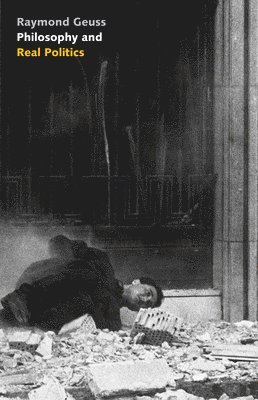
Many contemporary political thinkers are gripped by the belief that their task is to develop an ideal theory of rights or justice for guiding and judging political actions. But in Philosophy and Real Politics, Raymond Geuss argues that philosophers should first try to understand why real political actors behave as they actually do. Far from being applied ethics, politics is a skill that allows people to survive and pursue their goals. To understand politics is to understand the powers, motives, and concepts that people have and that shape how they deal with the problems they face in their particular historical situations. Philosophy and Real Politics both outlines a historically oriented, realistic political philosophy and criticizes liberal political philosophies based on abstract conceptions of rights and justice. The book is a trenchant critique of established ways of thought and a provocative call for change.
623 kr
Läs direkt efter köp
Why the human and natural world is not as intelligible to us as we think it isWishful thinking is a deeply ingrained human trait that has had a long-term distorting effect on ethical thinking. Many influential ethical views depend on the optimistic assumption that, despite appearances to the contrary, the human and natural world in which we live could, eventually, be made to make sense to us. In A World without Why, Raymond Geuss challenges this assumption.The essays in this collection—several of which are published here for the first time—explore the genesis and historical development of this optimistic configuration in ethical thought and the ways in which it has shown itself to be unfounded and misguided. Discussions of Greco-Roman antiquity and of the philosophies of Socrates, Plato, Hegel, Marx, Nietzsche, and Adorno play a central role in many of these essays. Geuss also ranges over such topics as the concepts of intelligibility, authority, democracy, and criticism; the role of lying in politics; architecture; the place of theology in ethics; tragedy and comedy; and the struggle between realism and our search for meaning.Characterized by Geuss''s wide-ranging interests in literature, philosophy, and history, and by his political commitment and trenchant style, A World without Why raises fundamental questions about the viability not just of specific ethical concepts and theses, but of our most basic assumptions about what ethics could and must be.