Raymond Hinnebusch – författare
Visar alla böcker från författaren Raymond Hinnebusch. Handla med fri frakt och snabb leverans.
18 produkter
18 produkter
Häftad, Engelska, 2019
588 kr
Skickas inom 10-15 vardagar
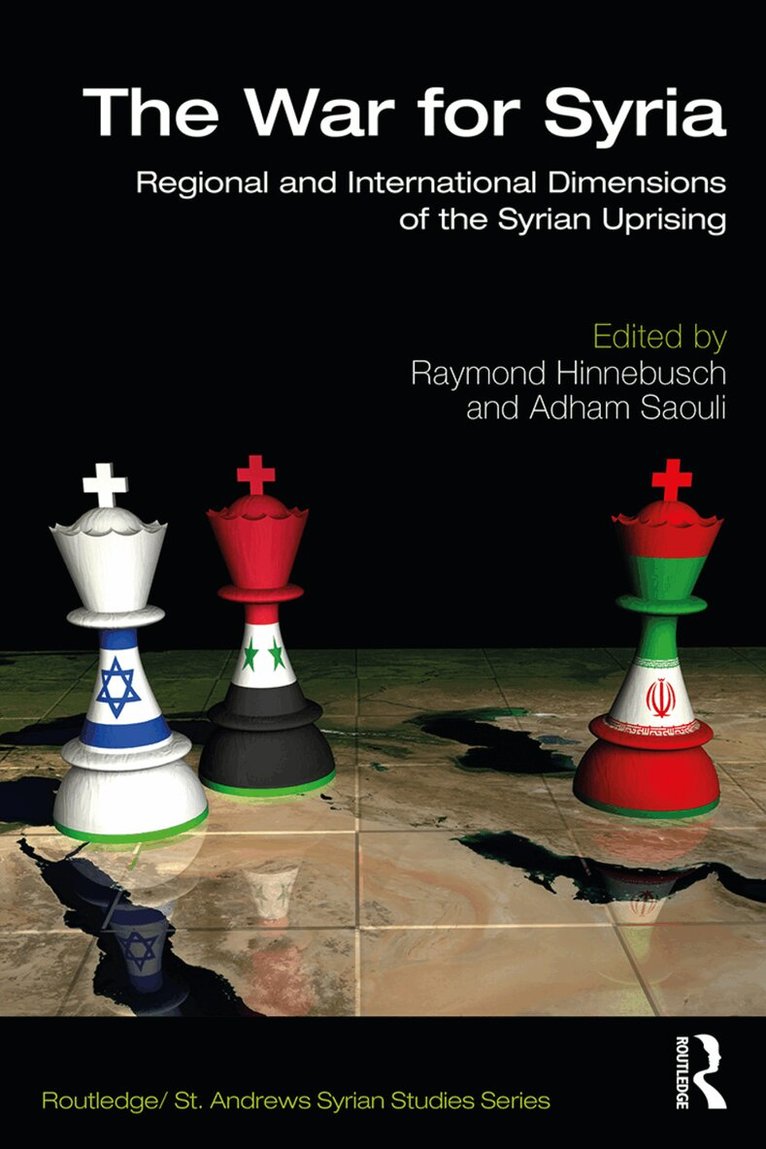
Examining the international dimensions of the Syrian conflict, this book studies external factors relating to the Uprising. It explores the involvement of outside powers and the events’ impact both on regional and international level.Syria was widely perceived to be essential to the regional power balance, hence it was a valued prize to be fought over. The book examines the impact of global and regional powers in propelling the conflict in Syria; looks at the motives and strategies of the key regional and international actors (Hizbollah, Palestinians, Iran, Qatar, Saudi Arabia, US, Russia, EU); and analyses the impact of the Syrian conflict on key relations between regional states (Turkey-Syria, Turkey-Iran, Iraq-Syria). Finally, several chapters treat the impact on Syria of international sanctions and the "Responsibility to Protect" doctrine. This book follows on to The Syrian Uprising: Domestic Origins and Early Trajectory, edited by Raymond Hinnebusch and Omar Imady (2018). Subsequent volumes will examine the later evolution of the conflict.Taking an innovative and interdisciplinary approach that seeks to capture the full complexity of the phenomenon, this book contributes significantly to our understanding of the Syrian conflict and will therefore be a valuable resource for anyone studying Middle Eastern Politics.
Inbunden, Engelska, 2019
2 151 kr
Skickas inom 10-15 vardagar
Examining the international dimensions of the Syrian conflict, this book studies external factors relating to the Uprising. It explores the involvement of outside powers and the events’ impact both on regional and international level.Syria was widely perceived to be essential to the regional power balance, hence it was a valued prize to be fought over. The book examines the impact of global and regional powers in propelling the conflict in Syria; looks at the motives and strategies of the key regional and international actors (Hizbollah, Palestinians, Iran, Qatar, Saudi Arabia, US, Russia, EU); and analyses the impact of the Syrian conflict on key relations between regional states (Turkey-Syria, Turkey-Iran, Iraq-Syria). Finally, several chapters treat the impact on Syria of international sanctions and the "Responsibility to Protect" doctrine. This book follows on to The Syrian Uprising: Domestic Origins and Early Trajectory, edited by Raymond Hinnebusch and Omar Imady (2018). Subsequent volumes will examine the later evolution of the conflict.Taking an innovative and interdisciplinary approach that seeks to capture the full complexity of the phenomenon, this book contributes significantly to our understanding of the Syrian conflict and will therefore be a valuable resource for anyone studying Middle Eastern Politics.
Inbunden, Engelska, 2019
2 714 kr
Skickas inom 10-15 vardagar
Conflict and instability are built into the very fabric of the Middle East and North African (MENA) state and states system; yet both states and states system have displayed remarkable resilience. How can we explain this? This handbook explores the main debates, theoretical approaches and accumulated empirical research by prominent scholars in the field, providing an essential context for scholars pursuing research on the MENA state and states system. Contributions are grouped into four key themes:• Historical contexts, state-building and politics in MENA • State actors, societal context and popular activism • Trans-state politics: the political economy and identity contexts • The international politics of MENA The 26 chapters examine the evolution of the state and states system, before and after independence, and take the 2011 Arab uprisings as a pivotal moment that intensified trends already embedded in the system, exposing the deep features of state and system—specifically their built-in vulnerability and their ability to survive. This handbook provides comprehensive coverage of the history and role of the state in the MENA region. It offers a key resource for all researchers and students interested in international relations and the Middle East and North Africa.
Inbunden, Engelska, 2001
2 429 kr
Skickas inom 10-15 vardagar
This study examines the development of the Syrian state as it has emerged under thirty-five years of military-Ba'thist rule and, particularly, under President Hafiz al-Asad. It analyzes the way in which the fragility of the post-independence state, unable to contain rising nationalist struggle and class conflict, opened the way to the Ba'th party's rise to power and examines how the Ba'th's 'revolution from above' transformed Syria's socio-political terrain.
Häftad, Engelska, 2002
762 kr
Skickas inom 10-15 vardagar
This study examines the development of the Syrian state as it has emerged under thirty-five years of military-Ba'thist rule and, particularly, under President Hafiz al-Asad. It analyzes the way in which the fragility of the post-independence state, unable to contain rising nationalist struggle and class conflict, opened the way to the Ba'th party's rise to power and examines how the Ba'th's 'revolution from above' transformed Syria's socio-political terrain.
Häftad, Engelska, 2015
349 kr
Skickas inom 5-8 vardagar
One of the major internationally recognised works on the international politics of the Middle East, this book systematically combines International Relations theory and Middle East case studies to provide a macro overview of the international relations of the region. The book has been widely used at both undergraduate levels, Masters degree and PhD levels. In providing a unique interpretation of Middle East North African (MENA) international politics, it will also be valuable for scholars of the region. The book provide readers with both theoretical and concrete information, with theoretically-framed major topics, liberally illustrated with case study material on key dimensions of regional politics. Topics include the place of the Middle East in the wider global system; the role of Arabism and Islam in regional politics; the impact of state formation in the region on its international relations; comparative foreign policy making looking at pivotal country cases, including Egypt, Syria, Saudi Arabia and Turkey; major regional wars and efforts at order building; the role of US hegemony and the two Iraq wars; and the impact of the Arab Uprising on regional politics.
Inbunden, Engelska, 2015
1 150 kr
Skickas inom 5-8 vardagar
One of the major internationally recognised works on the international politics of the Middle East, this book systematically combines international relations theory and Middle East case studies to provide a macro overview of the international relations of the region. The book has been widely used at both undergraduate levels, Masters degree and PhD levels. In providing a unique interpretation of Middle East North Africa (MENA) international politics, it will also be valuable for scholars of the region. The book provide readers with both theoretical and concrete information, with theoretically-framed major topics, liberally illustrated with case study material on key dimensions of regional politics. Topics include the place of the Middle East in the wider global system; the role of Arabism and Islam in regional politics; the impact of state formation in the region on its international relations; comparative foreign policy making looking at pivotal country cases, including Egypt, Syria, Saudi Arabia and Turkey; major regional wars and efforts at order building; the role of US hegemony and the two Iraq wars; and the impact of the Arab Uprising on regional politics.
Häftad, Engelska, 2012
633 kr
Skickas inom 3-6 vardagar
How does empire affect the route to successor sovereign state systems and the features of the sovereignty of these systems? This unique systematic comparison of empires and of their consequences for sovereignty in the Middle East and Central Asia brings theory on empire and sovereignty to bear on empirical variation across the two regions. The novel approach to understanding the political structures of states in two significant areas of the non-European world offers an important comparative discussion of post-imperial development and sovereignty. It raises a clear set of research questions about variations of imperial practice and puts forward an attractive and persuasive case that imperial legacy has been an important variable in the post-independence period.
Inbunden, Engelska, 2022
2 137 kr
Skickas inom 10-15 vardagar
This volume covers the "middle" time period of the Syrian uprising, roughly from 2012 when Syria’s peaceful protest began to mutate into a violent insurgency and civil war until roughly 2018 when the conflict took on features of a "frozen conflict". The middle period was important as one of key junctures or turning points when the struggle could have reached rather different outcomes. Non-violent protest failed to drive democratization and turned into violent insurrection but revolution from below also failed as did regime counter-insurgency, leaving protracted civil war the default outcome. Second, the consequences of civil war became evident with six themes: failing statehood coexisted with regime resilience; rebel governance emerged as a viable challenge to the regime; social forces were sharply polarized; external actors exacerbated internal divisions; a predatory war economy emerged; and intense violence led to massive displacement of the population. Taking an innovative and interdisciplinary approach that seeks to capture the full complexity of the phenomenon, this book contributes significantly to our understanding of the Syrian conflict, therefore it will be of interest to academics, students, journalists and policy-makers interested in the Syrian civil war.
Häftad, Engelska, 2022
570 kr
Skickas inom 10-15 vardagar
This volume covers the "middle" time period of the Syrian uprising, roughly from 2012 when Syria’s peaceful protest began to mutate into a violent insurgency and civil war until roughly 2018 when the conflict took on features of a "frozen conflict". The middle period was important as one of key junctures or turning points when the struggle could have reached rather different outcomes. Non-violent protest failed to drive democratization and turned into violent insurrection but revolution from below also failed as did regime counter-insurgency, leaving protracted civil war the default outcome. Second, the consequences of civil war became evident with six themes: failing statehood coexisted with regime resilience; rebel governance emerged as a viable challenge to the regime; social forces were sharply polarized; external actors exacerbated internal divisions; a predatory war economy emerged; and intense violence led to massive displacement of the population. Taking an innovative and interdisciplinary approach that seeks to capture the full complexity of the phenomenon, this book contributes significantly to our understanding of the Syrian conflict, therefore it will be of interest to academics, students, journalists and policy-makers interested in the Syrian civil war.
Häftad, Engelska, 2021
705 kr
Skickas inom 10-15 vardagar
Conflict and instability are built into the very fabric of the Middle East and North African (MENA) state and states system; yet both states and states system have displayed remarkable resilience. How can we explain this? This handbook explores the main debates, theoretical approaches and accumulated empirical research by prominent scholars in the field, providing an essential context for scholars pursuing research on the MENA state and states system. Contributions are grouped into four key themes:• Historical contexts, state-building and politics in MENA • State actors, societal context and popular activism • Trans-state politics: the political economy and identity contexts • The international politics of MENA The 26 chapters examine the evolution of the state and states system, before and after independence, and take the 2011 Arab uprisings as a pivotal moment that intensified trends already embedded in the system, exposing the deep features of state and system—specifically their built-in vulnerability and their ability to survive. This handbook provides comprehensive coverage of the history and role of the state in the MENA region. It offers a key resource for all researchers and students interested in international relations and the Middle East and North Africa.
Inbunden, Engelska, 2025
2 215 kr
Skickas inom 10-15 vardagar
As an epicentre of sectarian conflict before and after the Arab uprising, Syria provides an excellent laboratory for the study of sectarianization. This book compares variance in Syria’s sectarianism over time and across place to expose its causes and its varying impact on Syria’s society and polity.The book begins with an introductory chapter examining key approaches to and debates over sectarianism in Syria, from which a framework of analysis is derived. Subsequent empirical chapters are divided into two sections. Several chapters examine key aspects of sectarianism at the national level, looking at the interaction of sectarianism and state formation over the long term; the internal evolution of sectarianization during the uprising; the impact of the regional power struggle on Syria’s sectarianization; and whether sectarianism was institutionalized by civil war governance in both regime- and opposition-controlled areas. A second set of chapters looks at sectarianism in Syria’s different cities, regions and communities, notably in Damascus, Homs, Hama, Aleppo, Idlib, the Alawi coast, and the Druze and Christian communities. The concluding chapter makes use of the analytical framework to systematically compare the evidence from the empirical cases in order to identify regularities.Providing nuanced insights into the Syrian case whilst informing broader theoretical discussions of sectarianism, this book will appeal to students, researchers and general readers interested in Middle Eastern politics and political science generally.
Häftad, Engelska, 2025
605 kr
Skickas inom 10-15 vardagar
As an epicentre of sectarian conflict before and after the Arab uprising, Syria provides an excellent laboratory for the study of sectarianization. This book compares variance in Syria’s sectarianism over time and across place to expose its causes and its varying impact on Syria’s society and polity.The book begins with an introductory chapter examining key approaches to and debates over sectarianism in Syria, from which a framework of analysis is derived. Subsequent empirical chapters are divided into two sections. Several chapters examine key aspects of sectarianism at the national level, looking at the interaction of sectarianism and state formation over the long term; the internal evolution of sectarianization during the uprising; the impact of the regional power struggle on Syria’s sectarianization; and whether sectarianism was institutionalized by civil war governance in both regime- and opposition-controlled areas. A second set of chapters looks at sectarianism in Syria’s different cities, regions and communities, notably in Damascus, Homs, Hama, Aleppo, Idlib, the Alawi coast, and the Druze and Christian communities. The concluding chapter makes use of the analytical framework to systematically compare the evidence from the empirical cases in order to identify regularities.Providing nuanced insights into the Syrian case whilst informing broader theoretical discussions of sectarianism, this book will appeal to students, researchers and general readers interested in Middle Eastern politics and political science generally.
Inbunden, Engelska, 2018
2 215 kr
Skickas inom 10-15 vardagar
Most observers did not expect the Arab spring to spread to Syria, for a number of seemingly good reasons. Yet, with amazing rapidity, massive and unprecedented anti-regime mobilization took place, which put the regime very much on the defensive; what began as the Syrian Uprising in March 2011 has evolved into one of the world’s most damaging and protracted conflicts. Despite over six years having passed since the inception of the Syrian Uprising, this phenomenon remains difficult to fully grasp, both in terms of underlying forces and long-term implications.This book presents a snapshot of how the Uprising developed in roughly the first two to three years (2011–2013) and addresses key questions regarding the domestic origins of the Uprising and its early trajectory. Firstly, what were the causes of the conflict, both in terms of structure (contradictions and crisis within the pre-Uprising order) and agency (choices of the actors)? Why did the Uprising not lead to democratization and instead descend into violent civil war with a sectarian dimension? With all 19 chapters addressing an aspect of the Uprising, the book focuses on internal dynamics, whilst a subsequent volume will look at the international dimension of the Uprising. Taking an innovative and interdisciplinary approach that seeks to capture the full complexity of the phenomenon, this book contributes significantly to our understanding of the Syrian conflict, and will therefore be a valuable resource for anyone studying Middle Eastern Politics.
Häftad, Engelska, 2018
605 kr
Skickas inom 10-15 vardagar
Most observers did not expect the Arab spring to spread to Syria, for a number of seemingly good reasons. Yet, with amazing rapidity, massive and unprecedented anti-regime mobilization took place, which put the regime very much on the defensive; what began as the Syrian Uprising in March 2011 has evolved into one of the world’s most damaging and protracted conflicts. Despite over six years having passed since the inception of the Syrian Uprising, this phenomenon remains difficult to fully grasp, both in terms of underlying forces and long-term implications.This book presents a snapshot of how the Uprising developed in roughly the first two to three years (2011–2013) and addresses key questions regarding the domestic origins of the Uprising and its early trajectory. Firstly, what were the causes of the conflict, both in terms of structure (contradictions and crisis within the pre-Uprising order) and agency (choices of the actors)? Why did the Uprising not lead to democratization and instead descend into violent civil war with a sectarian dimension? With all 19 chapters addressing an aspect of the Uprising, the book focuses on internal dynamics, whilst a subsequent volume will look at the international dimension of the Uprising. Taking an innovative and interdisciplinary approach that seeks to capture the full complexity of the phenomenon, this book contributes significantly to our understanding of the Syrian conflict, and will therefore be a valuable resource for anyone studying Middle Eastern Politics.
Häftad, Engelska, 2018
712 kr
Skickas inom 10-15 vardagar
The Arab Uprisings that began in 2010 removed four presidents and made more mobilized mass publics an increased factor in the politics of regional states. The main initial problematic of the Arab Uprising was how to translate mass protest into democratization and ultimately democratic consolidation; yet four years later, there was little democratization. This book explores various aspects of this question while, comparing outcomes in three states, Egypt, Syria and Tunisia. The introduction by Raymond Hinnebusch explores how far different starting points —the features of the regime and of the uprising--explain these pathways. Morten Valbjørn then considers the consequences of the Arab uprisings for the credibility of rival democratization and post-democratization paradigms. Vincent Durac examines the efficacy of anti-system social movements in challenging regimes but their inability to steer a democratic transition. Joshua Stacher examines the increased violence deployed by more conercive authoritarian regimes to prevent such a transition. Frede´ric Volpi and Ewan Stein examine the conseuences of the relative balance between different kinds of Islamists for outcomes. James Allison then examines the impact of workers’ movements on democratic potentials. Adham Saouli assesses the mobilization of communal identities by ruling elites and counter-elites. Raymond Hinnebusch focuses on the negative impact on democratization of competitive external interference inside the uprising states. In Hinnebusch’s conclusion, the combined effects of the agency of these forces and the political, cultural, and economic contexts in which they operate are summarized. This book was previously published as a special issue of Democratization.
Inbunden, Engelska, 2016
2 151 kr
Skickas inom 10-15 vardagar
The Arab Uprisings that began in 2010 removed four presidents and made more mobilized mass publics an increased factor in the politics of regional states. The main initial problematic of the Arab Uprising was how to translate mass protest into democratization and ultimately democratic consolidation; yet four years later, there was little democratization. This book explores various aspects of this question while, comparing outcomes in three states, Egypt, Syria and Tunisia. The introduction by Raymond Hinnebusch explores how far different starting points —the features of the regime and of the uprising--explain these pathways. Morten Valbjørn then considers the consequences of the Arab uprisings for the credibility of rival democratization and post-democratization paradigms. Vincent Durac examines the efficacy of anti-system social movements in challenging regimes but their inability to steer a democratic transition. Joshua Stacher examines the increased violence deployed by more conercive authoritarian regimes to prevent such a transition. Frede´ric Volpi and Ewan Stein examine the conseuences of the relative balance between different kinds of Islamists for outcomes. James Allison then examines the impact of workers’ movements on democratic potentials. Adham Saouli assesses the mobilization of communal identities by ruling elites and counter-elites. Raymond Hinnebusch focuses on the negative impact on democratization of competitive external interference inside the uprising states. In Hinnebusch’s conclusion, the combined effects of the agency of these forces and the political, cultural, and economic contexts in which they operate are summarized. This book was previously published as a special issue of Democratization.
Inbunden, Engelska, 2013
2 151 kr
Skickas inom 10-15 vardagar
In 1997 Turkey and Syria were on the brink of war, engaged in a very real power struggle. Turkey was aligned with Syria's main enemy, Israel, and there were seemingly intractable differences on the issues of borders, the sharing of river waters and trans-border communities. In less than a decade, relations were transformed from enmity to amity. Border issues and water sharing quarrels were moving towards amicable settlement and the two states' policies toward the Kurdish issue converging. Turkey undertook to mediate the Syrian-Israeli conflict and close political and economic relations were developing rapidly between the two states. Yet, with the Syrian Uprising, relations returned to enmity. What explains these remarkable changes? Given that Turkey and Syria are two pivotal states in the region, what are the implications of this changing relationship for the international politics of the Middle East, the balance of power and regional stability? In this internationally collaborative work, co-edited by Raymond Hinnebusch and Özlem Tür, British, Syrian and Turkish scholars address these questions and examine the various domestic and international drivers in this key regional relationship. They discuss what theories best help us understand these seismic realignments and explore the impact of economic interdependence, identity changes and power balances on the evolving relationship between these two key regional powers.