Raymond MacDonald - Böcker
Visar alla böcker från författaren Raymond MacDonald. Handla med fri frakt och snabb leverans.
7 produkter
7 produkter
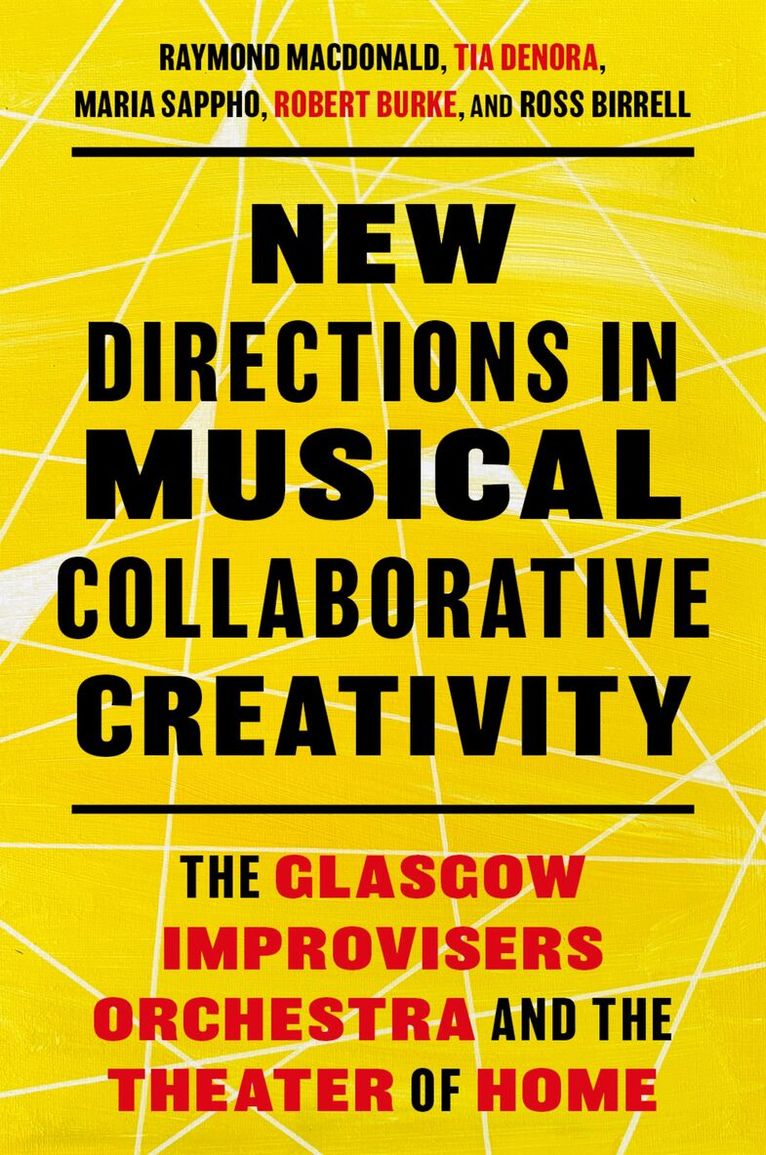
New Directions in Musical Collaborative Creativity
The Glasgow Improvisers Orchestra and the Theater of Home
Inbunden, Engelska, 2025
1 208 kr
Skickas inom 7-10 vardagar
During the COVID-19 pandemic, creative communities were faced with unprecedented challenges and forced to embark upon a re-evaluation of traditional approaches to artistic collaboration. In the wake of these discussions and experiments, New Directions in Musical Collaborative Creativity asks how new technology can be used to enhance creativity and how this creativity increases our knowledge in relation to musical interactions in group contexts. Focusing on a case study of a leading musical improvisation group--the Glasgow Improvisers Orchestra, and their online music sessions established during the COVID-19 lockdowns of March 2020--the book's five authors probe the transformative impact of online and hybrid improvisation and explore the crucial role of interactive (visual and sound) technology in the emergence of new identities and hybrid working practices.Virtual improvising, though a relatively new type of creative activity, has significant implications for how researchers can better understand improvisation generally as well as musical interactions in non-virtual environments. The book's topics range from an overview of digital music frameworks to an investigation of how improvisations begin and end, the unique context of the online sessions, the integration of audio and visual stimuli to produce audio-visual compositions, and new types of creative activities. The authors explore how improvisation--and online improvising in particular--can engender a fresh sense of community while presenting innovative opportunities for experimentation, communication, community involvement, educational enrichment, the cultivation of new virtuosities, and the promotion of health and well-being. Furthermore, they delve into the ramifications of these insights for education and health, emphasising the importance of new technologies and their potential to produce significant creative breakthroughs.Ultimately, the book points us toward novel manifestations of technologically-mediated and community-centred creative engagement, delineating avenues for future advancement and scholarly investigation. Bringing together a multidisciplinary and cross-generational author team with a wealth of complementary academic and artistic experience, this book responds to the significant growth in interest in improvisation as a musical and artistic practice and situates this research within the study of collaborative creativity in the contemporary "hybrid" context. A companion website features a series of films that document sessions of the Glasgow Improvisers Orchestra, showing the innovative collaborative artistic practices as they emerged.
New Directions in Musical Collaborative Creativity
The Glasgow Improvisers Orchestra and the Theater of Home
Häftad, Engelska, 2025
328 kr
Skickas inom 5-8 vardagar
During the COVID-19 pandemic, creative communities were faced with unprecedented challenges and forced to embark upon a re-evaluation of traditional approaches to artistic collaboration. In the wake of these discussions and experiments, New Directions in Musical Collaborative Creativity asks how new technology can be used to enhance creativity and how this creativity increases our knowledge in relation to musical interactions in group contexts. Focusing on a case study of a leading musical improvisation group--the Glasgow Improvisers Orchestra, and their online music sessions established during the COVID-19 lockdowns of March 2020--the book's five authors probe the transformative impact of online and hybrid improvisation and explore the crucial role of interactive (visual and sound) technology in the emergence of new identities and hybrid working practices.Virtual improvising, though a relatively new type of creative activity, has significant implications for how researchers can better understand improvisation generally as well as musical interactions in non-virtual environments. The book's topics range from an overview of digital music frameworks to an investigation of how improvisations begin and end, the unique context of the online sessions, the integration of audio and visual stimuli to produce audio-visual compositions, and new types of creative activities. The authors explore how improvisation--and online improvising in particular--can engender a fresh sense of community while presenting innovative opportunities for experimentation, communication, community involvement, educational enrichment, the cultivation of new virtuosities, and the promotion of health and well-being. Furthermore, they delve into the ramifications of these insights for education and health, emphasising the importance of new technologies and their potential to produce significant creative breakthroughs.Ultimately, the book points us toward novel manifestations of technologically-mediated and community-centred creative engagement, delineating avenues for future advancement and scholarly investigation. Bringing together a multidisciplinary and cross-generational author team with a wealth of complementary academic and artistic experience, this book responds to the significant growth in interest in improvisation as a musical and artistic practice and situates this research within the study of collaborative creativity in the contemporary "hybrid" context. A companion website features a series of films that document sessions of the Glasgow Improvisers Orchestra, showing the innovative collaborative artistic practices as they emerged.
2 572 kr
Skickas inom 5-8 vardagar
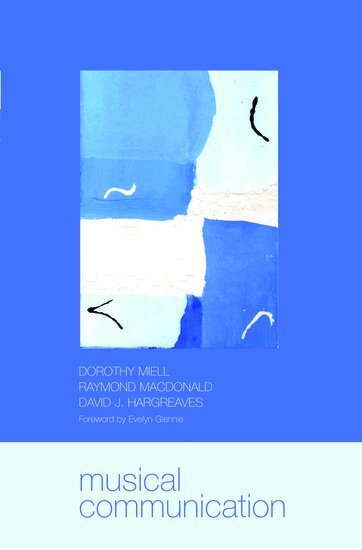
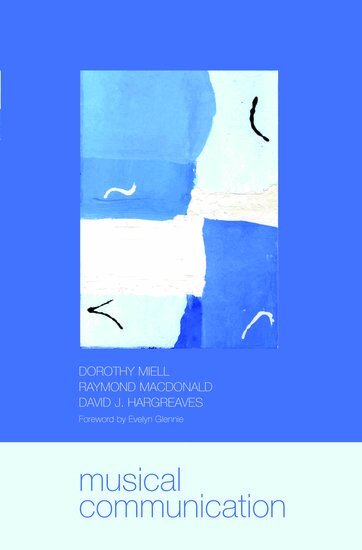
Music is a powerful means of communication. It provides a means by which people can share emotions, intentions, and meanings even though their spoken languages may be mutually incomprehensible. It can also provide a vital lifeline to human interaction for those whose special needs make other means of communication difficult. Music can exert powerful physical effects, can produce deep and profound emotions within us, and can be used to generate infinitely subtle variations of expressiveness by skilled composers and performers.This new addition to the music psychology list brings together leading researchers from a variety of academic and applied backgrounds. It examines how music can be used to communicate and the biological, cognitive, social, and cultural processes which underlie such communication. Taking a broad, interdisciplinary look at all aspects of communication, from the symbolic aspects of musical notation, to the use of music in advertising, the book is the first of its kind. It will be valuable for all those involved in music psychology, music education, and communication studies.
1 110 kr
Skickas inom 5-8 vardagar
Music is a powerful means of communication. It provides a means by which people can share emotions, intentions, and meanings even though their spoken languages may be mutually incomprehensible. It can also provide a vital lifeline to human interaction for those whose special needs make other means of communication difficult. Music can exert powerful physical effects, can produce deep and profound emotions within us, and can be used to generate infinitely subtle variations of expressiveness by skilled composers and performers.This new addition to the music psychology list brings together leading researchers from a variety of academic and applied backgrounds. It examines how music can be used to communicate and the biological, cognitive, social, and cultural processes which underlie such communication. Taking a broad, interdisciplinary look at all aspects of communication, from the symbolic aspects of musical notation, to the use of music in advertising, the book is the first of its kind. It will be valuable for all those involved in music psychology, music education, and communication studies.
Musical Imaginations
Multidisciplinary perspectives on creativity, performance and perception
Häftad, Engelska, 2011
1 379 kr
Skickas inom 7-10 vardagar
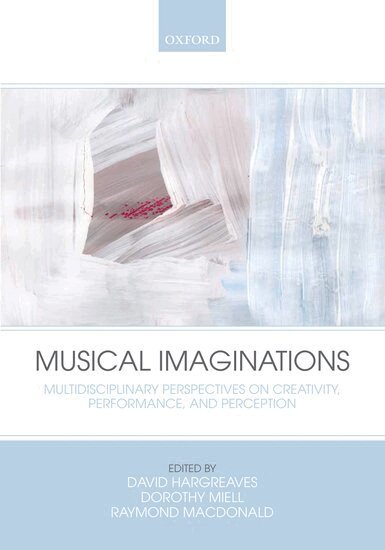
Musical imagination and creativity are amongst the most abstract and complex aspects of musical behaviour, though, until recently, they have been difficult to subject to empirical enquiry. However, music psychology and some allied disciplines have now developed, both theoretically and methodologically, to the point where some of these topics are now firmly within our grasp. The study of creativity and imagination is growing rapidly in disciplines including psychology, sociology, neuroscience, and education. The inter- and multidisciplinary study of music, and developments in music psychology in particular, mean that studies of musical imagination and creativity in action are now distinctly possible'Musical Imaginations' is a wide ranging, multidisciplinary review of the latest theory and research on musical creativity, performance and perception by some of the most eminent scholars in their respective disciplines. The topics addressed in this book include the investigation of creativity and imagination in music and emotion, composition and improvisation, performance and performance traditions, listening strategies, different musical genres and cultural belief systems, social collaboration, identity formation, and the development of psychologically-based strategies and interventions for the enhancement of performing musicians. With creativity now a topic of significant interest, this book will be valuable to all those in the fields of psychology, sociology, neuroscience, education, as well as to musicians themselves - dealing with practical as well as theoretical issues in music therapy, performance and education. The study of creativity and imagination is growing rapidly in disciplines including psychology, sociology, neuroscience, and education. The inter- and multidisciplinary study of music, and developments in music psychology in particular, mean that studies of musical imagination and creativity in action are now distinctly possible. This book undertakes a multidisciplinary review of these developments. It contains a wide range of contributions by some of the most eminent scholars in their respective disciplines, representing a comprehensive account of the state of the art of theory and research on musical creativity, performance and perception.
2 079 kr
Skickas inom 5-8 vardagar
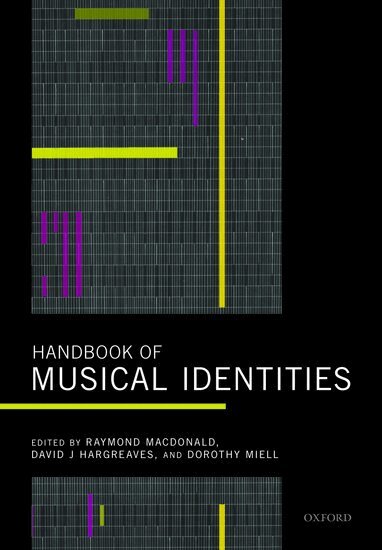
Music is a tremendously powerful channel through which people develop their personal and social identities. Music is used to communicate emotions, thoughts, political statements, social relationships, and physical expressions. But, just as language can mediate the construction and negotiation of developing identities, so music can also be a means of communication through which aspects of people's identities are constructed. Music can have a profound influence on our developing sense of identity, our values, and our beliefs, be it from rock music, classical music, or jazz.Musical identities (MacDonald, Hargreaves and Miell, 2002) was unique in being in being one of the first books to explore this fascinating topic. This new book documents the remarkable expansion and growth in the study of musical identities since the publication of the earlier work. The editors identify three main features of current psychological approaches to musical identities, which concern their definition, development, and the identification of individual differences, as well as four main real-life contexts in which musical identities have been investigated, namely in music and musical institutions; specific geographical communities; education; and in health and well-being. This conceptual framework provides the rationale for the structure of the Handbook.The book is divided into seven main sections. The first, 'Sociological, discursive and narrative approaches', includes several general theoretical accounts of musical identities from this perspective, as well as some more specific investigations. The second and third main sections deal in depth with two of the three psychological topics described above, namely the development of and individual differences in musical identities. The fourth, fifth and sixth main sections pursue three of the real-life contexts identified above, namely 'Musical institutions and practitioners', 'Education', and 'Health and well-being'. The seventh and final main section of the Handbook - 'Case studies' - includes chapters which look at particular musical identities in specific times, places, or contexts. The multidisciplinary range and breadth of the Handbook's contents reflect the rapid changes that are taking place in music, in digital technology, and in their role in society as a whole, such that the study of musical identity is likely to proliferate even further in the future.
519 kr
Skickas inom 5-8 vardagar
The great saxophonist Charlie Parker once proclaimed "if you don't live it, it won't come out of your horn". This quote has often been used to explain the hedonistic lifestyle of many jazz greats; however, but it also signals the reciprocal and inextricable relationship between music and wider social, cultural and psychological variables. This link is complex and multifaceted and is undoubtedly a central component of why music has been implicated as a therapeutic agent in vast swathes of contemporary research studies. Music is always about more than just acoustic events or notes on a page. Music has a universal and timeless potential to influence how we feel. Yet, only recently, have researchers begun to explore and understand the positive effects that music can have on our wellbeing - across a range of cultures and musical genres.This book brings together research from music psychology, therapy, public health, and medicine, to explore the relationship between music, health and wellbeing. It presents a range of chapters from internationally recognised experts, resulting in a comprehensive, multidisciplinary, and pluralistic account of recent advances and applications in both clinical and non-clinical practice and research. Some of the questions explored include: what is the nature of the scientific evidence to support the relationship between music, health and wellbeing? What are the current views from different disciplines on empirical observations and methodological issues concerning the effects of musical interventions on health-related processes? What are the mechanisms which drive these effects and how can they be utilised for building robust theoretical frameworks for future work? For the first time, research from disciplines including neuroscience of music, music therapy, psychophysiology and epidemiology of music, community music and music education is synthesised and presented together to further our understanding of music and health in one single volume, ensuring that closely related strands of research in different disciplines are brought together into a authoritative, comprehensive and robust collection of chapters. This book is a timely and unique response to an explosion of interest in the relationship between music, health, and wellbeing and will be invaluable resources for students, administrators and researchers in the humanities, social and medical sciences alike.