Rebecca Treiman - Böcker
Visar alla böcker från författaren Rebecca Treiman. Handla med fri frakt och snabb leverans.
7 produkter
7 produkter
1 792 kr
Skickas inom 5-8 vardagar
This groundbreaking study on the psycholinguistics of spelling presents the author's original empirical research on spelling and supplies the theoretical framework necessary to understand how children's ability to write is related to their ability to speak a language. The author explores areas in a field dominated by work traditionally concerned with the psychodynamics of reading skills and, in so doing, highlights the importance of learning to spell for both psycholinguists and educators, since as they begin to spell, children attempt to represent the phonological, or sound form, of words. The study of children's spelling can shed light on the nature of phonological systems and can illuminate the way sounds are organized into larger units, such as syllables and words. Research on children's spelling leads directly to an understanding of the way phonological knowledge is acquired and how phonological systems change with the development of reading and writing ability. In addition to this insight concerning cognitive processes, the findings presented here have implications for how spelling should be taught and why some writing systems are easier to master than others. The work will interest a wide range of cognitive and developmental psychologists, psycholinguists, and educational psychologists, as well as linguists and educators interested in psycholinguistics.
2 554 kr
Skickas inom 5-8 vardagar
Writing is one of humankind's greatest inventions, and modern societies could not function if their citizens could not read and write. How do skilled readers pick up meaning from markings on a page so quickly, and how do children learn to do so? The chapters in the Oxford Handbook of Reading synthesize research on these topics from fields ranging from vision science to cognitive psychology and education, focusing on how studies using a cognitive approach can shed light on how the reading process works. To set the stage, the opening chapters present information about writing systems and methods of studying reading, including those that examine speeded responses to individual words as well as those that use eye movement technology to determine how sentences and short passages of text are processed. The following section discusses the identification of single words by skilled readers, as well as insights from studies of adults with reading disabilities due to brain damage. Another section considers how skilled readers read a text silently, addressing such issues as the role of sound in silent reading and how readers' eyes move through texts. Detailed quantitative models of the reading process are proposed throughout. The final sections deal with how children learn to read and spell, and how they should be taught to do so. These chapters review research with learners of different languages and those who speak different dialects of a language; discuss children who develop typically as well as those who exhibit specific disabilities in reading; and address questions about how reading should be taught with populations ranging from preschoolers to adolescents, and how research findings have influenced education.The Oxford Handbook of Reading will benefit researchers and graduate students in the fields of cognitive psychology, developmental psychology, education, and related fields (e.g., speech and language pathology) who are interested in reading, reading instruction, or reading disorders.
1 386 kr
Skickas inom 5-8 vardagar
Writing allows people to convey information to others who are remote in time and space, vastly increasing the range over which people can cooperate and the amount they can learn. Mastering the writing system of one's language is crucial for success in a modern society. This book examines how children learn to write words. It provides a theoretical framework that integrates findings from a wide range of age groups--from children who are producing their first scribbles to experienced spellers who are writing complex words. To set the stage for these discussions, early chapters of the book consider the nature of writing systems and the nature of learning itself. The following chapters review various aspects of orthographic development, including the learning of symbol shapes and punctuation. Each chapter reviews research with learners of a variety of languages and writing systems, revealing underlying similarities. Discussions of how orthography is and should be taught are incorporated into each chapter, making the book of interest to educators as well as to psychologists, cognitive scientists, and linguists. This book is unique in the range of topics and languages that it covers and the degree to which it integrates linguistic insights about the nature of writing systems with discussions of how people learn to use these systems. It is written in a scholarly yet accessible manner, making it suited for a wide audience.
1 034 kr
Skickas inom 10-15 vardagar
The chapters in this volume focus on one important aspect of writing: spelling. There has been much less research on spelling and writing than on reading, and these papers represent an attempt to restore the balance. These papers by researchers in the field provide a sample of late 1990s research on spelling. Some of the papers focus on spelling as a linguistic process, examining the phonological and morphological factors that make certain words easier or harder to spell than others. Other papers treat spelling as a cognitive process, looking for example at the effects of task demands on performance. And still other papers view spelling as a developmental process, asking how children learn to spell and why some children experience more difficulty than others. Together, the papers reveal the progress that has been made in our understanding of spelling.
2 044 kr
Skickas inom 10-15 vardagar
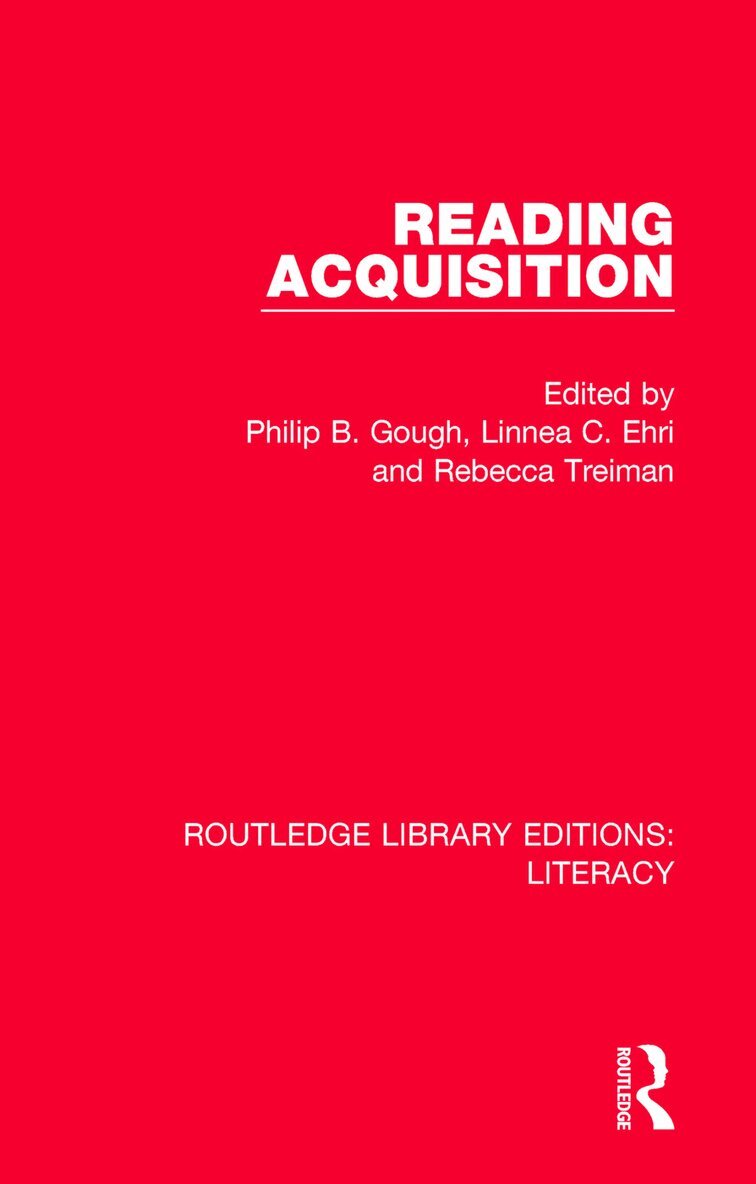
Originally published in 1992. This book brings together the work of a number of distinguished international researchers engaged in basic research on beginning reading. Individual chapters address various processes and problems in learning to read - including how acquisition gets underway, the contribution of story listening experiences, what is involved in learning to read words, and how readers represent information about written words in memory. In addition, the chapter contributors consider how phonological, onset-rime, and syntactic awareness contribute to reading acquisition, how learning to spell is involved, how reading ability can be explained as a combination of decoding skill plus listening comprehension skill, and what causes reading difficulties and how to study these causes.
467 kr
Skickas inom 10-15 vardagar
Originally published in 1992. This book brings together the work of a number of distinguished international researchers engaged in basic research on beginning reading. Individual chapters address various processes and problems in learning to read - including how acquisition gets underway, the contribution of story listening experiences, what is involved in learning to read words, and how readers represent information about written words in memory. In addition, the chapter contributors consider how phonological, onset-rime, and syntactic awareness contribute to reading acquisition, how learning to spell is involved, how reading ability can be explained as a combination of decoding skill plus listening comprehension skill, and what causes reading difficulties and how to study these causes.
1 034 kr
Skickas inom 10-15 vardagar
The chapters in this volume focus on one important aspect of writing: spelling. There has been much less research on spelling and writing than on reading, and these papers represent an attempt to restore the balance. The papers, by some of the leading researchers in the field, provide an excellent sample of current research on spelling. Some of the papers focus on spelling as a linguistic process, examining the phonological and morphological factors that make certain words easier or harder to spell than others. Other papers treat spelling as a cognitive process, looking for example at the effects of task demands on performance. And still other papers view spelling as a developmental process, asking how children learn to spell and why some children experience more difficulty than others. Together, the papers reveal the progress that has been made in our understanding of spelling.