Regina Seiwald – författare
Visar alla böcker från författaren . Handla med fri frakt och snabb leverans.
10 produkter
10 produkter
E-bok
PDF, Engelska, 20231 419 kr
Läs direkt efter köp
How do games represent history, and how do we make sense of the history of games? The industry regularly uses history to sell products, while processes of creation and of promotion leave behind markers of a game’s history. The access to this history is often granted by so-called paratexts, which are accompanying elements orbiting texts. Exploring this fully, case studies in this work move the focus of debate from the games themselves to wider, ancillary materials and ask how history is used in, and how we can use history to study games.
E-bok
Engelska, 20231 419 kr
Läs direkt efter köp
How do games represent history, and how do we make sense of the history of games? The industry regularly uses history to sell products, while processes of creation and of promotion leave behind markers of a game’s history. The access to this history is often granted by so-called paratexts, which are accompanying elements orbiting texts. Exploring this fully, case studies in this work move the focus of debate from the games themselves to wider, ancillary materials and ask how history is used in, and how we can use history to study games.
Inbunden, Engelska, 2023
1 335 kr
Skickas inom 5-8 vardagar
How do games represent history, and how do we make sense of the history of games? The industry regularly uses history to sell products, while processes of creation and of promotion leave behind markers of a game’s history. The access to this history is often granted by so-called paratexts, which are accompanying elements orbiting texts. Exploring this fully, case studies in this work move the focus of debate from the games themselves to wider, ancillary materials and ask how history is used in, and how we can use history to study games.
Del 13 - Video Games and the Humanities
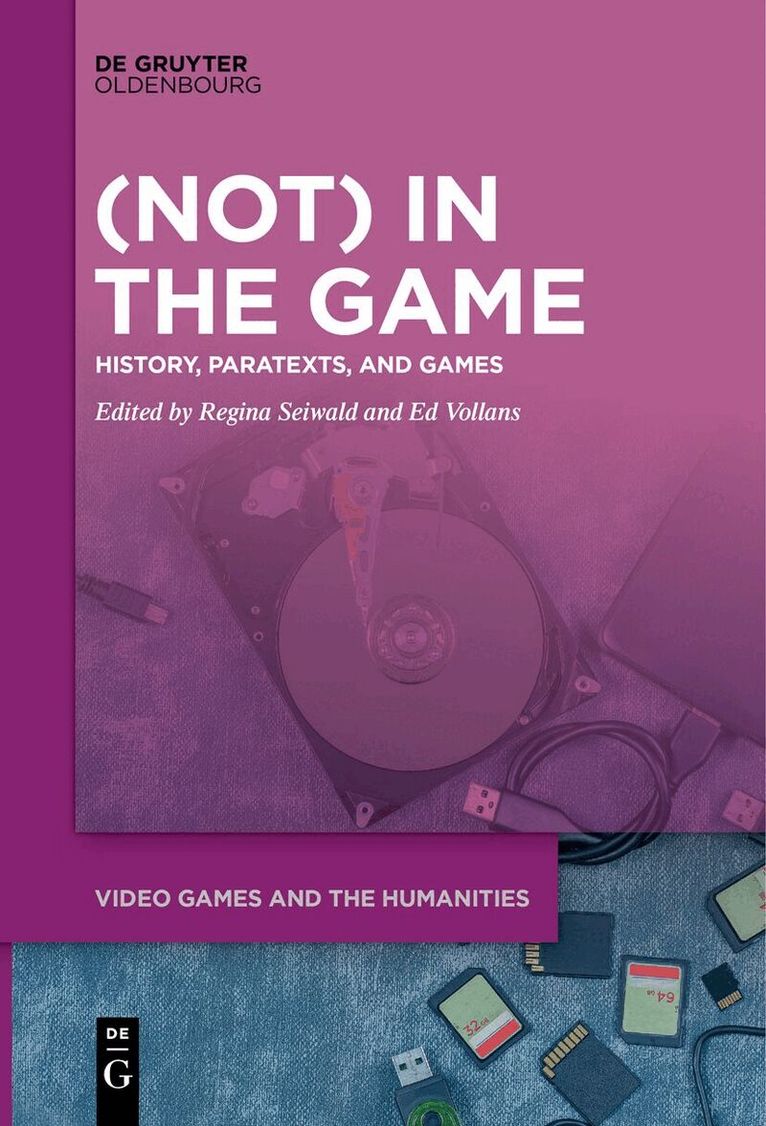
(Not) In the Game
History, Paratexts, and Games
Häftad, Engelska, 2024
279 kr
Skickas inom 3-6 vardagar
How do games represent history, and how do we make sense of the history of games? The industry regularly uses history to sell products, while processes of creation and of promotion leave behind markers of a game’s history. The access to this history is often granted by so-called paratexts, which are accompanying elements orbiting texts. Exploring this fully, case studies in this work move the focus of debate from the games themselves to wider, ancillary materials and ask how history is used in, and how we can use history to study games.
Häftad, Tyska, 2008
365 kr
Skickas inom 3-6 vardagar
E-bok
PDF, Engelska, 2011194 kr
Läs direkt efter köp
Essay from the year 2010 in the subject English Language and Literature Studies - Literature, grade: Sehr Gut, University of Birmingham (School of English), course: Film: Narrative, Meaning and Representation , language: English, abstract: Fritz Lang's films are influenced by German Expressionism, which originated in Germany in 1919 and ended in 1930. Extreme stylised mise-en-scene is employed to make the formal organisation of the films obvious (Cook 1999, p. 67). The main concern of German Expressionist films is to create a phantasy world, which is in stark contrast to the real world in order to reflect upon social grievances and chasms:Expressionism [ ] is a reaction against the atom-splitting of Impressionism, which reflects the iridescent ambiguities, disquieting diversity, and ephemeral hues of nature. At the same time Expressionism sets itself against Naturalism with its mania for recording mere facts, and its paltry aim of photographing nature or daily life. The world is there for all to see; it would be absurd to reproduce it purely and simply as it is. (Eisner 1969, p. 10)This is especially evident in Fritz Lang's revolutionary filming technique as the employed shot types and angles enhance angst and paranoia in the spectator. M and The Woman in the Window are also influenced by so-called 'Kammerspiel'-films of the 1920s, through which a new psychological realism emerged. The introduction of sound made it possible for Lang to represent the individual psyche through the character's speech. Fritz Lang uses universal symbols as a bridge between the character's inner state and the outer world. This also derives from German Expressionism, which aims to discuss low-life subject matters. In M, symbols are used to add further layers of meaning to the film and to foreshadow its plot, whereas in The Woman in the Window they mainly function as symbols of masculinity. In this essay, the influence of German Expressionism on Fritz Lang's films is discussed by closely analysing and explaining key scenes. It aims to show how the auteur uses key features of this movement to depict the dark chasms of human society.
E-bok
PDF, Engelska, 2011193 kr
Läs direkt efter köp
Essay from the year 2011 in the subject English Language and Literature Studies - Linguistics, grade: 1,0, University of Birmingham (School of English), course: Language and Communication, language: English, abstract: The notion of face as the public self-image plays a major role in every culture. It shapes the character of a speaker as well as how he or she is perceived by others. Therefore, the cross-cultural analysis of face is a crucial field of study in every social science. In this essay, the importance of face in Politeness Theory will be discussed. It aims to show the development of the concept first defined by Goffman in 1967 to the further analysis by Brown and Levinson in 1978, which is influenced by Grice's Cooperative Principle and Austin's Speech Act Theory, as well as recent criticism and re-evaluation in post-modernism. Furthermore, the two concepts of positive and negative face will be discussed, which then leads to the devision of negative and positive politeness strategies. These negative and positive face-threatening acts (FTAs) are further subdivided into acts which damage the hearer's and acts which damage the speaker's face. In the next chapter, five strategies for doing face-threatening acts are closely analysed: positive politeness, negative politeness, off-record, bald-on-record and redressive on-record acts. A fifth category do not do a FTA is also included in this section as not communicating may also minimise or increase the danger for doing a face-threatening act. In the last chapter of this paper, the development of Politeness Theory and face over the last twenty-five years will be critically discussed and compared to Brown and Levinson's 'traditional' theory.
Häftad, Engelska, 2011
345 kr
Skickas inom 3-6 vardagar
E-bok
PDF, Engelska, 2015193 kr
Läs direkt efter köp
Seminar paper from the year 2008 in the subject English Language and Literature Studies - Linguistics, grade: 2,1, University of Innsbruck, course: Language Awareness 3, language: English, abstract: This Proseminar paper is about "e;Future - Meaning and Form"e;, following the presentation held in the Awareness III. course in winter term 2007/08. In order to analyse the different forms and meanings of the various future concepts, there are several English Grammar books providing useful theoretical information. The first part of the paper serves as a theoretical overview. In this section the different future concepts are analysed and the meaning of the different tenses is dissected. The second part consists of the practical part. It illustrates where and why the different future concepts are used in different examples. It also shows how the rules in the theoretical part apply to the practical examples like dialogues and full texts. In English, like in all Germanic languages, there is no simple future tense. The futurity of an action is expressed either by using a word which expresses a future action, e.g. I drive to London in two days, or by utilising an auxiliary construction that combines a definite present tense verb with the stem of this verb which illustrates the actual action of the sentence. The English future tense was established during the period of 300 years, between 1066 and 1350. During that time, Anglo-Norman was the official language of the British Isles. Unlike English, Norman is a Romance Language, which does have a simple future tense. In the course of the study of the English future concepts, one has to make a difference between spoken and written language. As spoken language is used more often than written language, the used future tense differs.
Häftad, Engelska, 2015
322 kr
Skickas inom 3-6 vardagar