René Doursat - Böcker
Visar alla böcker från författaren René Doursat. Handla med fri frakt och snabb leverans.
6 produkter
6 produkter
IT Revolution
First International ICST Conference, IT Revolutions 2008, Venice, Italy, December 17-19, 2008, Revised Selected Papers
Häftad, Engelska, 2009
552 kr
Skickas inom 10-15 vardagar
“Mitigating Paradox at the eSociety Tipping Point” In the first two decades of the past Century, having as driving factor the automobile and its mass production, the command economy has radically changed our lifestyles, enabling the creation of offices, suburbs, fast food restaurants and unified school d- tricts. With the Internet as driving factor, socio-technical and industrial eNetworked ecosystems are about to change our lives again in these two decades of the twenty-first century, and we are just approaching the tipping point. As we have just reached the point where the tremendous changes fueled by concerted efforts in information communication technologies (ICT) research are unraveling the old society this is creating a lot of d- comfort, confusion and sometimes opposition from the traditional mainstream. This disconnect is being deepened even more by the rocketing speed of technological ICT advances. As technology is getting ahead of society, the old ways, although still do- nant, become more and more dysfunctional and we are experiencing an "age of pa- dox" as the new ways disrupt the way we used to do things and even the way we used to think about the world. Just like the major inventions that shaped the last century were made by 1920, it is expected that the major inventions that will shape the twen- first century are going to be made by 2020.
Swarm Intelligence
7th International Conference, ANTS 2010, Brussels, Belgium,September 8-10, 2010 Proceedings
Häftad, Engelska, 2010
1 096 kr
Skickas inom 10-15 vardagar
These proceedings contain the papers presented at ANTS 2010, the 7th Int- national Conference on Swarm Intelligence, organized by IRIDIA, CoDE, U- versiteLibre de Bruxelles,Brussels, Belgium, during September 8-10,2010.The ANTS series started in 1998 with the First International Workshop on Ant Colony Optimization (ANTS 1998), which attracted more than 50 participants. Since then ANTS, which is held bi-annually, has gradually become an inter- tional forum for researchers in the wider ?eld of swarm intelligence. In the past (since 2004), this development has been acknowledged by the inclusion of the term"SwarmIntelligence" (nextto"AntColonyOptimization")intheconference title. This year's ANTS conference was o?cially devoted to the ?eld of swarm intelligence as a whole, without any bias towards speci?c research directions. As a result, the title of the conference was changed to "The International Conf- ence on SwarmIntelligence." This name change is already in place this year,and future ANTS conferences will continue to use the new title. Thisvolumecontainsthebestpapersselectedoutof99submissions.Ofthese, 28 were accepted as full-length papers, while 27 were accepted as short papers.This corresponds to an overall acceptance rate of 56%. Also included in this volume are 14 extended abstracts. Of the full-length papers, 15 were selected for oral presentation at the c- ference. All other contributions, including short papers and extended abstracts, werepresentedin the formof poster presentations.Following the conference,the journal Swarm Intelligence will publish extended versions of some of the best papers presented at the conference.
1 381 kr
Skickas inom 10-15 vardagar
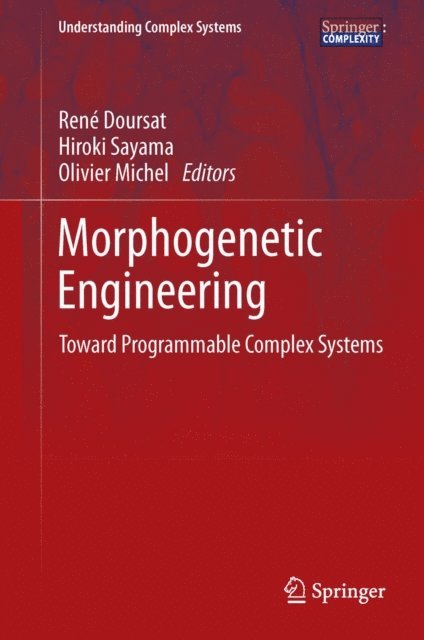
Generally, spontaneous pattern formation phenomena are random and repetitive, whereas elaborate devices are the deterministic product of human design.Yet, biological organisms and collective insect constructions are exceptional examples of complex systems that are both self-organized and architectural. This book is the first initiative of its kind toward establishing a new field of research, Morphogenetic Engineering, to explore the modeling and implementation of “self-architecturing” systems. Particular emphasis is placed on the programmability and computational abilities of self-organization, properties that are often underappreciated in complex systems science—while, conversely, the benefits of self-organization are often underappreciated in engineering methodologies. Altogether, the aim of this work is to provide a framework for and examples of a larger class of “self-architecturing” systems, while addressing fundamental questions such as > How do biological organisms carry out morphogenetic tasks so reliably? > Can we extrapolate their self-formation capabilities to engineered systems?> Can physical systems be endowed with information (or informational systems be embedded in physics) so as to create autonomous morphologies and functions?> What are the core principles and best practices for the design and engineering of such morphogenetic systems? The intended audience consists of researchers and graduate students who are working on, starting to work on, or interested in programmable self-organizing systems in a wide range of scientific fields, including computer science, robotics, bioengineering, control engineering, physics, theoretical biology, mathematics, and many others.
Del 557 - Studies in Computational Intelligence
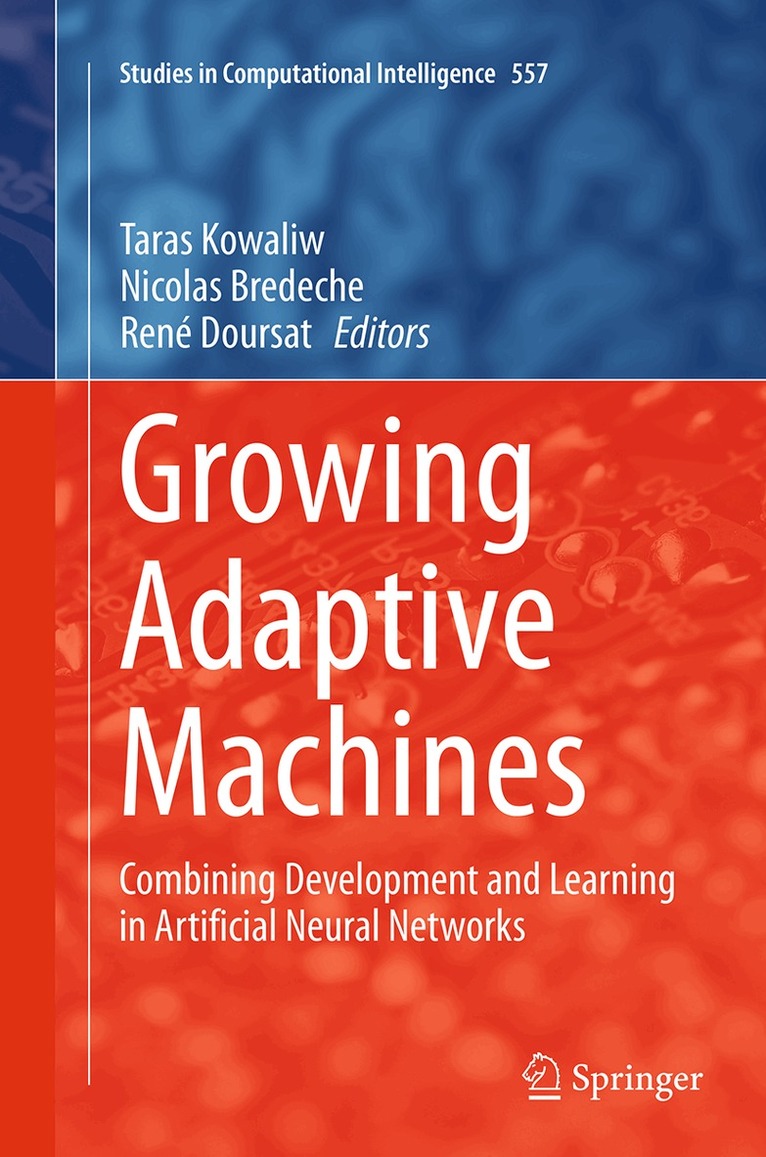
Growing Adaptive Machines
Combining Development and Learning in Artificial Neural Networks
Inbunden, Engelska, 2014
1 096 kr
Skickas inom 10-15 vardagar
The particular focus is on how to design artificial neural networks for engineering tasks.The book consists of contributions from 18 researchers, ranging from detailed reviews of recent domains by senior scientists, to exciting new contributions representing the state of the art in machine learning research.
1 381 kr
Skickas inom 10-15 vardagar
Generally, spontaneous pattern formation phenomena are random and repetitive, whereas elaborate devices are the deterministic product of human design.Yet, biological organisms and collective insect constructions are exceptional examples of complex systems that are both self-organized and architectural. This book is the first initiative of its kind toward establishing a new field of research, Morphogenetic Engineering, to explore the modeling and implementation of “self-architecturing” systems. Particular emphasis is placed on the programmability and computational abilities of self-organization, properties that are often underappreciated in complex systems science—while, conversely, the benefits of self-organization are often underappreciated in engineering methodologies. Altogether, the aim of this work is to provide a framework for and examples of a larger class of “self-architecturing” systems, while addressing fundamental questions such as > How do biological organisms carry out morphogenetic tasks so reliably? > Can we extrapolate their self-formation capabilities to engineered systems?> Can physical systems be endowed with information (or informational systems be embedded in physics) so as to create autonomous morphologies and functions?> What are the core principles and best practices for the design and engineering of such morphogenetic systems? The intended audience consists of researchers and graduate students who are working on, starting to work on, or interested in programmable self-organizing systems in a wide range of scientific fields, including computer science, robotics, bioengineering, control engineering, physics, theoretical biology, mathematics, and many others.
Del 557 - Studies in Computational Intelligence
Growing Adaptive Machines
Combining Development and Learning in Artificial Neural Networks
Häftad, Engelska, 2016
1 096 kr
Skickas inom 10-15 vardagar
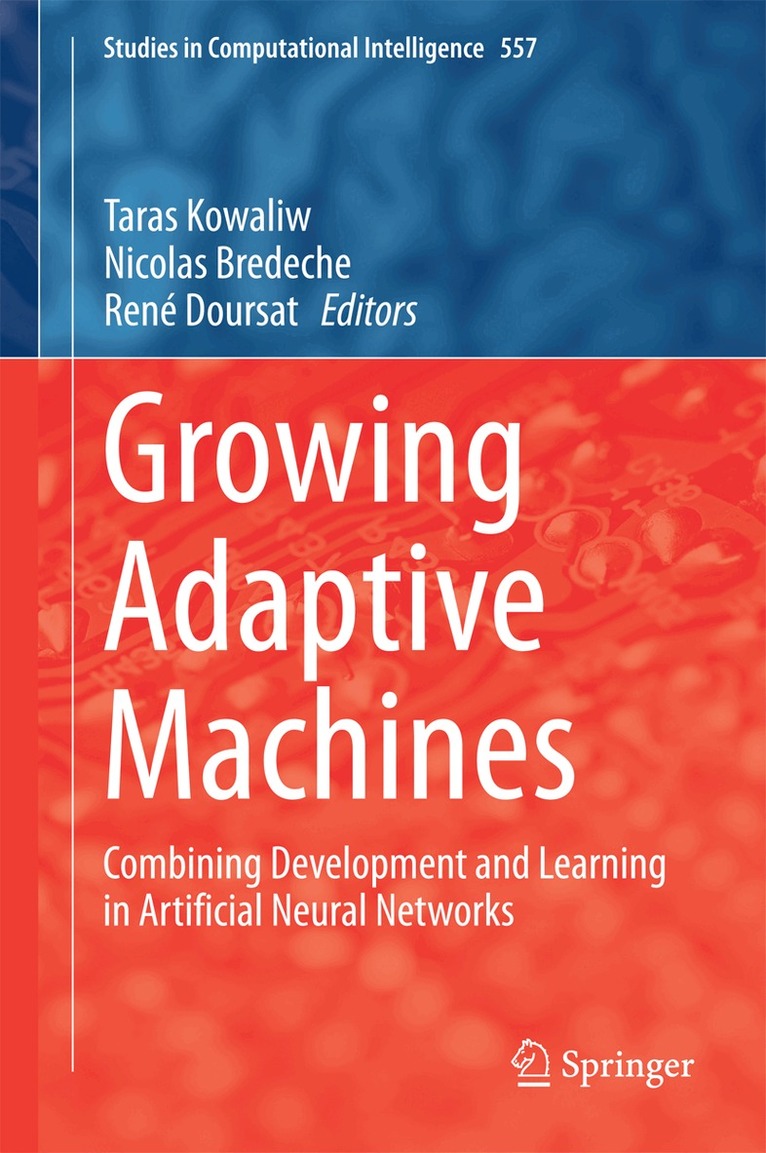
The pursuit of artificial intelligence has been a highly active domain of research for decades, yielding exciting scientific insights and productive new technologies. In terms of generating intelligence, however, this pursuit has yielded only limited success. This book explores the hypothesis that adaptive growth is a means of moving forward. By emulating the biological process of development, we can incorporate desirable characteristics of natural neural systems into engineered designs and thus move closer towards the creation of brain-like systems. The particular focus is on how to design artificial neural networks for engineering tasks.The book consists of contributions from 18 researchers, ranging from detailed reviews of recent domains by senior scientists, to exciting new contributions representing the state of the art in machine learning research. The book begins with broad overviews of artificial neurogenesis and bio-inspired machine learning, suitable both as an introduction to the domains and as a reference for experts. Several contributions provide perspectives and future hypotheses on recent highly successful trains of research, including deep learning, the Hyper NEAT model of developmental neural network design, and a simulation of the visual cortex. Other contributions cover recent advances in the design of bio-inspired artificial neural networks, including the creation of machines for classification, the behavioural control of virtual agents, the design of virtual multi-component robots and morphologies and the creation of flexible intelligence. Throughout, the contributors share their vast expertise on the means and benefits of creating brain-like machines.This book is appropriate for advanced students and practitioners of artificial intelligence and machine learning.