Richard Cookson – författare
Visar alla böcker från författaren Richard Cookson. Handla med fri frakt och snabb leverans.
8 produkter
8 produkter
E-bok
PDF, Engelska, 2020413 kr
Läs direkt efter köp
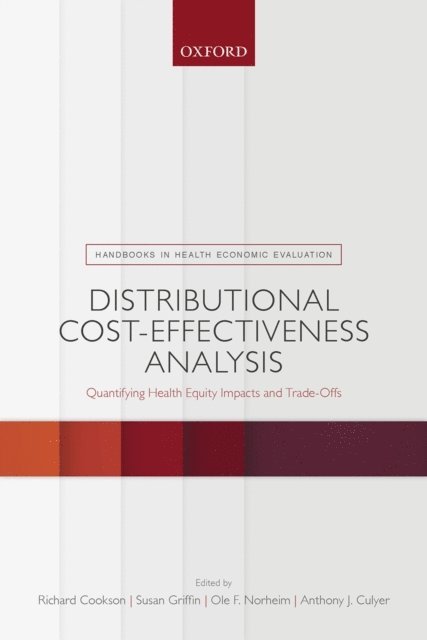
Distributional cost-effectiveness analysis aims to help health care and public health organisations make fairer decisions with better outcomes. Whereas standard cost-effectiveness analysis provides information about total costs and effects, distributional cost-effectiveness analysis provides additional information about fairness in the distribution of costs and effects - who gains, who loses, and by how much. It can also provide information about the trade-offs that sometimes occur between efficiency objectives, such as improving total health, and equity objectives, such as reducing unfair inequality in health.This is a practical guide to a flexible suite of economic methods for quantifying the equity consequences of health programmes in high-, middle- and low-income countries. The methods can be tailored and combined in various ways to provide useful information to different decision-makers in different countries with different distributional equity concerns. The handbook is primarily aimed at postgraduate students and analysts specialising in cost-effectiveness analysis but is also accessible to a broader audience of health sector academics, practitioners, managers, policymakers and stakeholders. As well as offering an overview for research commissioners, users, and producers, the book includes systematic technical guidance on how to simulate and evaluate distributions, with accompanying hands-on spreadsheet training exercises, and discussions about how to handle uncertainty about facts and disagreement about values, and the future challenges facing this young and rapidly evolving field of study.
E-bok
Engelska, 2020409 kr
Läs direkt efter köp
Distributional cost-effectiveness analysis aims to help health care and public health organisations make fairer decisions with better outcomes. Whereas standard cost-effectiveness analysis provides information about total costs and effects, distributional cost-effectiveness analysis provides additional information about fairness in the distribution of costs and effects - who gains, who loses, and by how much. It can also provide information about the trade-offs that sometimes occur between efficiency objectives, such as improving total health, and equity objectives, such as reducing unfair inequality in health.This is a practical guide to a flexible suite of economic methods for quantifying the equity consequences of health programmes in high-, middle- and low-income countries. The methods can be tailored and combined in various ways to provide useful information to different decision-makers in different countries with different distributional equity concerns. The handbook is primarily aimed at postgraduate students and analysts specialising in cost-effectiveness analysis but is also accessible to a broader audience of health sector academics, practitioners, managers, policymakers and stakeholders. As well as offering an overview for research commissioners, users, and producers, the book includes systematic technical guidance on how to simulate and evaluate distributions, with accompanying hands-on spreadsheet training exercises, and discussions about how to handle uncertainty about facts and disagreement about values, and the future challenges facing this young and rapidly evolving field of study.
Häftad, Engelska, 2020
987 kr
Skickas inom 3-6 vardagar
Distributional cost-effectiveness analysis aims to help health care and public health organisations make fairer decisions with better outcomes. Whereas standard cost-effectiveness analysis provides information about total costs and effects, distributional cost-effectiveness analysis provides additional information about fairness in the distribution of costs and effects - who gains, who loses, and by how much. It can also provide information about the trade-offs that sometimes occur between efficiency objectives, such as improving total health, and equity objectives, such as reducing unfair inequality in health.This is a practical guide to a flexible suite of economic methods for quantifying the equity consequences of health programmes in high-, middle- and low-income countries. The methods can be tailored and combined in various ways to provide useful information to different decision-makers in different countries with different distributional equity concerns. The handbook is primarily aimed at postgraduate students and analysts specialising in cost-effectiveness analysis but is also accessible to a broader audience of health sector academics, practitioners, managers, policymakers and stakeholders. As well as offering an overview for research commissioners, users, and producers, the book includes systematic technical guidance on how to simulate and evaluate distributions, with accompanying hands-on spreadsheet training exercises, and discussions about how to handle uncertainty about facts and disagreement about values, and the future challenges facing this young and rapidly evolving field of study.
Inbunden, Engelska, 2022
400 kr
Skickas inom 5-8 vardagar
Häftad, Engelska, 2022
290 kr
Skickas inom 5-8 vardagar
Inbunden, Engelska, 2026
375 kr
Skickas inom 5-8 vardagar
Häftad, Engelska, 2026
268 kr
Skickas inom 5-8 vardagar
Häftad, Engelska, 2019
286 kr
Skickas inom 5-8 vardagar