Richard E. Klima - Böcker
Visar alla böcker från författaren Richard E. Klima. Handla med fri frakt och snabb leverans.
3 produkter
3 produkter
685 kr
Skickas inom 10-15 vardagar
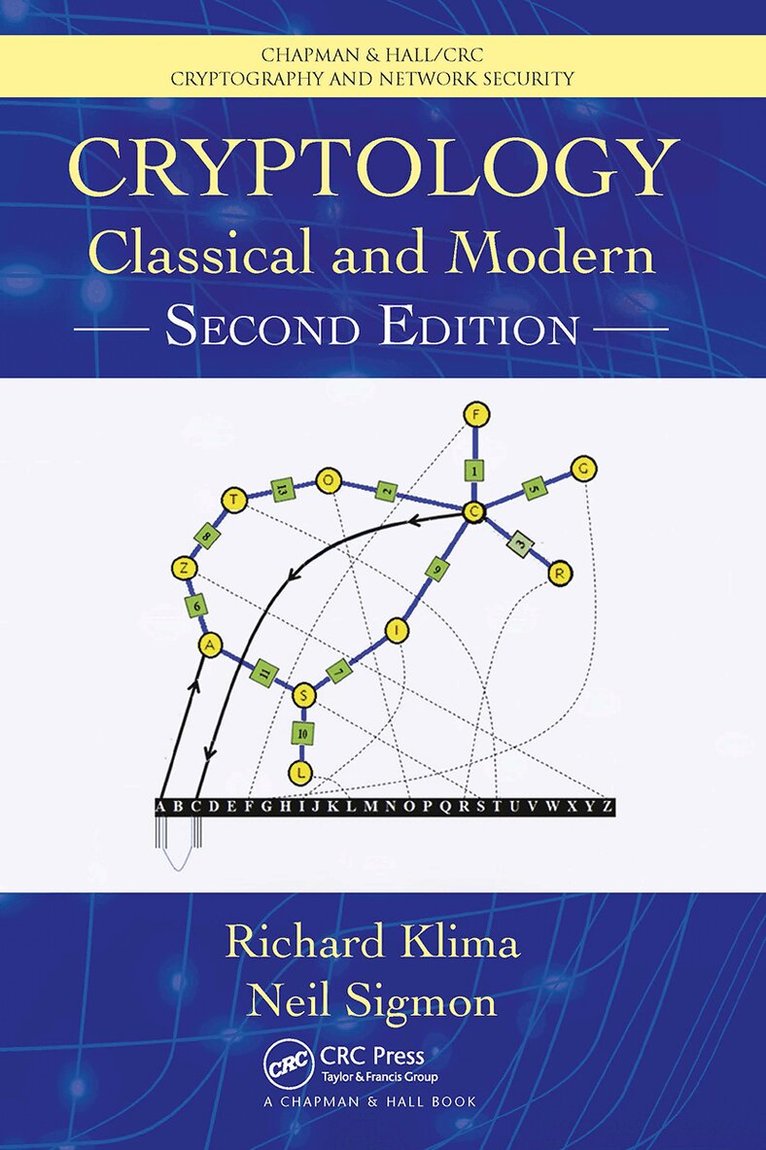
Cryptology: Classical and Modern, Second Edition proficiently introduces readers to the fascinating field of cryptology. The book covers classical methods including substitution, transposition, Alberti, Vigenère, and Hill ciphers. It also includes coverage of the Enigma machine, Turing bombe, and Navajo code. Additionally, the book presents modern methods like RSA, ElGamal, and stream ciphers, as well as the Diffie-Hellman key exchange and Advanced Encryption Standard. When possible, the book details methods for breaking both classical and modern methods. The new edition expands upon the material from the first edition which was oriented for students in non-technical fields. At the same time, the second edition supplements this material with new content that serves students in more technical fields as well. Thus, the second edition can be fully utilized by both technical and non-technical students at all levels of study. The authors include a wealth of material for a one-semester cryptology course, and research exercises that can be used for supplemental projects. Hints and answers to selected exercises are found at the end of the book. Features: Requires no prior programming knowledge or background in college-level mathematics Illustrates the importance of cryptology in cultural and historical contexts, including the Enigma machine, Turing bombe, and Navajo code Gives straightforward explanations of the Advanced Encryption Standard, public-key ciphers, and message authentication Describes the implementation and cryptanalysis of classical ciphers, such as substitution, transposition, shift, affine, Alberti, Vigenère, and Hill
1 685 kr
Skickas inom 10-15 vardagar
Cryptology: Classical and Modern, Second Edition proficiently introduces readers to the fascinating field of cryptology. The book covers classical methods including substitution, transposition, Alberti, Vigenère, and Hill ciphers. It also includes coverage of the Enigma machine, Turing bombe, and Navajo code. Additionally, the book presents modern methods like RSA, ElGamal, and stream ciphers, as well as the Diffie-Hellman key exchange and Advanced Encryption Standard. When possible, the book details methods for breaking both classical and modern methods. The new edition expands upon the material from the first edition which was oriented for students in non-technical fields. At the same time, the second edition supplements this material with new content that serves students in more technical fields as well. Thus, the second edition can be fully utilized by both technical and non-technical students at all levels of study. The authors include a wealth of material for a one-semester cryptology course, and research exercises that can be used for supplemental projects. Hints and answers to selected exercises are found at the end of the book. Features: Requires no prior programming knowledge or background in college-level mathematics Illustrates the importance of cryptology in cultural and historical contexts, including the Enigma machine, Turing bombe, and Navajo code Gives straightforward explanations of the Advanced Encryption Standard, public-key ciphers, and message authentication Describes the implementation and cryptanalysis of classical ciphers, such as substitution, transposition, shift, affine, Alberti, Vigenère, and Hill
743 kr
Skickas inom 7-10 vardagar
The Mathematics of Voting and Elections: A Hands-On Approach, Second Edition, is an inquiry-based approach to the mathematics of politics and social choice. The aim of the book is to give readers who might not normally choose to engage with mathematics recreationally the chance to discover some interesting mathematical ideas from within a familiar context, and to see the applicability of mathematics to real-world situations. Through this process, readers should improve their critical thinking and problem solving skills, as well as broaden their views of what mathematics really is and how it can be used in unexpected ways. The book was written specifically for non-mathematical audiences and requires virtually no mathematical prerequisites beyond basic arithmetic. At the same time, the questions included are designed to challenge both mathematical and non-mathematical audiences alike. More than giving the right answers, this book asks the right questions.The book is fun to read, with examples that are not just thought-provoking, but also entertaining. It is written in a style that is casual without being condescending. But the discovery-based approach of the book also forces readers to play an active role in their learning, which should lead to a sense of ownership of the main ideas in the book. And while the book provides answers to some of the important questions in the field of mathematical voting theory, it also leads readers to discover new questions and ways to approach them.In addition to make small improvements in all the chapters, this second edition contains several new chapters. Of particular interest might be Chapter 12 which covers a host of topics related to gerrymandering.