Richard F. Bellaver – författare
Visar alla böcker från författaren Richard F. Bellaver. Handla med fri frakt och snabb leverans.
4 produkter
4 produkter
Häftad, Engelska, 2006
340 kr
Skickas inom 5-8 vardagar
Häftad, Engelska, 2011
481 kr
Skickas inom 5-8 vardagar
E-bok
Engelska, 2011119 kr
Läs direkt efter köp
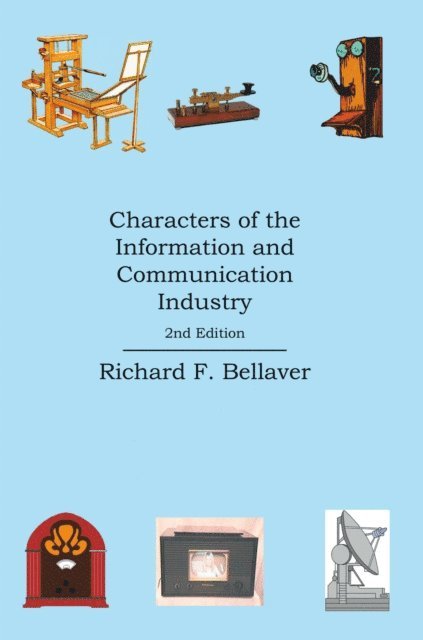
I have taught a graduate course on the history of the information and communications industry for 20 years. The course shows students how the world has moved from primitive communication to the integrated multi-media situation we are in today. Concentration is on the fields of journalism, telecommunications, broadcasting, and computing. Emphasis is placed on the leaders of the areas and the political and cultural surroundings that encouraged or discouraged growth of the industry. It is true that technology is a driving force of this industry, but it has been the individual people (characters) impelled by discovery, acceptance and marketability of that technology who have taken the next step to improve communication. The Journalism field started with Gutenberg and early added Ben Franklin, later it got a little yellow with Hearst and Pulitzer. I think Henry Luce started the business of media integration, but Rupert Murdoch certainly keeps it going. The first practical use of electricity was found by Samuel Morse and his telegraph. Bell invented the telephone, or was it Meucci? Theodore Vail invented the Bell System. Broadcasting started with Marconis invention, or was it Teslas? David Sarnoff and William Paley made the medium practical and characters like Edwin R. Morrow, Walter Cronkite and even Oprah Winfrey gave it credibility. Certainly Charles Babbage and Ada Lovelace had something to do with the start of computers, but later scientists Vannevar bush and Jon von Neumann added the electronics. Then UNIVAC convinced Thomas Watson Junior that IBM better start making them. Jobs and Wozniac started the personal computer business, but Bill Gates created the software to make them run. Tim Berners-Lee hooked those computers to a network and then Amazon, eBay, and Google found a way to make money using the result. This book is the story of these people and companies.
Inbunden, Engelska, 2001
967 kr
Skickas inom 5-8 vardagar
This resource provides a thorough, up-to-date understanding of knowledge management (KM) and details the techniques needed to identify, manage, control the flow, store, and share access to information. Utilizing real-world case studies and in-depth discussions, the book is designed to help the reader develop a strategy for implementing programs to take advantage of the power of knowledge, create systems to make knowledge readily available throughout an organization, and prepare directory systems that provide a source for locating and interacting with knowledge workers and automating the sharing of knowledge. From leveraging intangible knowledge assets, enterprise data warehousing, and data quality, to the three-level model for managing knowledge, the network economy, and groupware tools, the authors cover critical KM topics and show how knowledge management is a key strategic tool. Moreover, the book shows how to formulate an effective knowledge management policy that addresses technological, organizational and process elements.