
Richard J. T. Klein - Böcker
Visar alla böcker från författaren Richard J. T. Klein. Handla med fri frakt och snabb leverans.
3 produkter
3 produkter
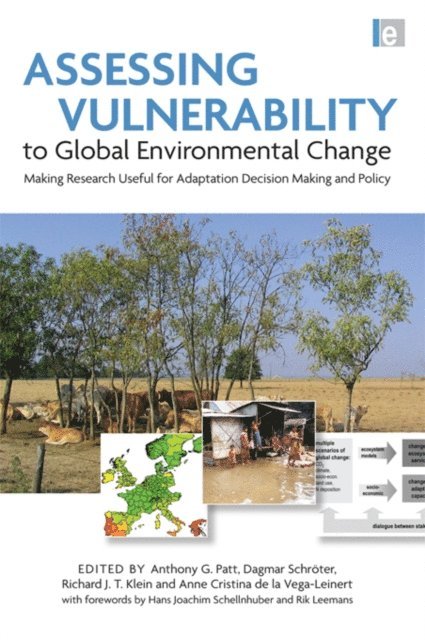
Assessing Vulnerability to Global Environmental Change
Making Research Useful for Adaptation Decision Making and Policy
Inbunden, Engelska, 2008
1 292 kr
Skickas inom 10-15 vardagar
Assessing the vulnerability of human populations to global environmental change, particularly climate change, is now the main imperative of research and international action. However, much of the research into vulnerability is not designed to feed directly into decision making and policy, creating a gap between the knowledge created by researchers and what is required by decision makers. This book seeks to rectify this problem and bridge the gap. It discusses vulnerability as the central theme and brings together many different applications from disaster studies, climate change impact studies and several other fields and provides the most comprehensive synthesis of definitions, theories, formalization and applications to date, illustrated with examples from different disciplines, regions and periods, and from local through to regional, national and international levels.Case study topics cover sea level rise, vulnerability to changes in ecosystem services, assessing the vulnerability of human health and 'double exposure' to climate change and trade liberalization amongst other issues. Research outcomes stress that science-policy dialogues must be transparent to be effective and concentrate on a mutual understanding of the concepts used. A key research finding is that the most useful information for decision makers is that which shows the separate causes and drivers of vulnerability, rather than presenting vulnerability in an aggregated form. The book concludes with a unifying framework for analysing integrated methodologies of vulnerability assessment and guiding how research and policy can be linked to reduce vulnerability.
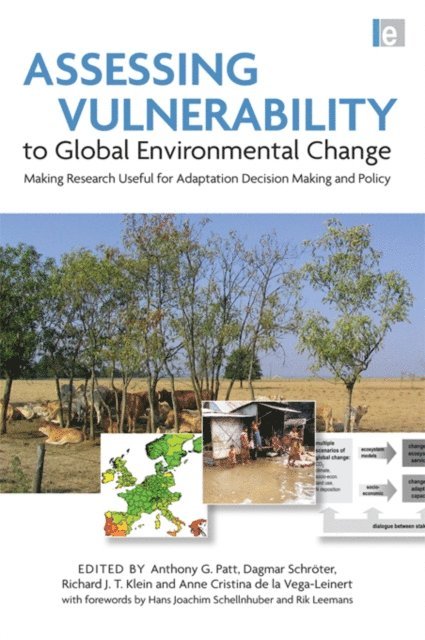
Assessing Vulnerability to Global Environmental Change
Making Research Useful for Adaptation Decision Making and Policy
Häftad, Engelska, 2010
616 kr
Skickas inom 10-15 vardagar
Assessing the vulnerability of human populations to global environmental change, particularly climate change, is now the main imperative of research and international action. However, much of the research into vulnerability is not designed to feed directly into decision making and policy, creating a gap between the knowledge created by researchers and what is required by decision makers. This book seeks to rectify this problem and bridge the gap. It discusses vulnerability as the central theme and brings together many different applications from disaster studies, climate change impact studies and several other fields and provides the most comprehensive synthesis of definitions, theories, formalization and applications to date, illustrated with examples from different disciplines, regions and periods, and from local through to regional, national and international levels.Case study topics cover sea level rise, vulnerability to changes in ecosystem services, assessing the vulnerability of human health and 'double exposure' to climate change and trade liberalization amongst other issues. Research outcomes stress that science-policy dialogues must be transparent to be effective and concentrate on a mutual understanding of the concepts used. A key research finding is that the most useful information for decision makers is that which shows the separate causes and drivers of vulnerability, rather than presenting vulnerability in an aggregated form. The book concludes with a unifying framework for analysing integrated methodologies of vulnerability assessment and guiding how research and policy can be linked to reduce vulnerability.
1 617 kr
Tillfälligt slut
The Third Assessment Report of the Intergovernmental Panel on Climate Change (IPCC) has presented strong evidence that human-induced climate change is occurring and that all countries of the world will be affected and need to adapt to impacts. The IPCC points out that many developing countries are particularly vulnerable because of their relatively low adaptive capacity. Therefore it is seen as a development priority to help these countries enhance their adaptive capacity to climate change.The Potsdam Institute for Climate Impact Research and Stratus Consulting organized a workshop in the fall of 2001 to develop an agenda for research on how best to enhance the capacity of developing countries to adapt to climate change. This research agenda is relevant for governments and institutions that wish to support developing countries in adapting to climate change. The workshop brought together experts from developing and industrialized countries, non-governmental organizations, and multilateral and bilateral donor organizations to discuss a number of important topics related to adaptation, adaptive capacity and sustainable development. A dozen papers were commissioned to cover these topics, both from a theoretical perspective and in the form of national case studies. The papers form the basis for this important book, which presents the latest interdisciplinary knowledge about the nature and components of adaptive capacity and how it may be strengthened.