Richard Stivers – författare
Visar alla böcker från författaren Richard Stivers. Handla med fri frakt och snabb leverans.
18 produkter
18 produkter
Häftad, Engelska, 2004
448 kr
Skickas inom 10-15 vardagar
To varying degrees, loneliness has us all in its grip. In this incisive and controversial book, Richard Stivers rejects the recent emphasis on genetic explanations of psychological problems, arguing that the very organization of technological societies is behind the pervasive experience of loneliness. The extreme rationality that governs our institutions and organizations results in abstract and impersonal relationships in much of daily life. Moreover, as common meaning is gradually eroded, our connections to others become vague and tenuous. Our ensuing fear and loneliness, however, can be masked by an outgoing, extroverted personality. In its extreme form, loneliness assumes pathological dimensions in neurosis and schizophrenia. Stivers maintains that even here the causes remain social. The various forms of neuroses and psychoses follow the key contradictions of a technological society. For instance, narcissism and depression reflect the tension between power and meaninglessness that characterizes modern societies. Stivers demonstrates that there is a continuum from the normal 'technological personality' through the various neuroses to full-blown schizophrenia. He argues that all forms of loneliness emanate from the same cause; they likewise share a common dynamic despite their differences. Loneliness, in its many manifestations, seems to be the price we must pay for living in the modern world. Yet nurturing family, friend, and community ties can mitigate its culturally and psychologically disorganizing power. This book is a clarion call for a renewal of moral awareness and custom to combat the fragmentation and depersonalization of our technological civilization.
Häftad, Engelska, 2009
489 kr
Skickas inom 3-6 vardagar
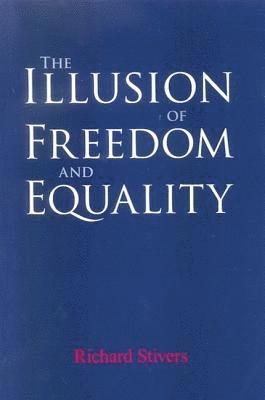
Explores how Enlightenment values have been transformed in a technological civilization.Arguing that the ideology of freedom and equality today bears little resemblance to its eighteenth-century counterpart, Richard Stivers examines how these values have been radically transformed in a technological civilization. Once thought of as a kind of personal property and an aspect of the dignity of the individual, the context of freedom and equality today is technological before it is political and economic and is also now largely thought of in collective terms. Focusing on the work of Jacques Ellul and Max Weber, Stivers traces the development of freedom and equality in Enlightenment thought and American history and then proceeds to discuss their current ideologies, realities, and illusions.
Häftad, Engelska, 2020
243 kr
Skickas inom 5-8 vardagar
Inbunden, Engelska, 2020
417 kr
Skickas inom 5-8 vardagar
E-bok
PDF, Engelska, 2020374 kr
Läs direkt efter köp
Richard Stivers' concern is with the social construction of evil, that is, with how modern societies, in a partly unconscious way, create evil as a category of the sacred and how symbols, myths, and rituals of evil are related to this. He is interested, moreover, in how modern societies provoke individuals to commit evil actions. This fascinating and stimulating book is the first attempt to work out in detail how the concepts of the sacred, symbol, myth, and ritual form a cultural configuration in modern technological societies, and not just in traditional societies.
Häftad, Engelska, 2019
273 kr
Skickas inom 5-8 vardagar
Inbunden, Engelska, 2019
452 kr
Skickas inom 5-8 vardagar
E-bok
PDF, Engelska, 2019435 kr
Läs direkt efter köp
"e;Not only is this study meticulous in its methodology and insightful in its perceptions, but it is remarkable in its very successful interdisciplinary approach. A must for students of Irish and Irish American Studies."e;--Emmet Larkin, The University of Chicago"e;A work of great significance in studies of American immigrant history and in studies of American drinking patterns. It is a welcome event to see Richard Stivers' brilliant study make a reappearance."e;--Joseph Gusfield, University of California, San Diego"e;A classic contribution to our understanding of drinking, gender and culture, how myth and masculinity intertwine to produce unique patterns of alcohol use and abuse."e;--Norman K. Denzin, University of Illinois, Urbana-Champaign"e;Absorbing and well-written. . . . Stivers is careful to emphasize the implications of his findings for the sociological study of deviant behavior, of stereotyping, and of ethnic relations. Stivers is rapidly establishing himself as a recognized scholar of alcohol studies, and this latest contribution promises to become a classic."e;--Choice
Häftad, Engelska, 2020
276 kr
Skickas inom 5-8 vardagar
Inbunden, Engelska, 2020
450 kr
Skickas inom 5-8 vardagar
E-bok
Engelska, 2020438 kr
Läs direkt efter köp
The Media Creates Us in Its Image and Other Essays on Technology and Culture proposes that modern technology seriously influences every aspect of culture and personality. Technology shapes our beliefs and values and even how we think of ourselves. It affects religion, morality, education, language, communication, and sexual identity. Every institution, every organization, is brought under its purview. This book attempts to awaken the reader to the destructive side of modern technology that exists side-by-side with its constructive side. What modern technology is destroying, however, is the very meaning of being human. The essay "e;The Media Creates Us in Its Image"e; makes this case most dramatically. The book asks the reader the following question: Is what you have gained from the use of modern technology more important than what you have lost? How do we once again bring technology under our control in the face of its inexorable "e;progress"e;?
Häftad, Engelska, 1994
553 kr
Skickas inom 5-8 vardagar
In 1987, Professor Richard Stivers was the recipient of an Earhart Foundation research fellowship to undertake a study of American morality. The Culture of Cynicism is the result. It is not only the most wide-ranging book yet written on the subject, tracing the intellectual history of American morality from its European origins in the Middle Ages to the 1990s, but alos by far the most thought-provoking.
Häftad, Engelska, 2023
284 kr
Skickas inom 5-8 vardagar
Inbunden, Engelska, 2023
463 kr
Skickas inom 5-8 vardagar
Inbunden, Engelska, 2021
330 kr
Skickas inom 5-8 vardagar
E-bok
Engelska, 2021311 kr
Läs direkt efter köp
Religion in American Today describes how sacred powers and secular religions have overtaken and infiltrated Christianity. Secular religion is now dominant in America: It assumes the forms of personal religion and political religion. Christianity makes its living within the confines of these secular religions. The point of the book is to identify the idolatry in what now passes for Christianity. Technology and the political state are socially constructed as sacred powers. As such they are idols. In its slumber Christianity embraces technology and the political state to the point of becoming subordinate to them. Concurrently technology and the political state give rise to the dominant secular religions. Personal religion acts as a consumer service, a psychological technique, to acquire health and happiness in this life. Political religion is a consequence of politics replacing religion in the quest for collective meaning in a technological society. Political movements become religious revivals and political parties, churches. This book is an attempt to awaken Christians to the idols that beckon.
Häftad, Engelska, 2021
200 kr
Skickas inom 5-8 vardagar
Inbunden, Engelska, 2008
1 042 kr
Tillfälligt slut
Explores how Enlightenment values have been transformed in a technological civilization.Arguing that the ideology of freedom and equality today bears little resemblance to its eighteenth-century counterpart, Richard Stivers examines how these values have been radically transformed in a technological civilization. Once thought of as a kind of personal property and an aspect of the dignity of the individual, the context of freedom and equality today is technological before it is political and economic and is also now largely thought of in collective terms. Focusing on the work of Jacques Ellul and Max Weber, Stivers traces the development of freedom and equality in Enlightenment thought and American history and then proceeds to discuss their current ideologies, realities, and illusions.