Robert C. Berwick - Böcker
Visar alla böcker från författaren Robert C. Berwick. Handla med fri frakt och snabb leverans.
8 produkter
8 produkter
458 kr
Skickas inom 5-8 vardagar
This book addresses one of the most famous and controversial arguments in the study of language and mind, the Poverty of the Stimulus. Presented by Chomsky in 1968, the argument holds that children do not receive enough evidence to infer the existence of core aspects of language, such as the dependence of linguistic rules on hierarchical phrase structure. The argument strikes against empiricist accounts of language acquisition and supports the conclusion that knowledge of some aspects of grammar must be innate. In the first part of Rich Languages from Poor Inputs, contributors consider the general issues around the Poverty of the Stimulus argument, review the empirical data, and offer new and plausible explanations. This is followed by a discussion of the processes of language acquisition, and observed 'gaps' between adult and child grammar, concentrating on the late spontaneous acqquisition by children of some key syntactic principles, mainly, though not exclusively, between the ages of 5 and 9. The last part of the book widens the horizon beyond language acquisition in the narrow sense, examining the natural development of reading and writing and of the child's growing sensitivity for the fine arts.
1 871 kr
Skickas inom 3-6 vardagar
This book is the first dedicated to linguistic parsing - the processing of natural language according to the rules of a formal grammar - in the Minimalist Program. While Minimalism has been at the forefront of generative grammar for several decades, it often remains inaccessible to computer scientists and others in adjacent fields. This volume makes connections with standard computational architectures, provides efficient implementations of some fundamental minimalist accounts of syntax, explores implementations of recent theoretical proposals, and explores correlations between posited structures and measures of neural activity during human language comprehension. These studies will appeal to graduate students and researchers in formal syntax, computational linguistics, psycholinguistics, and computer science.
553 kr
Skickas inom 5-8 vardagar
This book is the first dedicated to linguistic parsing - the processing of natural language according to the rules of a formal grammar - in the Minimalist Program. While Minimalism has been at the forefront of generative grammar for several decades, it often remains inaccessible to computer scientists and others in adjacent fields. This volume makes connections with standard computational architectures, provides efficient implementations of some fundamental minimalist accounts of syntax, explores implementations of recent theoretical proposals, and explores correlations between posited structures and measures of neural activity during human language comprehension. These studies will appeal to graduate students and researchers in formal syntax, computational linguistics, psycholinguistics, and computer science.
1 301 kr
Skickas inom 5-8 vardagar
This book addresses one of the most famous and controversial arguments in the study of language and mind, the Poverty of the Stimulus. Presented by Chomsky in 1968, the argument holds that children do not receive enough evidence to infer the existence of core aspects of language, such as the dependence of linguistic rules on hierarchical phrase structure. The argument strikes against empiricist accounts of language acquisition and supports the conclusion that knowledge of some aspects of grammar must be innate. In the first part of Rich Grammars from Poor Inputs, contributors consider the general issues around the POS argument, review the empirical data, and offer new and plausible explanations. This is followed by a discussion of the the processes of language acquisition, and observed 'gaps' between adult and child grammar, concentrating on the late spontaneous acquisition by children of some key syntactic principles, basically, though not exclusively, between the ages of 5 to 9. Part 3 widens the horizon beyond language acquisition in the narrow sense, examining the natural development of reading and writing and of the child's growing sensitivity for the fine arts.
137 kr
Tillfälligt slut
284 kr
Skickas
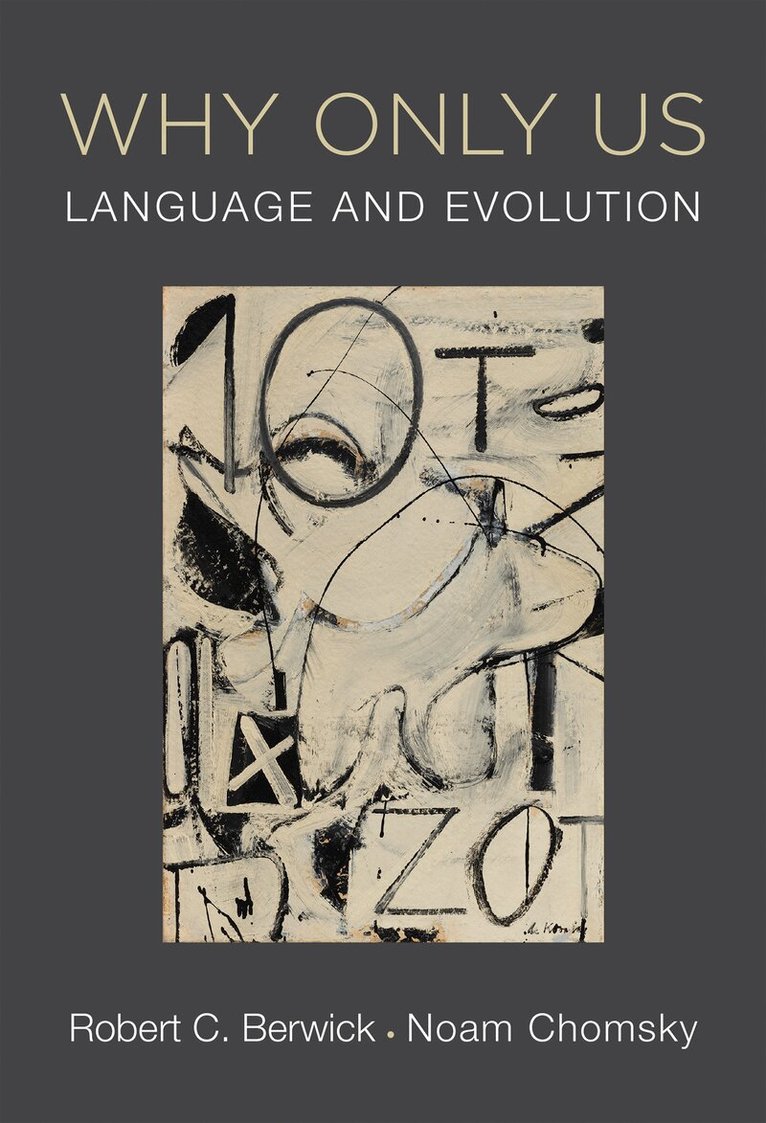
Berwick and Chomsky draw on recent developments in linguistic theory to offer an evolutionary account of language and humans' remarkable, species-specific ability to acquire it."A loosely connected collection of four essays that will fascinate anyone interested in the extraordinary phenomenon of language."— New York Review of BooksWe are born crying, but those cries signal the first stirring of language. Within a year or so, infants master the sound system of their language; a few years after that, they are engaging in conversations. This remarkable, species-specific ability to acquire any human language—"the language faculty"—raises important biological questions about language, including how it has evolved. This book by two distinguished scholars—a computer scientist and a linguist—addresses the enduring question of the evolution of language.Robert Berwick and Noam Chomsky explain that until recently the evolutionary question could not be properly posed, because we did not have a clear idea of how to define "language" and therefore what it was that had evolved. But since the Minimalist Program, developed by Chomsky and others, we know the key ingredients of language and can put together an account of the evolution of human language and what distinguishes us from all other animals.Berwick and Chomsky discuss the biolinguistic perspective on language, which views language as a particular object of the biological world; the computational efficiency of language as a system of thought and understanding; the tension between Darwin's idea of gradual change and our contemporary understanding about evolutionary change and language; and evidence from nonhuman animals, in particular vocal learning in songbirds.
241 kr
Skickas inom 7-10 vardagar
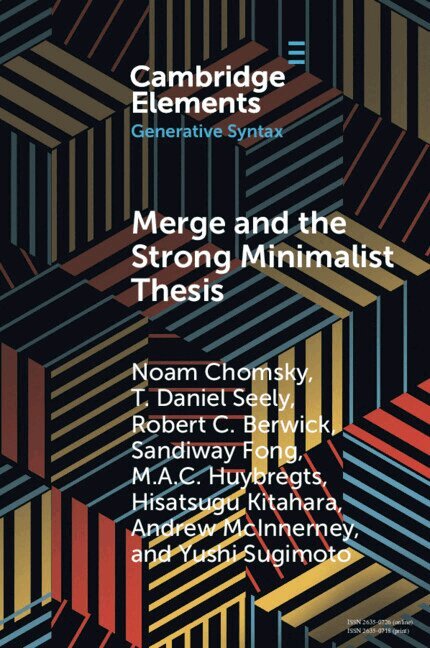
The goal of this contribution to the Elements series is to closely examine Merge, its form, its function, and its central role in current linguistic theory. It explores what it does (and does not do), why it has the form it has, and its development over time. The basic idea behind Merge is quite simple. However, Merge interacts, in intricate ways, with other components including the language's interfaces, laws of nature, and certain language-specific conditions. Because of this, and because of its fundamental place in the human faculty of language, this Element's focus on Merge provides insights into the goals and development of generative grammar more generally, and its prospects for the future.
775 kr
Skickas inom 7-10 vardagar
The goal of this contribution to the Elements series is to closely examine Merge, its form, its function, and its central role in current linguistic theory. It explores what it does (and does not do), why it has the form it has, and its development over time. The basic idea behind Merge is quite simple. However, Merge interacts, in intricate ways, with other components including the language's interfaces, laws of nature, and certain language-specific conditions. Because of this, and because of its fundamental place in the human faculty of language, this Element's focus on Merge provides insights into the goals and development of generative grammar more generally, and its prospects for the future.