Robert J. Weber – författare
Visar alla böcker från författaren Robert J. Weber. Handla med fri frakt och snabb leverans.
7 produkter
7 produkter
Inbunden, Engelska, 1993
807 kr
Skickas inom 5-8 vardagar
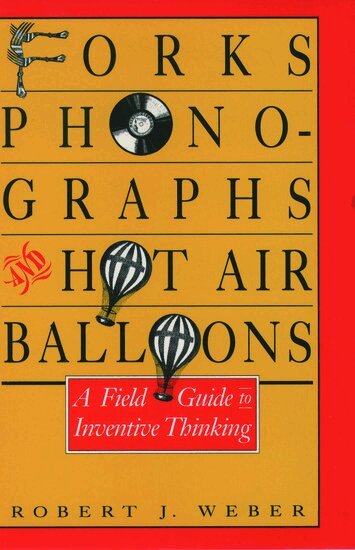
Wheels, doorknobs, forks, and sewing needles are such everyday items that we rarely bother to wonder how they were invented. But where did the idea for the tea bag come from? Or the waterscrew, synthesizers, or genetic engineering? Drawing on hundreds of examples, this intriguing book sheds new light on human ingenuity from the Stone Age to the present day. Arguing that all inventions are the result of the same basic principles rather than random inspiration, cognitive psychologist Robert Weber reveals our mind's amazing capacity for problem-solving, and encourages us to take a fresh look at the world around us and tap into our own creativity.
Inbunden, Engelska, 1993
1 421 kr
Skickas inom 5-8 vardagar
Is invention really "99 percent perspiration and one percent inspiration" as Thomas Edison assured us? Inventive Minds assembles a group of authors well equipped to address this question: contemporary inventors of important new technologies, historians of science and industry, and cognitive psychologists interested in the process of creativity. In telling their stories, the inventors describe the origins of such remarkable devices as ultrasound, the electron microscope, and artificial diamonds. The historians help us look into the minds of innovators like Thomas Edison, Alexander Graham Bell, Michael Faraday, and the Wright brothers, drawing on original notebooks and other sources to show how they made their key discoveries. Finally, cognitive psychologists explore the mental processes that figure in creative thinking.Contributing to the authors' insight is their special focus on the "front end" of invention - where ideas come from and how they are transformed into physical prototypes. They answer three questions: How does invention happen? How does invention contrast with other commonly creative pursuits such as scientific inquiry, musical composition, or painting? And how might invention best happen - that is, what kinds of settings, conditions, and strategies appear to foster inventive activity? The book yields a wealth of information that will make absorbing reading for cognitive and social psychologists, social historians, and many working scientists and general readers who are interested in the psychology of personality and the roots of ingenuity.
E-bok
PDF, Engelska, 1993463 kr
Läs direkt efter köp
How do inventions take shape? How did the inventors of the sewing needle, the hammer, or the wheel find their ideas? Are these creations the result of random events, or are hidden principles at work? Using everyday objects most of us take for granted--from forks and Velcro to safety pins and doorknobs--noted cognitive psychologist Robert Weber takes a fascinating look at how our world of inventions came into being, and how the mind''s problem-solving abilities gave them the forms they have. As an archaeologist studies shards of pottery for clues about an ancient culture, Weber examines the many forms of inventions, from stone knives to genetically engineered mice, and finds a rich record of the work of many minds over time--a record of human creativity and problem-solving handed down through the centuries. He offers various methods for analyzing what mental paths might have been taken by these inventive minds. In the test for design, for example, he ponders how an item would work if various components were shuffled or constructed differently, revealing how the optimal shape of the invention was discovered. He challenges the reader to engage in thought experiments to explore how the horse-drawn cart, the waterscrew, or the fork might have taken shape over many years, through the efforts of successive inventors and adapters. In stripping these simple artifacts to the bone, Weber finds a hidden intelligence at work in everyday objects as well as recurrent heuristics (basic principles or rules of thumb) that are common among many of our most successful inventions--heuristics powerful enough to generate endless new ideas. Weber ranges across the work of Archimedes, Leonardo da Vinci, the Wright brothers, as well as grade-school children who have won national awards for their inventions, revealing that the same principles are at work in the discoveries of all of them. Basic principles of invention, he writes, govern how we think, solve, and manipulate ideas, whether mechanical or mental, real or mythological. Weber''s playful, original, and insightful look at the inventions around us reveals a hidden intelligence in everything from screws to tea bags to synthesizers--an intelligence based on principles of creativity and problem-solving. His fascinating account sheds light on how the mind hones its most original thoughts and products, and provides a field guide for how we can tap into our own creativity.
Häftad, Engelska, 2001
306 kr
Skickas inom 5-8 vardagar
In today’s culture the self is considered largely a work in progress, and as we constantly reinvent ourselves, the challenge becomes one of coordinating change with the integrity and unity of the self. Using the insights of William James and evolutionary psychology as a springboard, Robert Weber explores the nature and meaning of our shifting selves. He proposes an ecology of the self based on three distinct but interdependent spheres: the body, the persona, and the spirit. Our bodily selves can be cosmetically nipped and tucked, and through new reproductive technologies extended in ways previously undreamed of. Our personas, comprising both our self-image and the image we present to others, are constantly assuming multiple roles in the course of our daily lives. And finally the modern changing self finds spiritual fulfillment in myriad traditional and nontraditional cultures, both sacred and secular, as we craft beliefs to suit our individual and communal needs.
Del 1 - IEEE Press Series on RF and Microwave Technology
Introduction to Microwave Circuits
Radio Frequency and Design Applications
Inbunden, Engelska, 2001
2 319 kr
Skickas inom 5-8 vardagar
"Do you want to design a wireless transmitter or receiver for hand-held telephones? Have you wondered why the printed circuit wires on high-frequency circuits don't always run in a straight line? This valuable text will answer all of your questions regarding component parasitics and circuit characterization for rf/microwave amplifier, oscillator, and filter circuit design and analysis. You will understand why capacitors act as inductors and vice versa and why amplifiers work like oscillators, while oscillators for local area networks work more like local area heaters. Application of the information in Introduction to Microwave Circuits will reduce design-cycle time and costs, markedly increasing the probability of first-time success in printed circuit or monolithic microwave integrated circuit (MMIC) design. Several approaches are taken into consideration, such as the effects of currents on the ground plane, bypass and coupling capacitors, and nonlinear effects in linear circuits. Featured topics include:* Incorporation of component parasitics in the design cycle* Closed form solution to oscillator design* Odd mode stability analysis* PIN diode analysis for high-power switching applications An integrated design example of a 1.25 GHz amplifier, oscillator, and filter printed circuit is also included, which could be useful in printed circuit board designs from tens of megahertz to tens of gigahertz. Introduction to Microwave Circuits provides the tools necessary to analyze or synthesize microwave circuits. This text is an essential reference for undergraduate students, microwave engineers, and administrators. Also, it will assist experienced designers in other fields to meet the current rapid expansion of communication system applications and work effectively in microwave circuit design. About the Author Robert J. Weber began his prolific career in the Solid State Research Laboratory at the Collins Radio Company, later a part of Rockwell International. For 25 years, he worked on advanced development and applied research in the one- to ten-gigahertz frequency range and received several distinguished awards for his valuable contributions to the field. Dr. Weber is involved in ongoing experimental research in integrating microwave circuits with other devices such as MEMS, chemical sensors, and electro-optics. Also, he teaches microwave circuit design and fiber-optics communications at the Department of Electrical and Computer Engineering, Iowa State University. Dr. Weber is an IEEE Fellow." Sponsored by:IEEE Microwave Theory and Techniques Society.
Häftad, Engelska, 2026
214 kr
Skickas inom 5-8 vardagar
Del 39 - Monografías a
Galdós Studies II
Häftad, Engelska
457 kr
Tillfälligt slut