Robert Pitofsky – författare
Visar alla böcker från författaren . Handla med fri frakt och snabb leverans.
5 produkter
5 produkter
Häftad, Engelska, 2008
912 kr
Skickas inom 5-8 vardagar
How the Chicago School Overshot the Mark is about the rise and recent fall of American antitrust. It is a collection of 15 essays, almost all expressing a deep concern that conservative economic analysis is leading judges and enforcement officials toward an approach that will ultimately harm consumer welfare. For the past 40 years or so, U.S. antitrust has been dominated intellectually by an unusually conservative style of economic analysis. Its advocates, often referred to as "The Chicago School," argue that the free market (better than any unelected band of regulators) can do a better job of achieving efficiency and encouraging innovation than intrusive regulation. The cutting edge of Chicago School doctrine originated in academia and was popularized in books by brilliant and innovative law professors like Robert Bork and Richard Posner. Oddly, a response to that kind of conservative doctrine may be put together through collections of scores of articles but until now cannot be found in any one book. This collection of essays is designed in part to remedy that situation. The chapters in this book were written by academics, former law enforcers, private sector defense lawyers, Republicans and Democrats, representatives of the left, right and center. Virtually all agree that antitrust enforcement today is better as a result of conservative analysis, but virtually all also agree that there have been examples of extreme interpretations and misinterpretations of conservative economic theory that have led American antitrust in the wrong direction. The problem is not with conservative economic analysis but with those portions of that analysis that have "overshot the mark" producing an enforcement approach that is exceptionally generous to the private sector. If the scores of practices that traditionally have been regarded as anticompetitive are ignored, or not subjected to vigorous enforcement, prices will be higher, quality of products lower, and innovation diminished. In the end consumers will pay.
Inbunden, Engelska, 2008
2 341 kr
Skickas inom 5-8 vardagar
How the Chicago School Overshot the Mark is about the rise and recent fall of American antitrust. It is a collection of 15 essays, almost all expressing a deep concern that conservative economic analysis is leading judges and enforcement officials toward an approach that will ultimately harm consumer welfare. For the past 40 years or so, U.S. antitrust has been dominated intellectually by an unusually conservative style of economic analysis. Its advocates, often referred to as "The Chicago School," argue that the free market (better than any unelected band of regulators) can do a better job of achieving efficiency and encouraging innovation than intrusive regulation. The cutting edge of Chicago School doctrine originated in academia and was popularized in books by brilliant and innovative law professors like Robert Bork and Richard Posner. Oddly, a response to that kind of conservative doctrine may be put together through collections of scores of articles but until now cannot be found in any one book. This collection of essays is designed in part to remedy that situation. The chapters in this book were written by academics, former law enforcers, private sector defense lawyers, Republicans and Democrats, representatives of the left, right and center. Virtually all agree that antitrust enforcement today is better as a result of conservative analysis, but virtually all also agree that there have been examples of extreme interpretations and misinterpretations of conservative economic theory that have led American antitrust in the wrong direction. The problem is not with conservative economic analysis but with those portions of that analysis that have "overshot the mark" producing an enforcement approach that is exceptionally generous to the private sector. If the scores of practices that traditionally have been regarded as anticompetitive are ignored, or not subjected to vigorous enforcement, prices will be higher, quality of products lower, and innovation diminished. In the end consumers will pay.
E-bok
PDF, Engelska, 2008465 kr
Läs direkt efter köp
How the Chicago School Overshot the Mark is about the rise and recent fall of American antitrust. It is a collection of 15 essays, almost all expressing a deep concern that conservative economic analysis is leading judges and enforcement officials toward an approach that will ultimately harm consumer welfare. For the past 40 years or so, U.S. antitrust has been dominated intellectually by an unusually conservative style of economic analysis. Its advocates, often referred to as "The Chicago School," argue that the free market (better than any unelected band of regulators) can do a better job of achieving efficiency and encouraging innovation than intrusive regulation. The cutting edge of Chicago School doctrine originated in academia and was popularized in books by brilliant and innovative law professors like Robert Bork and Richard Posner. Oddly, a response to that kind of conservative doctrine may be put together through collections of scores of articles but until now cannot be found in any one book. This collection of essays is designed in part to remedy that situation. The chapters in this book were written by academics, former law enforcers, private sector defense lawyers, Republicans and Democrats, representatives of the left, right and center. Virtually all agree that antitrust enforcement today is better as a result of conservative analysis, but virtually all also agree that there have been examples of extreme interpretations and misinterpretations of conservative economic theory that have led American antitrust in the wrong direction. The problem is not with conservative economic analysis but with those portions of that analysis that have "overshot the mark" producing an enforcement approach that is exceptionally generous to the private sector. If the scores of practices that traditionally have been regarded as anticompetitive are ignored, or not subjected to vigorous enforcement, prices will be higher, quality of products lower, and innovation diminished. In the end consumers will pay.
E-bok
Engelska, 2008421 kr
Läs direkt efter köp
How the Chicago School Overshot the Mark is about the rise and recent fall of American antitrust. It is a collection of 15 essays, almost all expressing a deep concern that conservative economic analysis is leading judges and enforcement officials toward an approach that will ultimately harm consumer welfare. For the past 40 years or so, U.S. antitrust has been dominated intellectually by an unusually conservative style of economic analysis. Its advocates, often referred to as "The Chicago School," argue that the free market (better than any unelected band of regulators) can do a better job of achieving efficiency and encouraging innovation than intrusive regulation. The cutting edge of Chicago School doctrine originated in academia and was popularized in books by brilliant and innovative law professors like Robert Bork and Richard Posner. Oddly, a response to that kind of conservative doctrine may be put together through collections of scores of articles but until now cannot be found in any one book. This collection of essays is designed in part to remedy that situation. The chapters in this book were written by academics, former law enforcers, private sector defense lawyers, Republicans and Democrats, representatives of the left, right and center. Virtually all agree that antitrust enforcement today is better as a result of conservative analysis, but virtually all also agree that there have been examples of extreme interpretations and misinterpretations of conservative economic theory that have led American antitrust in the wrong direction. The problem is not with conservative economic analysis but with those portions of that analysis that have "overshot the mark" producing an enforcement approach that is exceptionally generous to the private sector. If the scores of practices that traditionally have been regarded as anticompetitive are ignored, or not subjected to vigorous enforcement, prices will be higher, quality of products lower, and innovation diminished. In the end consumers will pay.
Inbunden, Engelska, 1991
960 kr
Skickas inom 10-15 vardagar
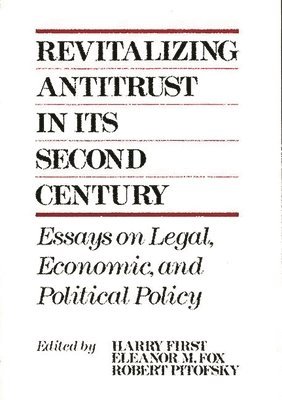
America has entered its second century of antitrust law. The United States has come through the 1980s of laissez faire when antitrust had its lowest profile since the Hoover days, lawyers advised clients that anything goes, and theorists justified non-enforcement of the law by Chicago School economics--the claim that antitrust exists only to create efficiency and that business freedom creates efficiency. Meanwhile, the European Community has a developing body of antitrust law. It rejects the Chicago School as ignoring market realities, and it incorporates into its law values of opportunity, access, open markets and the right to be free from exploitation. The newly democratized European nations and Russia all have moved to market economies and adopted antitrust law in the image of the European Community, in spite of the carpet baggers trying to sell laissez faire. The Supreme Court of the United States has now reversed the swing of the U.S. antitrust pendulum, rejecting Chicago School theory in favor of market reality and accepting the fact that there is an antitrust right not to be coerced and abused by market power.What is the intellectual foundation of this new antitrust--this law that respects efficiency, progressiveness, access, and freedom from abuse of power, and which reflects the need of business firms to be active and agile players in a global marketplace? That foundation is contained in Revitalizing Antitrust in its Second Century. This is the only book that provides the underpinnings for the new antitrust. It is the only book that helps the scholar/lawyer/business advisor/student understand the direction of antitrust and how to predict the course of the law. Four of the authors in the book were cited by the Supreme Court in its June opinion; one was cited eleven times. Revitalizing Antitrust in its Second Century is an indispensable volume for lawyers, economists, business advisors, sholars and students of law, economics, business and political economy.