Roel Rutten – författare
2 246 kr
Skickas inom 10-15 vardagar
2 746 kr
Skickas inom 10-15 vardagar
612 kr
Skickas inom 10-15 vardagar
2 386 kr
Skickas inom 10-15 vardagar
869 kr
Läs direkt efter köp
869 kr
Läs direkt efter köp
919 kr
Läs direkt efter köp
819 kr
Läs direkt efter köp
The book aims to identify key issues and developments in ASEAN-5 that illustrate the transition of this region towards a knowledge-based economy. The book contributes to understanding the opportunities and challenges faced by emerging economies. It explains the transition process from a knowledge based perspective, showing how knowledge creation and innovation contribute to the competitiveness of companies and sectors in this region. The book takes a distinctly ASEAN perspective by discussing examples of the transition process from all ASEAN 5 nations that show how this region is attempting to link up to the global knowledge economy of the 21st Century.
To achieve these aims the book is divided into three parts, preceded by an introductory chapter explaining the logic, objectives and contributions of the book. Part I discusses ASEAN-5 as an emerging hub in the global economy. Part II discusses the global links of the ASEAN region. Part III highlights innovation support in the ASEAN region. Each part identifies key developments and discusses relevant challenges and opportunities regarding the economic transition process based on examples for the various ASEAN-5 nations.
The book contributes to the literature on emerging economies by explaining their challenges and opportunities of the catching-up process from a knowledge-based perspective. It is definitely a must-read.
819 kr
Läs direkt efter köp
The book aims to identify key issues and developments in ASEAN-5 that illustrate the transition of this region towards a knowledge-based economy. The book contributes to understanding the opportunities and challenges faced by emerging economies. It explains the transition process from a knowledge based perspective, showing how knowledge creation and innovation contribute to the competitiveness of companies and sectors in this region. The book takes a distinctly ASEAN perspective by discussing examples of the transition process from all ASEAN 5 nations that show how this region is attempting to link up to the global knowledge economy of the 21st Century.
To achieve these aims the book is divided into three parts, preceded by an introductory chapter explaining the logic, objectives and contributions of the book. Part I discusses ASEAN-5 as an emerging hub in the global economy. Part II discusses the global links of the ASEAN region. Part III highlights innovation support in the ASEAN region. Each part identifies key developments and discusses relevant challenges and opportunities regarding the economic transition process based on examples for the various ASEAN-5 nations.
The book contributes to the literature on emerging economies by explaining their challenges and opportunities of the catching-up process from a knowledge-based perspective. It is definitely a must-read.
795 kr
Läs direkt efter köp
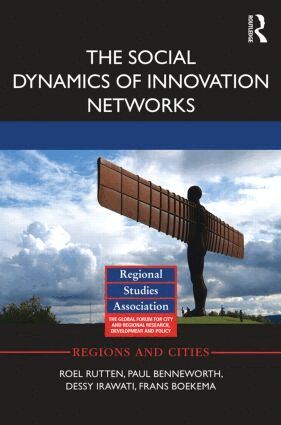
The social dynamics of innovation networks captures the important role of trust, social capital, institutions and norms and values in the creation of knowledge in innovation networks. In doing so, this book connects to a long-standing debate on the socio-spatial context of innovation in economic geography, which is usually referred to as the Territorial Models of Innovation (TIMs) literature.
This present volume breaks with the TIM literature in several important ways. In the first place, this book emphasizes the role of individual agency because individuals and their networks are increasingly recognized as the principal agents of knowledge creation. Secondly, this volume looks at space as a continuous field of opportunity rather than as bounded territory with a set of endowments, such as knowledge base and social capital. Although individually these elements are not new to the TIM literature, it has thus far failed to grasp their critical implication for studying the social dynamics of innovation networks.
The approach to the socio-spatial context of innovation in this volume is summarized as Knowledge Economy 2.0. It emphasizes that human creativity is now the main source of economic value and that human creativity and knowledge creation is not an organized process within organizations, but happens bottom up in formal and informal professional and social networks of individuals that cut across multiple organizations.
795 kr
Läs direkt efter köp
The social dynamics of innovation networks captures the important role of trust, social capital, institutions and norms and values in the creation of knowledge in innovation networks. In doing so, this book connects to a long-standing debate on the socio-spatial context of innovation in economic geography, which is usually referred to as the Territorial Models of Innovation (TIMs) literature.
This present volume breaks with the TIM literature in several important ways. In the first place, this book emphasizes the role of individual agency because individuals and their networks are increasingly recognized as the principal agents of knowledge creation. Secondly, this volume looks at space as a continuous field of opportunity rather than as bounded territory with a set of endowments, such as knowledge base and social capital. Although individually these elements are not new to the TIM literature, it has thus far failed to grasp their critical implication for studying the social dynamics of innovation networks.
The approach to the socio-spatial context of innovation in this volume is summarized as Knowledge Economy 2.0. It emphasizes that human creativity is now the main source of economic value and that human creativity and knowledge creation is not an organized process within organizations, but happens bottom up in formal and informal professional and social networks of individuals that cut across multiple organizations.
693 kr
Skickas inom 10-15 vardagar
800 kr
Skickas inom 10-15 vardagar
800 kr
Skickas inom 10-15 vardagar
713 kr
Skickas inom 10-15 vardagar
1 647 kr
Skickas inom 5-8 vardagar
430 kr
Läs direkt efter köp
Throughout the book, Rutten demonstrates how QCA’s interpretive logic pervades every step of a QCA study. He uses critical realism as a philosophical foundation to explain how QCA researchers develop their partial and perspectival knowledge of cases into Boolean expressions. Proposing multi-level sets as a way to acknowledge the diversity of social reality, Rutten criticises the use of fuzzy sets in QCA as a poor match to QCA’s threshold logic.
Comprehensive and innovative, this book is a vital read for social science methods experts and users. It is also an important book for QCA experts and students looking for a deeper understanding of QCA.
2 028 kr
Skickas inom 5-8 vardagar
Cooperation, Clusters, and Knowledge Transfer
Universities and Firms Towards Regional Competitiveness
1 089 kr
Skickas inom 10-15 vardagar
Cooperation, Clusters, and Knowledge Transfer
Universities and Firms Towards Regional Competitiveness
1 367 kr
Läs direkt efter köp
Cooperation, Clusters, and Knowledge Transfer
Universities and Firms Towards Regional Competitiveness
1 089 kr
Skickas inom 10-15 vardagar