Roger Heacock – författare
Visar alla böcker från författaren Roger Heacock. Handla med fri frakt och snabb leverans.
3 produkter
3 produkter
Inbunden, Engelska, 1990
1 082 kr
Skickas inom 10-15 vardagar
The theme is the struggle for Palestinian national liberation from `colonial' rule, of which the uprising since December 1987 is seen as the latest and most powerful phase. Most of the contributors are professionals in the occupied territories (in sociology, economics, political science, public health, etc.), and they write as scholars and firsthand observers as well as supporters of the intifada. There is much interesting material on the respective roles of villagers, urban workers, the merchant class and Palestinian women, as well as on the competing secular and Islamic wings of the nationalist movement. Foreign Affairs An unusually well-informed collection of 19 essays on the Palestinian uprising, or intifada, which has been underway since December 1987. The contributors know their subject and in composite they provide a clear, pithy (and sympathetic) picture of the economic, political, and social underpinnings of the uprising. Although the perspective is generally inside looking outward, there are several good chapters on the international aspects of the intifada. . . . Highly recommended for academic libraries. ChoiceThis edited volume presents a historical background of the occupation and its nature and ramifications to Palestinian nationalism. Its coverage also embraces the catalysts for and the revolutionary transformation of the Palestinian uprising and it includes an interim assessment of the achievements and failures of the Intifada. By relying on first-hand original Arabic and Hebrew sources, the book provides a comprehensive survey and analysis of the Palestinian uprising. Intifada's perspective is unique in that many of its contributors have been actual participants in the uprising as well as its professional observers.Part I presents the setting and conditions that gave rise to the uprising, with an analysis of the nature of the occupation, a presentation of the colonial economic policies imposed by the Israelis and the development of the Palestinian political consciousness, and an analysis of the infrastructure of the resistance. Part II looks at the participants of the uprising from several different perspectives: refugee camps, villages, the role of women, the working class, petite bourgeoisie, religion, revolution, and the PLO. Part III examines the Intifada's implications on the Arab world, the United States, and the European community. Part IV examines the impact on the protagonists, Israel and the Palestinians. The conclusion takes a look at prospects for the future. This book should appeal to students and scholars of Middle East/Israeli-Arab relations.
Häftad, Tyska
259 kr
Skickas inom 3-6 vardagar
191 kr
Läs direkt efter köp
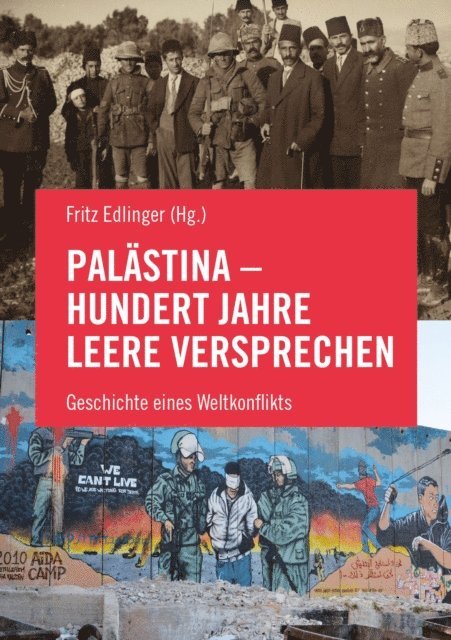
Am 2. November 1917 erklärte der britische Außenminister Arthur James Balfour, in Palästina eine Heimstätte für das jüdische Volk errichten zu wollen. Er nahm damit einen genau 20 Jahre zuvor auf dem zionistischen Weltkongress in Basel entwickelten Vorschlag auf. Die Balfour-Erklärung ist eine bedeutsame weltpolitische Zäsur, die den Nahen Osten seither nicht zur Ruhe kommen lässt und darüber hinaus ein Paradebeispiel des britischen Imperialismus darstellt. Denn zum Zeitpunkt der Erklärung war Palästina eine osmanische Provinz, die erst erobert werden musste.Den 100. Jahrestag dieser Verbindung aus britischem Weltmachtstreben und Zionismus nimmt der Herausgeber Fritz Edlinger zum Anlass, einerseits die gegebenen Versprechen und die vergebenen Chancen der seither verstrichenen Jahrzehnte zu analysieren und andererseits aktuelle Lösungsmodelle für den israelisch-palästinensischen Dauerkonflikt zu präsentieren.Erinnerungspunkte, die im Buch behandelt werden, sind der UN-Teilungsplan von 1947, der eine Wirtschaftsunion zwischen Palästina und Israel vorsah, der 50. Jahrestag der Besatzung 1967, als Israel im Sechs-Tage-Krieg die Westbank, Ostjerusalem, Gaza, Golan und die später an Ägypten zurückgegebene Sinai-Halbinsel eroberte, sowie der "Krieg der Steine", wie die erste Intifada von 1987 genannt wird.