Rowena Maguire – författare
642 kr
Skickas inom 10-15 vardagar
590 kr
Skickas inom 10-15 vardagar
2 262 kr
Skickas inom 10-15 vardagar
2 091 kr
Skickas inom 5-8 vardagar
410 kr
Läs direkt efter köp
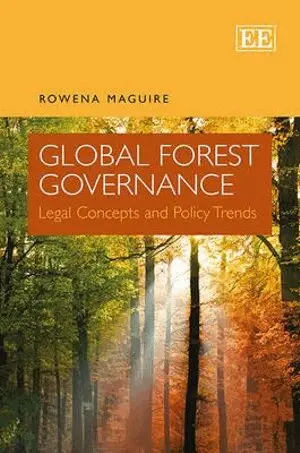
This book identifies the fundamental legal principles and the governance requirements of sustainable forest management. An analytical model for assessing forest regulation is created which identifies the doctrinal concepts that underpin forest regulation (justice, property, sovereignty and governance). It also highlights the dominant public international institutions involved in forest regulation (UNFF, UNFCCC and WB) which is followed by analysis of non-state international forest regulation (forest certification and ecosystem markets). The book concludes by making a number of practical recommendations for reform of global forest governance arrangements and suggested reforms for individual international forest institutions.
This book will appeal to academics, policymakers, international environmental researchers, government officials involved in forest regulation and environmental regulation more broadly.
2 107 kr
Skickas inom 5-8 vardagar
410 kr
Läs direkt efter köp
410 kr
Läs direkt efter köp
740 kr
Läs direkt efter köp
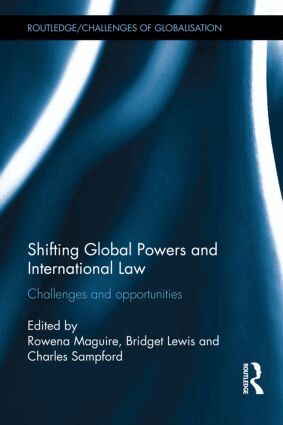
This book explores the impacts of global economic, political and cultural shifts on various international legal frameworks and legal norms.
The economic growth of states throughout Asia, South and Central America and Africa is having a profound effect on the dynamics of international relations, with a resulting impact on the operation and development of international law. This book examines the influence of emerging economies on international legal rules, institutions and processes. It describes recent and predicted changes in economic, political and cultural powers, flowing from the growth of emerging economies such as China, India, Brazil, South Africa and Russia, and analyses the influence of these changes on various legal frameworks and norms. Expert contributors drawn from a variety of fields, including international law, politics, environmental law, human rights, economics and finance, provide a broad analysis of the nature of the shifting global dynamic in its historical and contemporary contexts, and a range of perspectives on the impact of these changes as they relate to specific regimes and issues, including climate change regulation, collective security, indigenous rights, the rights of women and girls, environmental protection and foreign aid and development. The book provides a fresh and comprehensive analysis of an issue with extensive implications for international law and politics.
Shifting Global Powers and International Law will be of interest to students and scholars of international relations; international law; international political economy, human rights; and development.
740 kr
Läs direkt efter köp
This book explores the impacts of global economic, political and cultural shifts on various international legal frameworks and legal norms.
The economic growth of states throughout Asia, South and Central America and Africa is having a profound effect on the dynamics of international relations, with a resulting impact on the operation and development of international law. This book examines the influence of emerging economies on international legal rules, institutions and processes. It describes recent and predicted changes in economic, political and cultural powers, flowing from the growth of emerging economies such as China, India, Brazil, South Africa and Russia, and analyses the influence of these changes on various legal frameworks and norms. Expert contributors drawn from a variety of fields, including international law, politics, environmental law, human rights, economics and finance, provide a broad analysis of the nature of the shifting global dynamic in its historical and contemporary contexts, and a range of perspectives on the impact of these changes as they relate to specific regimes and issues, including climate change regulation, collective security, indigenous rights, the rights of women and girls, environmental protection and foreign aid and development. The book provides a fresh and comprehensive analysis of an issue with extensive implications for international law and politics.
Shifting Global Powers and International Law will be of interest to students and scholars of international relations; international law; international political economy, human rights; and development.
2 211 kr
Skickas inom 10-15 vardagar
758 kr
Skickas inom 10-15 vardagar
669 kr
Skickas inom 10-15 vardagar
758 kr
Läs direkt efter köp
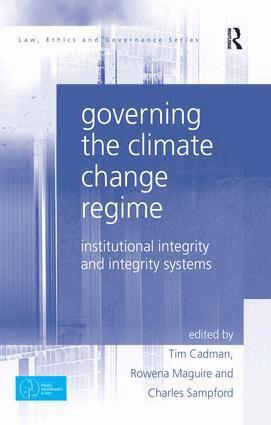
This volume, the second in a series of three, examines the institutional architecture underpinning the global climate integrity system. This system comprises an inter-related set of institutions, governance arrangements, regulations, norms and practices that aim to implement the United Nations Framework Convention on Climate Change (UNFCCC). Arguing that governance is a neutral term to describe the structures and processes that coordinate climate action, the book presents a continuum of governance values from ‘thick’ to ‘thin’ to determine the regime’s legitimacy and integrity. The collection contains four parts with part one exploring the links between governance and integrity, part two containing chapters which evaluate climate governance arrangements, part three exploring avenues for improving climate governance and part four reflecting on the road to the UNFCCC''s Paris Agreement. The book provides new insights into understanding how systemic institutional and governance failures have occurred, how they could occur again in the same or different form and how these failures impact on the integrity of the UNFCCC. This work extends contemporary governance scholarship to explore the extent to which selected institutional case studies, thematic areas and policy approaches contribute to the overall integrity of the regime.
758 kr
Läs direkt efter köp
This volume, the second in a series of three, examines the institutional architecture underpinning the global climate integrity system. This system comprises an inter-related set of institutions, governance arrangements, regulations, norms and practices that aim to implement the United Nations Framework Convention on Climate Change (UNFCCC). Arguing that governance is a neutral term to describe the structures and processes that coordinate climate action, the book presents a continuum of governance values from ‘thick’ to ‘thin’ to determine the regime’s legitimacy and integrity. The collection contains four parts with part one exploring the links between governance and integrity, part two containing chapters which evaluate climate governance arrangements, part three exploring avenues for improving climate governance and part four reflecting on the road to the UNFCCC''s Paris Agreement. The book provides new insights into understanding how systemic institutional and governance failures have occurred, how they could occur again in the same or different form and how these failures impact on the integrity of the UNFCCC. This work extends contemporary governance scholarship to explore the extent to which selected institutional case studies, thematic areas and policy approaches contribute to the overall integrity of the regime.
925 kr
Läs direkt efter köp
925 kr
Läs direkt efter köp
2 237 kr
Skickas inom 10-15 vardagar
2 192 kr
Skickas inom 10-15 vardagar