• Fri frakt över 249 kr
  • •
  • Snabba leveranser
  • •
  • Billiga böcker
Kundservice

Du är på sajten för privatpersoner.

Företag, bibliotek eller offentlig verksamhet?

Du handlar på classic.bokus.com, där alla dina funktioner finns intakta.
Till classic.bokus.com
Bokus logotyp. Gå till startsidan.
  • Erbjudanden
  • Nyheter
  • Student
  • Topplistor
  • Barn & ungdom
  • Bokus Play
  • E-böcker
  • Pocketböcker
  • Spel & pussel

10% rabatt på allt med kod: NYSTART10 →

Sidfot

Mina sidor

    Hjälp

    • Kundservice
    • Vanliga frågor och svar
    • Frakt och leverans
    • Retur vid ångerrätt
    • Reklamera vara
    • Betalning
    • Köpvillkor
    • Allmänna villkor
    • Information om webbplatsens tillgänglighet

    Om Bokus

    • Om oss
    • Pressrum
    • För studenter
    • För företag
    • För bibliotek och offentlig verksamhet
    • För leverantörer
    • Hållbarhet

    Populärt

    • Aktuella erbjudanden
    • Presentkort
    • Studentlitteratur
    • Nya böcker
    • Topplistor
    • Signerade böcker
    • Engelska böcker

    Inspiration

    • Boktips
    • BookTok
    • Populära bokserier
    • Barnbokskaraktärer
    • Populära författare
    Logotyp för Bokus
    Följ oss på Facebook (extern länk)Följ oss på Instagram (extern länk)Följ oss på YouTube (extern länk)Följ oss på TikTok (extern länk)
    bokus @ CookiesAnpassa cookiesIntegritetspolicyKöpvillkor
    Till Citymail hemsida (extern länk)Till Budbee hemsida (extern länk)Till Postnord hemsida (extern länk)Till Schenker hemsida (extern länk)Till Early Bird hemsida (extern länk)Till Walleys hemsida (extern länk)
    1. Juridik
    2. Internationell rätt
    3. Folkrätt

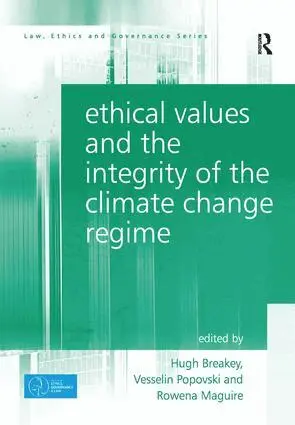
    Ethical Values and the Integrity of the Climate Change Regime

    AvHugh Breakey,Vesselin Popovski

    Inbunden, Engelska, 2015

    Del i serien Law, Ethics and Governance

    2 421 kr

    Beställningsvara. Skickas inom 10-15 vardagar. Fri frakt över 249 kr.

    Fler format och utgåvor

    Häftad

    613 kr

    Beskrivning

    This book investigates the ethical values that inform the global carbon integrity system, and reflects on alternative norms that could or should do so. The global carbon integrity system comprises the emerging international architecture being built to respond to the climate change. This architecture can be understood as an 'integrity system'- an inter-related set of institutions, governance arrangements, regulations and practices that work to ensure the system performs its role faithfully and effectively. This volume investigates the ways ethical values impact on where and how the integrity system works, where it fails, and how it can be improved. With a wide array of perspectives across many disciplines, including ethicists, philosophers, lawyers, governance experts and political theorists, the chapters seek to explore the positive values driving the global climate change processes, to offer an understanding of the motivations justifying the creation of the regime and the way that social norms impact upon the operation of the integrity system. The collection focuses on the nexus between ideal ethics and real-world implementation through institutions and laws. The book will be of interest to policy makers, climate change experts, carbon taxation regulators, academics, legal practitioners and researchers.

    Produktinformation

    • Utgivningsdatum:2015-11-28
    • Mått:174 x 246 x 25 mm
    • Vikt:740 g
    • Format:Inbunden
    • Språk:Engelska
    • Serie:Law, Ethics and Governance
    • Antal sidor:312
    • Förlag:Taylor & Francis Ltd
    • ISBN:9781472469595

    Utforska kategorier

    • Folkrätt inom Juridik
    • Filosofiska discipliner inom Filosofi och religion

    Mer om författaren

    Hugh Breakey is a Research Fellow at Griffith University's Key Centre for Ethics, Law, Justice and Governance, Australia. His work stretches across the philosophical sub-disciplines of political theory, legal philosophy, normative ethics and applied philosophy. He is the author of Intellectual Liberty: Natural Rights and Intellectual Property (Ashgate). His works explore the ethical issues arising in such diverse fields as peacekeeping, institutional governance, climate change, sustainable tourism, private property, medicine and international law. Since 2013, Hugh has served as President of the Australian Association for Professional and Applied Ethics. Vesselin Popovski is Vice Dean and Executive Director of the Centre for United Nations Studies at Jindal Global University in India. He previously worked as Senior Academic Officer at the United Nations University in Tokyo, Director of the EU project `Legal Protection of Individual Rights in Russia' (2002-2004), lecturer at the University of Exeter, UK (1999-2002), Research Fellow, NATO Democratic Institutions Programme (1996-1998) and Bulgarian diplomat (1988-1996) serving in Sofia, New York and London. He currently sits on the Advisory Board of the `Journal of International Humanitarian Legal Studies' and of the Editorial Boards of `International Studies Review' and of `Sustainability Science'. He has published numerous articles in peer-reviewed journals and authored and edited over twenty books. Rowena Maguire is a Senior Lecturer in the School of Law and Co-Chair of the International Law and Global Governance Research Program at the Queensland University of Technology. Rowena's principal research interests and publications concern international climate and forest regulation with a focus on equitable design and implementation.

    Recensioner i media

    "While I believe that cooperative international action on climate change is unlikely to happen until after islands disappear or massive property loss occurs in the wake of a climate change-induced storm, a book like this is important for advancing public consciousness about climate change ethics and governance. This book talks cogently about decentralized and unsystematic collective problem solving and explores climate ethics and the moral problems raised by climate change. The book shows how human rights took decades to become universal, and climate ethics may be at the beginning of a similar trajectory." - Armin Rosencranz, Jindal Global University, India, and co-editor of Climate Change Science and Policy"International debate and action addressing the impacts of climate change are bedevilled by a vacuum at the interface between the normative and empirical, between values and the practical. Ethical Values and the Integrity of the Climate Change Regime addresses this gap comprehensively. This timely collection of cross disciplinary expertise commendably combines ethical analysis with resources essential to public policy and public debate." - Noel Preston, Griffith University, Australia "This excellent book goes a long way toward closing the gap between ethics and real-world climate change governance. Across a wide range of topics - including national governance, international trade, personal values, and international climate change negotiations - it provides insightful suggestions on how to employ ethical norms to effectively address climate change. This book will be useful to both scholars and policy makers." - John C. Dernbach, Widener University, Commonwealth Law School, USA "This timely collection addresses how ethical values should work in shaping the global carbon integrity system. Written by an internationally renowned panel of experts, it is a must read for anyone interested in the ethical values underlying the policies and practices of the global climate change regime." - Fabrice Renaud, United Nations University, Germany

    Innehållsförteckning

    • Introductory Framework: Ethical values and the global carbon integrity system, Rowena Maguire, David M. Douglas, Vesselin Popovski and Hugh Breakey; A comprehensive framework for evaluating the integrity of the climate regime complex, Hugh Breakey and Tim Cadman. Part I Injecting Ethics into Governance Arrangements: Mapping the integrity of differential obligations within the United Nations Framework Convention on Climate Change, Rowena Maguire; Stakeholder perspectives on the integrity of the climate regime, Tim Cadman; How to assure that nations consider ethics and justice in climate change policy formulation, Donald A. Brown; The context-integrity of the global carbon regime: the relevance and impact of the World Trade Organization, Felicity Deane. Part II Ethics in a Dynamic and Decentralized World: Top-down proposals for sharing the global climate policy effort fairly: lost in translation in a bottom-up world?, Jonathan Pickering; Reflecting climate change impacts in governance and integrity system design, Liese Coulter; Ethics and governance in climate change debate: the need for an institutional shift from nation-states to individuals, Yugank Goyal; Polycentric systems and the integrity approach, Anne Schwenkenbecher. Part III Social Norms in the Global Context: Eco v. ego: non-anthropocentric ethic in anthropocene epoch, Vesselin Popovski; Still in search of the good life, Charles Sampford; Two epistemic errors in the climate change debate, David Coady. Part IV Marshalling Human Rights to the Cause: The contribution of human rights to the effectiveness and integrity of the global carbon regime, Bridget Lewis; Mary Robinson’s Declaration of Climate Justice: climate change, human rights and fossil fuel divestment, Matthew Rimmer; The ethical responsibility of the loss and damage mechanism: a consideration of non-economic loss and human rights, Andrea C. Simonelli; Heating up climate change norms - lessons from human rights, Hugh Breakey. Bibliography; Index.