Rudolf Fritsch – författare
Visar alla böcker från författaren Rudolf Fritsch. Handla med fri frakt och snabb leverans.
8 produkter
8 produkter
Inbunden, Engelska, 1998
868 kr
Skickas inom 10-15 vardagar
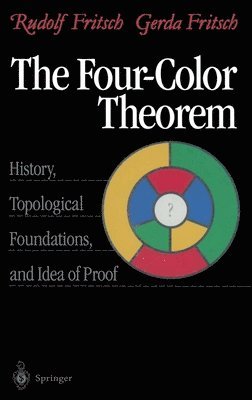
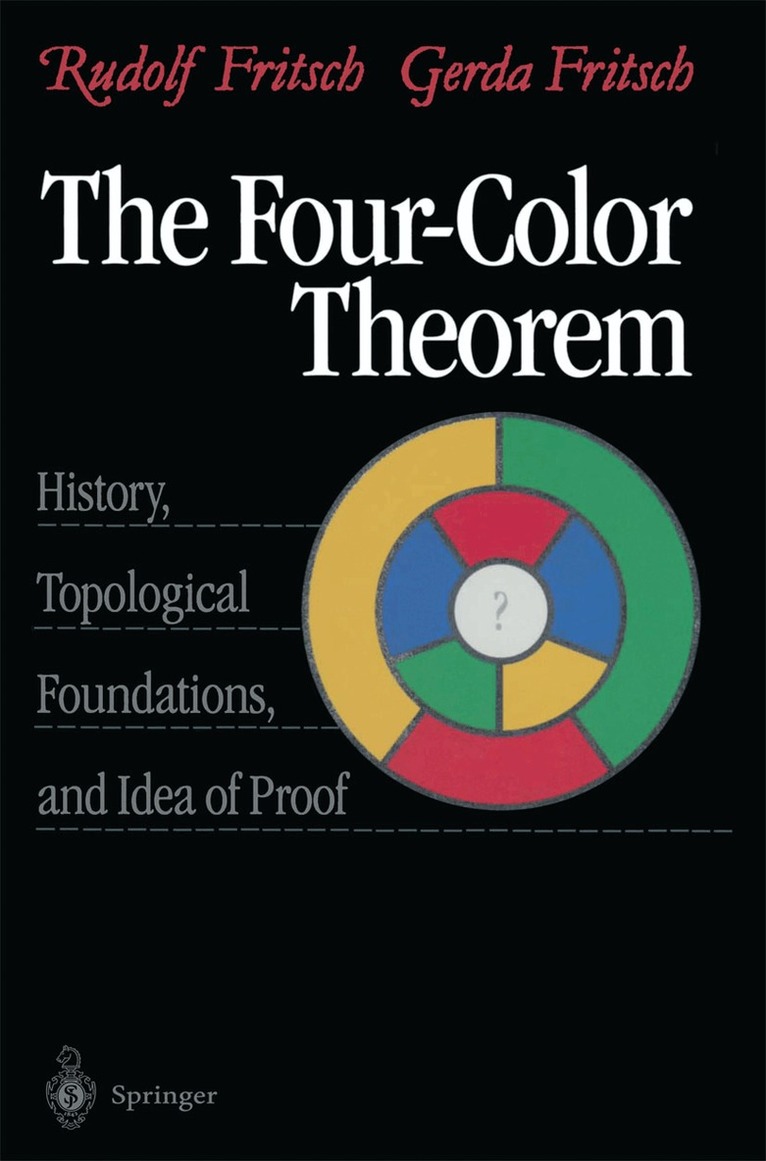
This elegant little book discusses a famous problem that helped to define the field now known as topology: What is the minimum number of colors required to print a map such that no two adjoining countries have the same color, no matter how convoluted their boundaries. Many famous mathematicians have worked on the problem, but the proof eluded fomulation until the 1950s, when it was finally cracked with a brute-force approach using a computer. The book begins by discussing the history of the problem, and then goes into the mathematics, both pleasantly enough that anyone with an elementary knowledge of geometry can follow it, and still with enough rigor that a mathematician can also read it with pleasure. The authors discuss the mathematics as well as the philosophical debate that ensued when the proof was announced: Just what is a mathematical proof, if it takes a computer to provide one - and is such a thing a proof at all?
E-bok
PDF, Engelska, 19901 045 kr
Läs direkt efter köp
This book describes the construction and the properties of CW-complexes. These spaces are important because firstly they are the correct framework for homotopy theory, and secondly most spaces that arise in pure mathematics are of this type. The authors discuss the foundations and also developments, for example, the theory of finite CW-complexes, CW-complexes in relation to the theory of fibrations, and Milnor''s work on spaces of the type of CW-complexes. They establish very clearly the relationship between CW-complexes and the theory of simplicial complexes, which is developed in great detail. Exercises are provided throughout the book; some are straightforward, others extend the text in a non-trivial way. For the latter; further reference is given for their solution. Each chapter ends with a section sketching the historical development. An appendix gives basic results from topology, homology and homotopy theory. These features will aid graduate students, who can use the work as a course text. As a contemporary reference work it will be essential reading for the more specialized workers in algebraic topology and homotopy theory.
Del 19 - Cambridge Studies in Advanced Mathematics
Cellular Structures in Topology
Häftad, Engelska, 2008
895 kr
Skickas inom 7-10 vardagar
This book describes the construction and the properties of CW-complexes. These spaces are important because firstly they are the correct framework for homotopy theory, and secondly most spaces that arise in pure mathematics are of this type. The authors discuss the foundations and also developments, for example, the theory of finite CW-complexes, CW-complexes in relation to the theory of fibrations, and Milnor's work on spaces of the type of CW-complexes. They establish very clearly the relationship between CW-complexes and the theory of simplicial complexes, which is developed in great detail. Exercises are provided throughout the book; some are straightforward, others extend the text in a non-trivial way. For the latter; further reference is given for their solution. Each chapter ends with a section sketching the historical development. An appendix gives basic results from topology, homology and homotopy theory. These features will aid graduate students, who can use the work as a course text. As a contemporary reference work it will be essential reading for the more specialized workers in algebraic topology and homotopy theory.
Del 19 - Cambridge Studies in Advanced Mathematics
Cellular Structures in Topology
Inbunden, Engelska, 1990
1 177 kr
Skickas inom 7-10 vardagar
This book describes the construction and the properties of CW-complexes. These spaces are important because firstly they are the correct framework for homotopy theory, and secondly most spaces that arise in pure mathematics are of this type. The authors discuss the foundations and also developments, for example, the theory of finite CW-complexes, CW-complexes in relation to the theory of fibrations, and Milnor's work on spaces of the type of CW-complexes. They establish very clearly the relationship between CW-complexes and the theory of simplicial complexes, which is developed in great detail. Exercises are provided throughout the book; some are straightforward, others extend the text in a non-trivial way. For the latter; further reference is given for their solution. Each chapter ends with a section sketching the historical development. An appendix gives basic results from topology, homology and homotopy theory. These features will aid graduate students, who can use the work as a course text. As a contemporary reference work it will be essential reading for the more specialized workers in algebraic topology and homotopy theory.
E-bok
PDF, Engelska, 2012712 kr
Läs direkt efter köp
During the university reform of the 1970s, the classical Faculty of Science of the venerable Ludwig-Maximilians-Universitat in Munich was divided into five smaller faculties. One was for mathematics, the others for physics, chemistry and pharmaceutics, biology, and the earth sciences. Nevertheless, in order to maintain an exchange of ideas between the various disciplines and so as not to permit the complete undermining of the original notion of "universitas,,,l the Carl-Friedrich-von-Siemens Foundation periodically invites the pro fessors from the former Faculty of Science to a luncheon gathering. These are working luncheons during which recent developments in the various disciplines are presented by means of short talks. The motivation for such talks does not come, in the majority of cases, from the respective subject itself, but from another discipline that is loosely affiliated with it. In this way, the controversy over the modern methods used in the proof of the Four-Color Theorem had also spread to disciplines outside of mathematics. I, as a trained algebraic topologist, was asked to comment on this. Naturally, I was acquainted with the Four-Color 1 A Latin word meaning the whole of something, a collective entirety. Vll viii Preface Problem but, up to that point, had never intensively studied it. As an outsider,2 I dove into the material, not so much to achieve any scientific progress with it but to make this already achieved objective more understandable.
Häftad, Engelska, 2012
546 kr
Skickas inom 10-15 vardagar
During the university reform of the 1970s, the classical Faculty of Science of the venerable Ludwig-Maximilians-Universitat in Munich was divided into five smaller faculties. One was for mathematics, the others for physics, chemistry and pharmaceutics, biology, and the earth sciences. Nevertheless, in order to maintain an exchange of ideas between the various disciplines and so as not to permit the complete undermining of the original notion of "universitas,,,l the Carl-Friedrich-von-Siemens Foundation periodically invites the pro fessors from the former Faculty of Science to a luncheon gathering. These are working luncheons during which recent developments in the various disciplines are presented by means of short talks. The motivation for such talks does not come, in the majority of cases, from the respective subject itself, but from another discipline that is loosely affiliated with it. In this way, the controversy over the modern methods used in the proof of the Four-Color Theorem had also spread to disciplines outside of mathematics. I, as a trained algebraic topologist, was asked to comment on this. Naturally, I was acquainted with the Four-Color 1 A Latin word meaning the whole of something, a collective entirety. Vll viii Preface Problem but, up to that point, had never intensively studied it. As an outsider,2 I dove into the material, not so much to achieve any scientific progress with it but to make this already achieved objective more understandable.
Inbunden, Engelska, 1995
3 314 kr
Skickas inom 5-8 vardagar
No detailed description available for "Mathematics and Theoretical Physics".
E-bok
PDF, Engelska, 20112 894 kr
Läs direkt efter köp
The series is aimed specifically at publishing peer reviewed reviews and contributions presented at workshops and conferences. Each volume is associated with a particular conference, symposium or workshop. These events cover various topics within pure and applied mathematics and provide up-to-date coverage of new developments, methods and applications.