E-bok, Engelska, 2012
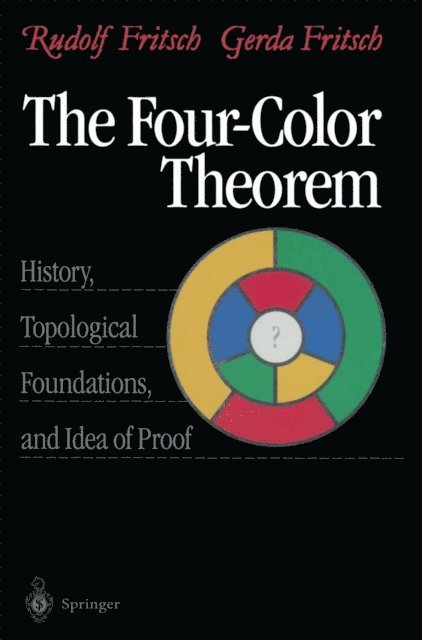
Four-Color Theorem
Av Gerda Fritsch, Rudolf Fritsch
734 kr
Läs direkt i Bokus Reader – eller ladda ned till din enhet (PDF kräver ofta zoom och scroll på små skärmar).
Beskrivning
During the university reform of the 1970s, the classical Faculty of Science of the venerable Ludwig-Maximilians-Universitat in Munich was divided into five smaller faculties. One was for mathematics, the others for physics, chemistry and pharmaceutics, biology, and the earth sciences. Nevertheless, in order to maintain an exchange of ideas between the various disciplines and so as not to permit the complete undermining of the original notion of "universitas,,,l the Carl-Friedrich-von-Siemens Foundation periodically invites the pro fessors from the former Faculty of Science to a luncheon gathering. These are working luncheons during which recent developments in the various disciplines are presented by means of short talks. The motivation for such talks does not come, in the majority of cases, from the respective subject itself, but from another discipline that is loosely affiliated with it. In this way, the controversy over the modern methods used in the proof of the Four-Color Theorem had also spread to disciplines outside of mathematics. I, as a trained algebraic topologist, was asked to comment on this. Naturally, I was acquainted with the Four-Color 1 A Latin word meaning the whole of something, a collective entirety. Vll viii Preface Problem but, up to that point, had never intensively studied it. As an outsider,2 I dove into the material, not so much to achieve any scientific progress with it but to make this already achieved objective more understandable.
Produktinformation
- Utgivningsdatum: 2012-12-06
- Språk: Engelska
- Filformat: PDF
- Kopieringsskydd: LCP
- ISBN: 9781461217206
- Förlag: Springer New York
- Översättare: J.lie Peschke
Utforska kategorier
Betyg & recensioner
0 recensioner
Inga recensioner tillgängliga.