Russell D. Wolfinger – författare
Visar alla böcker från författaren . Handla med fri frakt och snabb leverans.
6 produkter
6 produkter
Del 122 - Lecture Notes in Statistics
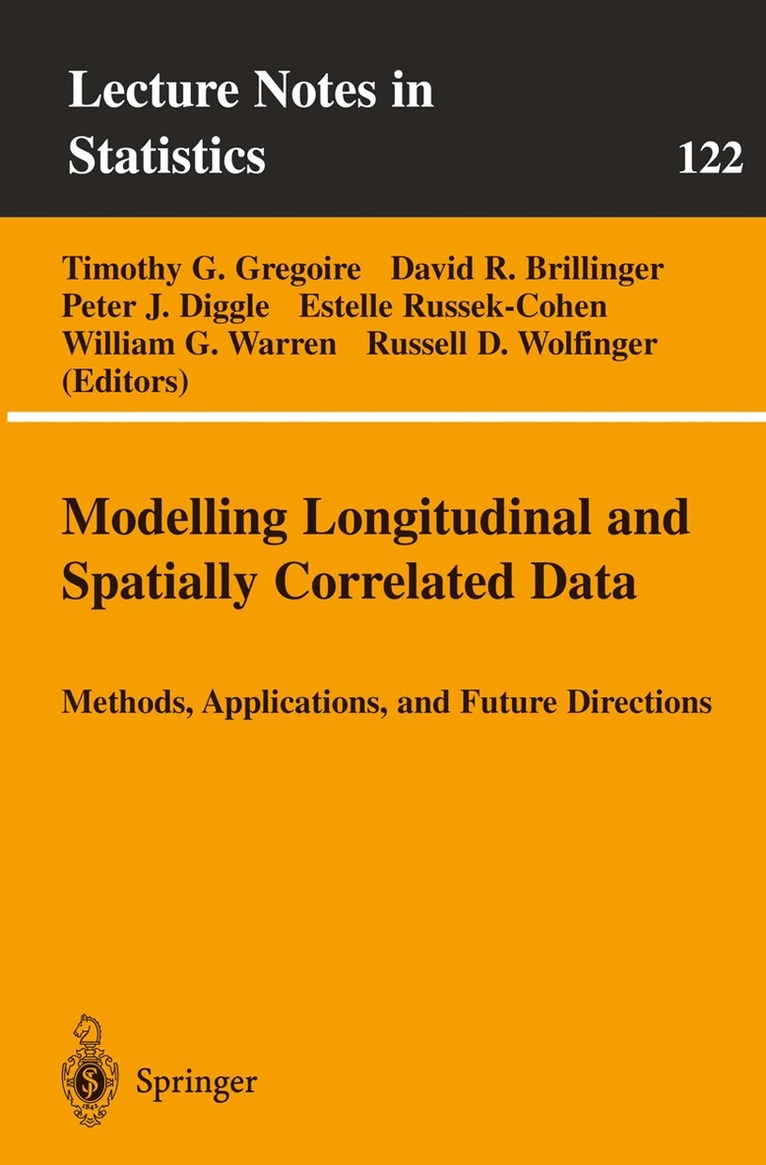
Modelling Longitudinal and Spatially Correlated Data
Häftad, Engelska, 1997
1 075 kr
Skickas inom 10-15 vardagar
Correlated data arise in numerous contexts across a wide spectrum of subject-matter disciplines. Modeling such data present special challenges and opportunities that have received increasing scrutiny by the statistical community in recent years. In October 1996 a group of 210 statisticians and other scientists assembled on the small island of Nantucket, U. S. A. , to present and discuss new developments relating to Modelling Longitudinal and Spatially Correlated Data: Methods, Applications, and Future Direc tions. Its purpose was to provide a cross-disciplinary forum to explore the commonalities and meaningful differences in the source and treatment of such data. This volume is a compilation of some of the important invited and volunteered presentations made during that conference. The three days and evenings of oral and displayed presentations were arranged into six broad thematic areas. The session themes, the invited speakers and the topics they addressed were as follows: • Generalized Linear Models: Peter McCullagh-"Residual Likelihood in Linear and Generalized Linear Models" • Longitudinal Data Analysis: Nan Laird-"Using the General Linear Mixed Model to Analyze Unbalanced Repeated Measures and Longi tudinal Data" • Spatio---Temporal Processes: David R. Brillinger-"Statistical Analy sis of the Tracks of Moving Particles" • Spatial Data Analysis: Noel A. Cressie-"Statistical Models for Lat tice Data" • Modelling Messy Data: Raymond J. Carroll-"Some Results on Gen eralized Linear Mixed Models with Measurement Error in Covariates" • Future Directions: Peter J.
E-bok
PDF, Engelska, 20121 416 kr
Läs direkt efter köp
Correlated data arise in numerous contexts across a wide spectrum of subject-matter disciplines. Modeling such data present special challenges and opportunities that have received increasing scrutiny by the statistical community in recent years. In October 1996 a group of 210 statisticians and other scientists assembled on the small island of Nantucket, U. S. A. , to present and discuss new developments relating to Modelling Longitudinal and Spatially Correlated Data: Methods, Applications, and Future Direc tions. Its purpose was to provide a cross-disciplinary forum to explore the commonalities and meaningful differences in the source and treatment of such data. This volume is a compilation of some of the important invited and volunteered presentations made during that conference. The three days and evenings of oral and displayed presentations were arranged into six broad thematic areas. The session themes, the invited speakers and the topics they addressed were as follows: • Generalized Linear Models: Peter McCullagh-"Residual Likelihood in Linear and Generalized Linear Models" • Longitudinal Data Analysis: Nan Laird-"Using the General Linear Mixed Model to Analyze Unbalanced Repeated Measures and Longi tudinal Data" • Spatio---Temporal Processes: David R. Brillinger-"Statistical Analy sis of the Tracks of Moving Particles" • Spatial Data Analysis: Noel A. Cressie-"Statistical Models for Lat tice Data" • Modelling Messy Data: Raymond J. Carroll-"Some Results on Gen eralized Linear Mixed Models with Measurement Error in Covariates" • Future Directions: Peter J.
Häftad, Engelska, 2021
577 kr
Skickas inom 5-8 vardagar
E-bok
PDF, Engelska, 2021459 kr
Läs direkt efter köp
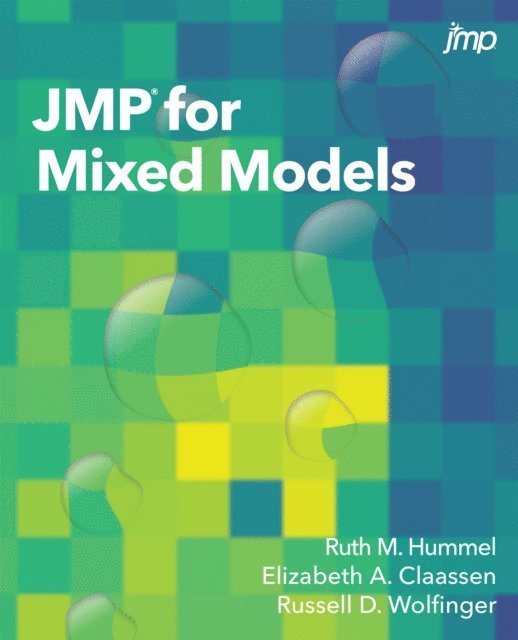
Discover the power of mixed models with JMP and JMP Pro.Mixed models are now the mainstream method of choice for analyzing experimental data. Why? They are arguably the most straightforward and powerful way to handle correlated observations in designed experiments. Reaching well beyond standard linear models, mixed models enable you to make accurate and precise inferences about your experiments and to gain deeper understanding of sources of signal and noise in the system under study. Well-formed fixed and random effects generalize well and help you make the best data-driven decisions. JMP for Mixed Models brings together two of the strongest traditions in SAS software: mixed models and JMP. JMP s groundbreaking philosophy of tight integration of statistics with dynamic graphics is an ideal milieu within which to learn and apply mixed models, also known as hierarchical linear or multilevel models. If you are a scientist or engineer, the methods described herein can revolutionize how you analyze experimental data without the need to write code.Inside you ll find a rich collection of examples and a step-by-step approach to mixed model mastery. Topics include:Learning how to appropriately recognize, set up, and interpret fixed and random effectsExtending analysis of variance (ANOVA) and linear regression to numerous mixed model designs Understanding how degrees of freedom work using Skeleton ANOVAAnalyzing randomized block, split-plot, longitudinal, and repeated measures designs Introducing more advanced methods such as spatial covariance and generalized linear mixed models Simulating mixed models to assess power and other important sampling characteristicsProviding a solid framework for understanding statistical modeling in generalImproving perspective on modern dilemmas around Bayesian methods, p-values, and causal inference
E-bok
Engelska, 2021459 kr
Läs direkt efter köp
Discover the power of mixed models with JMP and JMP Pro.Mixed models are now the mainstream method of choice for analyzing experimental data. Why? They are arguably the most straightforward and powerful way to handle correlated observations in designed experiments. Reaching well beyond standard linear models, mixed models enable you to make accurate and precise inferences about your experiments and to gain deeper understanding of sources of signal and noise in the system under study. Well-formed fixed and random effects generalize well and help you make the best data-driven decisions. JMP for Mixed Models brings together two of the strongest traditions in SAS software: mixed models and JMP. JMP s groundbreaking philosophy of tight integration of statistics with dynamic graphics is an ideal milieu within which to learn and apply mixed models, also known as hierarchical linear or multilevel models. If you are a scientist or engineer, the methods described herein can revolutionize how you analyze experimental data without the need to write code.Inside you ll find a rich collection of examples and a step-by-step approach to mixed model mastery. Topics include:Learning how to appropriately recognize, set up, and interpret fixed and random effectsExtending analysis of variance (ANOVA) and linear regression to numerous mixed model designs Understanding how degrees of freedom work using Skeleton ANOVAAnalyzing randomized block, split-plot, longitudinal, and repeated measures designs Introducing more advanced methods such as spatial covariance and generalized linear mixed models Simulating mixed models to assess power and other important sampling characteristicsProviding a solid framework for understanding statistical modeling in generalImproving perspective on modern dilemmas around Bayesian methods, p-values, and causal inference
Inbunden, Engelska, 2021
740 kr
Skickas inom 5-8 vardagar