Russell West-Pavlov – författare
419 kr
Läs direkt efter köp
545 kr
Skickas inom 7-10 vardagar
1 634 kr
Skickas inom 5-8 vardagar
2 011 kr
Skickas inom 10-15 vardagar
409 kr
Skickas inom 10-15 vardagar
1 450 kr
Skickas inom 5-8 vardagar
851 kr
Läs direkt efter köp
851 kr
Läs direkt efter köp
2 765 kr
Skickas inom 10-15 vardagar
759 kr
Skickas
437 kr
Läs direkt efter köp
437 kr
Läs direkt efter köp
362 kr
Skickas inom 7-10 vardagar
1 632 kr
Skickas inom 7-10 vardagar
484 kr
Läs direkt efter köp
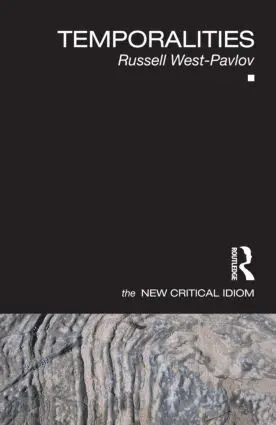
Temporalities presents a concise critical introduction to the treatment of time throughout literature. Time and its passage represent one of the oldest and most complex philosophical subjects in art of all forms, and Russell West-Pavlov explains and interrogates the most important theories of temporality across a range of disciplines.
The author explores temporality''s relationship with a diverse range of related concepts, including:
historiography psychology gender economics postmodernism postcolonialismRussell West-Pavlov examines time as a crucial part of the critical theories of Newton, Freud, Ricoeur, Benjamin, and explores the treatment of time in a broad range of texts, ranging from the writings of St. Augustine and Sterne’s Tristram Shandy, to Woolf’s Mrs Dalloway and Stoppard’s Rosencrantz and Guildenstern are Dead.
This comprehensive and accessible guide establishes temporality as an essential theme within literary and cultural studies today.
484 kr
Läs direkt efter köp
Temporalities presents a concise critical introduction to the treatment of time throughout literature. Time and its passage represent one of the oldest and most complex philosophical subjects in art of all forms, and Russell West-Pavlov explains and interrogates the most important theories of temporality across a range of disciplines.
The author explores temporality''s relationship with a diverse range of related concepts, including:
historiography psychology gender economics postmodernism postcolonialismRussell West-Pavlov examines time as a crucial part of the critical theories of Newton, Freud, Ricoeur, Benjamin, and explores the treatment of time in a broad range of texts, ranging from the writings of St. Augustine and Sterne’s Tristram Shandy, to Woolf’s Mrs Dalloway and Stoppard’s Rosencrantz and Guildenstern are Dead.
This comprehensive and accessible guide establishes temporality as an essential theme within literary and cultural studies today.
1 281 kr
Skickas inom 5-8 vardagar
406 kr
Skickas
Contestatory and Creative Poetics for a Time of Climate Catastrophe: Volume 1: Per Se is an extended narrative meditation upon the meaning of per se, which generally denotes the thing-in-itself, for its own sake – but that, upon closer examination, transpires to be a high tensile composite of the ‘thing’ (se) and a relationship (per) that always links it to something else – and indeed, in relations of internal complexity, to itself. Per se, in the book’s multiple parsings of the term, is a moniker for the infinite relationality of the world and the relationality of each thing in itself. Per se also denotes the endless fractal embedding of bundles of relationality at the successive levels of thing-ness from the infinitesimally minute nano-scale to the unimaginably distant outer reaches of the sideral. Per se becomes an exploration of the way commodities, cut loose from their context of production and floating on sea of oscillating (exchange) values, never cease to morph back into artefacts defined by the socially intensive use-values their fellow actants discover in them.
The book thus focalises a politicised effort to revision the rampant multiscalar individualism, solipsism and apartheid-like segregation of our age. Instead, it searches for possibilities or community in every aspect of the world we have learnt to see through a relentlessly atomising and hypostatising filter. The volume claims that every act of perception is political, reestablishing obfuscated connections, thereby seeking to repair the shredded fabric of the ecosphere below the threshold of myopic common-sense. Yet it also celebrates the myriad acts of citizen defiance, visible and invisible, that constitute activist agendas around the world, sending signals – both practical and exemplary, symbolic and literary – that shore up communities of resistance everywhere. The book does not hesitate to interrogate the fractal responsiveness to its own nature, meditating repeatedly on the political character of writing, and more significantly, of the teaching of writing.
Central to its concerns are various avatars of trees, from the pirogue that hangs above a bar in Lille, and one that is crafted as part of an Italian artist’s global collaboration on the periphery of this volume’s emergence, via the jacarandas of post-apartheid South Africa, to a wood-chipped pine forest that has become a memorial library in Oslo – to name only a few of the topics taken up by the book’s many silvan micro-fictions. Looming over all these concerns are two contemporary silvan catastrophes: the megablazes that destroyed forests in Amazonia, Australia, California, Siberia and the Mediterranean during the period when the book was being written and the deforestation that has allowed zoogenic diseases to jump from once secluded animal species to the humans that would never have been their neighbours if naturally occurring forest-barriers had been left intact.
421 kr
Skickas
Contestatory and Creative Poetics for a Time of Climate Catastrophe: Volume 1: Per Se is an extended narrative meditation upon the meaning of per se, which generally denotes the thing-in-itself, for its own sake – but that, upon closer examination, transpires to be a high tensile composite of the ‘thing’ (se) and a relationship (per) that always links it to something else – and indeed, in relations of internal complexity, to itself. Per se, in the book’s multiple parsings of the term, is a moniker for the infinite relationality of the world and the relationality of each thing in itself. Per se also denotes the endless fractal embedding of bundles of relationality at the successive levels of thing-ness from the infinitesimally minute nano-scale to the unimaginably distant outer reaches of the sideral. Per se becomes an exploration of the way commodities, cut loose from their context of production and floating on sea of oscillating (exchange) values, never cease to morph back into artefacts defined by the socially intensive use-values their fellow actants discover in them.
The book thus focalises a politicised effort to revision the rampant multiscalar individualism, solipsism and apartheid-like segregation of our age. Instead, it searches for possibilities or community in every aspect of the world we have learnt to see through a relentlessly atomising and hypostatising filter. The volume claims that every act of perception is political, reestablishing obfuscated connections, thereby seeking to repair the shredded fabric of the ecosphere below the threshold of myopic common-sense. Yet it also celebrates the myriad acts of citizen defiance, visible and invisible, that constitute activist agendas around the world, sending signals – both practical and exemplary, symbolic and literary – that shore up communities of resistance everywhere. The book does not hesitate to interrogate the fractal responsiveness to its own nature, meditating repeatedly on the political character of writing, and more significantly, of the teaching of writing.
Central to its concerns are various avatars of trees, from the pirogue that hangs above a bar in Lille, and one that is crafted as part of an Italian artist’s global collaboration on the periphery of this volume’s emergence, via the jacarandas of post-apartheid South Africa, to a wood-chipped pine forest that has become a memorial library in Oslo – to name only a few of the topics taken up by the book’s many silvan micro-fictions. Looming over all these concerns are two contemporary silvan catastrophes: the megablazes that destroyed forests in Amazonia, Australia, California, Siberia and the Mediterranean during the period when the book was being written and the deforestation that has allowed zoogenic diseases to jump from once secluded animal species to the humans that would never have been their neighbours if naturally occurring forest-barriers had been left intact.
719 kr
Läs direkt efter köp
745 kr
Läs direkt efter köp
544 kr
Läs direkt efter köp
635 kr
Läs direkt efter köp
707 kr
Läs direkt efter köp
452 kr
Läs direkt efter köp
617 kr
Läs direkt efter köp
707 kr
Läs direkt efter köp
452 kr
Läs direkt efter köp
544 kr
Läs direkt efter köp
635 kr
Läs direkt efter köp