S. R. Epstein - Böcker
Visar alla böcker från författaren S. R. Epstein. Handla med fri frakt och snabb leverans.
4 produkter
4 produkter
631 kr
Skickas inom 7-10 vardagar
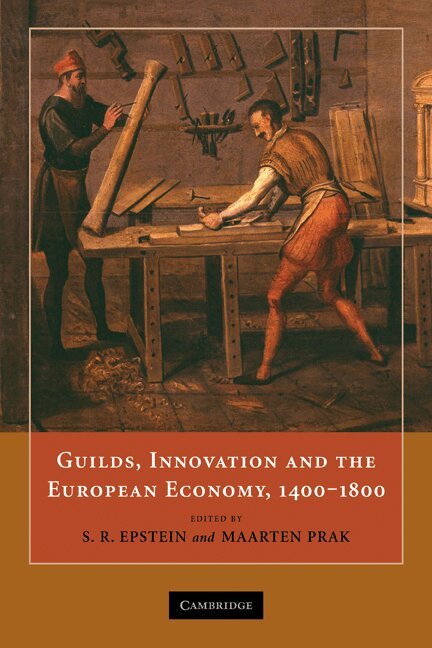
For a long time guilds have been condemned as a major obstacle to economic progress in the pre-industrial era. This re-examination of the role of guilds in the early modern European economy challenges that view by taking into account fresh research on innovation, technological change and entrepreneurship. Leading economic historians argue that industry before the Industrial Revolution was much more innovative than previous studies have allowed for and explore the different products and production techniques that were launched and developed in this period. Much of this innovation was fostered by the craft guilds that formed the backbone of industrial production before the rise of the steam engine. The book traces the manifold ways in which guilds in a variety of industries in Italy, Austria, Germany, Switzerland, France, Belgium, the Netherlands, and Britain helped to create an institutional environment conducive to technological and marketing innovations.
Del 5 - Themes in International Urban History
Town and Country in Europe, 1300-1800
Häftad, Engelska, 2004
333 kr
Skickas inom 7-10 vardagar
Relations between town and country are central to Europe's long-term economic, political and social evolution. This 2001 book surveys and re-interprets these relations in particular countries and regions in the light of the most recent debates on state formation, urbanisation, proto-industrialisation, and the regional character of pre-modern economic growth. Thirteen specially commissioned chapters, ranging chronologically from the Black Death to the Enlightenment, give a comprehensive coverage of Europe, from Spain to Sweden and England, and from the Polish Commonwealth to Holland and Italy. Each chapter offers a self-contained analysis of its country or region and provides a basis for systematic comparison. The Introduction (by S. R. Epstein) discusses the historiographical and theoretical framework for the regional chapters, emphasising how evolving political configurations changed the balance between 'coercive' and 'market-based' solutions to town-country relations and set countries on different paths to growth.
Del 5 - Themes in International Urban History
Town and Country in Europe, 1300-1800
Inbunden, Engelska, 2001
1 729 kr
Skickas inom 7-10 vardagar
Relations between town and country are central to Europe's long-term economic, political and social evolution. This 2001 book surveys and re-interprets these relations in particular countries and regions in the light of the most recent debates on state formation, urbanisation, proto-industrialisation, and the regional character of pre-modern economic growth. Thirteen specially commissioned chapters, ranging chronologically from the Black Death to the Enlightenment, give a comprehensive coverage of Europe, from Spain to Sweden and England, and from the Polish Commonwealth to Holland and Italy. Each chapter offers a self-contained analysis of its country or region and provides a basis for systematic comparison. The Introduction (by S. R. Epstein) discusses the historiographical and theoretical framework for the regional chapters, emphasising how evolving political configurations changed the balance between 'coercive' and 'market-based' solutions to town-country relations and set countries on different paths to growth.
1 485 kr
Skickas inom 7-10 vardagar
For a long time guilds have been condemned as a major obstacle to economic progress in the pre-industrial era. This re-examination of the role of guilds in the early modern European economy challenges that view by taking into account fresh research on innovation, technological change and entrepreneurship. Leading economic historians argue that industry before the Industrial Revolution was much more innovative than previous studies have allowed for and explore the different products and production techniques that were launched and developed in this period. Much of this innovation was fostered by the craft guilds that formed the backbone of industrial production before the rise of the steam engine. The book traces the manifold ways in which guilds in a variety of industries in Italy, Austria, Germany, Switzerland, France, Belgium, the Netherlands, and Britain helped to create an institutional environment conducive to technological and marketing innovations.