Sandro Pignatti - Böcker
Visar alla böcker från författaren Sandro Pignatti. Handla med fri frakt och snabb leverans.
12 produkter
12 produkter
2 101 kr
Skickas inom 10-15 vardagar
The book contains detailed descriptions of the unique desert environment with particular emphasis on vegetation and survival strategies of plants.
2 101 kr
Skickas inom 10-15 vardagar
The book contains detailed descriptions of the unique desert environment with particular emphasis on vegetation and survival strategies of plants.
3 149 kr
Skickas inom 10-15 vardagar
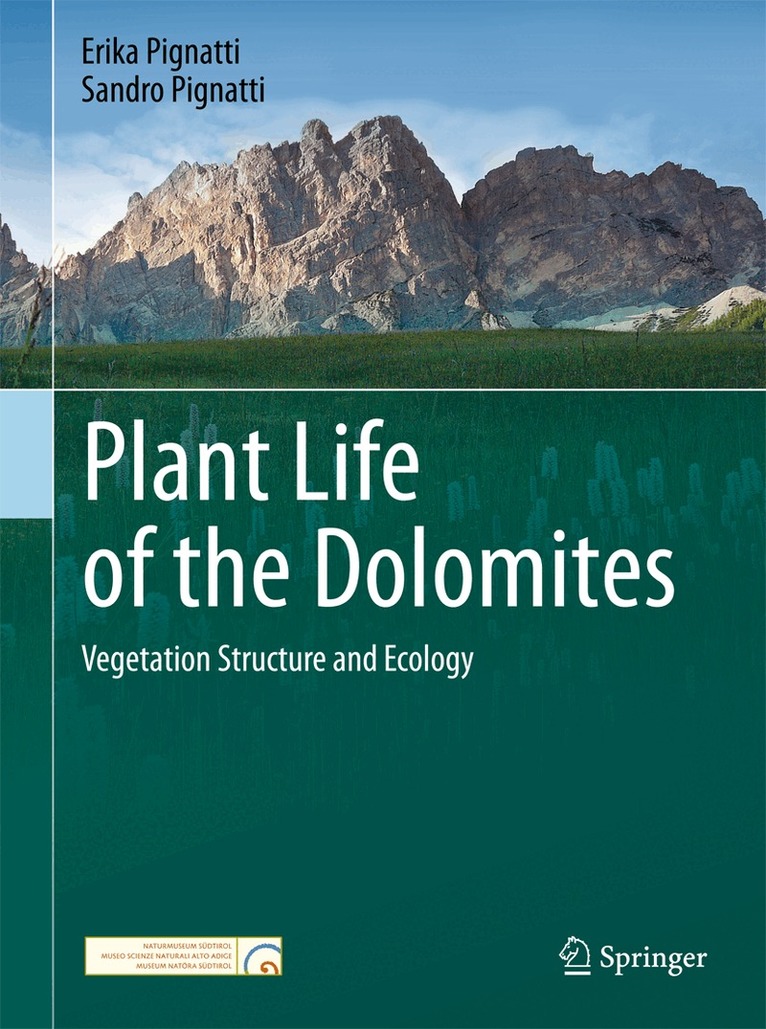
The landscape and vegetation of the Dolomites have characteristics that are very particular. Some 2300 species live here, about a fifth of the flora in Europe as a whole. This book depicts what the plant cover of the Dolomites is composed of, how it was formed, and what future evolution may bring. The data presented is based on the authors’ combined botanical research, which consists of thousands of surveys throughout the entire region of the Dolomites.To explain the vegetation, 106 plant communities are described in detailed datasheets. Biological, geological, climatic and physical-chemical parameters are given for each plant community, including a description of the habitat, the indicator species, the floristic composition, distribution, conservation, and alteration risks, as well as a distribution map and a photo of the association. The associations are grouped into habitats, such as the human habitat, natural forests and meadows on the valley floor, the coniferous forestbelt, screes, alpine vegetation on granite, porphyry, and volcanic rock, as well as on dolomite and limestones. In closing, the authors make a case for using the scientific information provided in the book for the conservation of the Dolomites, the heritage of all humanity. Additional in-depth analysis will be presented in the supplementary volumes “Plant Life of the Dolomites: Vegetation Tables” and “Plant Life of the Dolomites: Atlas of Flora.”
1 064 kr
Skickas inom 10-15 vardagar
This book describes the mountain forests of East Asia (Korea, Japan, China and Taiwan), the tree layers of which contain different species of the genus Fagus.
1 064 kr
Skickas inom 10-15 vardagar
This book describes the mountain forests of East Asia (Korea, Japan, China and Taiwan), the tree layers of which contain different species of the genus Fagus.
1 064 kr
Skickas inom 10-15 vardagar
This volume provides an in-depth analysis of over 100 plant communities of the Dolomite vegetation. The data is based on the phytosociological relevés, which have been collected by the authors in nearly 2000 surveys. The key part consists of approx. 130 association tables presenting plant sociological data for the respective plant communities. Thus, this volume perfectly complements the successful main volume “Plant Life of the Dolomites: Vegetation Structure and Ecology,” which features summarized, synoptic association tables of the twelve habitats. In addition, geo-referenced locations of relevés and detailed ecological measures are provided. A further part describes the individual components of the fascinating dolomitic landscape (Heritage of all Humanity) and presents tables of vegetation complexes, which summarize the more than 400 surveys carried out in the Dolomites.The structure of this supplementary volume corresponds to that of the main volume with a key part consisting of twelve chapters, each describing a specific habitat, and a total of 106 associations. Several topics covered in the main volume, such as the exploration of the flora, ecological factors and syntaxonomy are discussed further here.
3 149 kr
Skickas inom 10-15 vardagar
The landscape and vegetation of the Dolomites have characteristics that are very particular. Some 2300 species live here, about a fifth of the flora in Europe as a whole. This book depicts what the plant cover of the Dolomites is composed of, how it was formed, and what future evolution may bring. The data presented is based on the authors’ combined botanical research, which consists of thousands of surveys throughout the entire region of the Dolomites.To explain the vegetation, 106 plant communities are described in detailed datasheets. Biological, geological, climatic and physical-chemical parameters are given for each plant community, including a description of the habitat, the indicator species, the floristic composition, distribution, conservation, and alteration risks, as well as a distribution map and a photo of the association. The associations are grouped into habitats, such as the human habitat, natural forests and meadows on the valley floor, the coniferous forestbelt, screes, alpine vegetation on granite, porphyry, and volcanic rock, as well as on dolomite and limestones. In closing, the authors make a case for using the scientific information provided in the book for the conservation of the Dolomites, the heritage of all humanity. Additional in-depth analysis will be presented in the supplementary volumes “Plant Life of the Dolomites: Vegetation Tables” and “Plant Life of the Dolomites: Atlas of Flora.”
1 682 kr
Skickas inom 10-15 vardagar
This volume offers distribution maps of over 2200 individual species living in the Dolomite area, presenting detailed records on the local range of every species growing in the area studied, from the Puster Valley to the Piave River. The data was collected on the basis of a multiple field observations carried out over several decades. After dividing the area into approx. 200 quadrants, a nearly complete census of the species present was obtained for each quadrant. The evaluation and synopsis of this extensive set of data, which is presented in the form of a chorological atlas in keeping with international standard methods, allows the area to be accurately compared with other parts of the Alps. In addition to the chorological atlas and floristic inventory, a list of synonyms and toponyms of the three languages used in the analyzed territory, an expanded list of updated scientific names, and some helpful remarks on various Dolomites species are included. Lastly, the book explores howspecies can be considered as landscape bioindicators.This third volume of the work Plant Life of the Dolomites complements the main volume Vegetation Structure and Ecology and the volume Vegetation Tables, which presents essential data at the plant association level.
1 064 kr
Skickas inom 10-15 vardagar
This volume provides an in-depth analysis of over 100 plant communities of the Dolomite vegetation. The data is based on the phytosociological relevés, which have been collected by the authors in nearly 2000 surveys. The key part consists of approx. 130 association tables presenting plant sociological data for the respective plant communities. Thus, this volume perfectly complements the successful main volume “Plant Life of the Dolomites: Vegetation Structure and Ecology,” which features summarized, synoptic association tables of the twelve habitats. In addition, geo-referenced locations of relevés and detailed ecological measures are provided. A further part describes the individual components of the fascinating dolomitic landscape (Heritage of all Humanity) and presents tables of vegetation complexes, which summarize the more than 400 surveys carried out in the Dolomites.The structure of this supplementary volume corresponds to that of the main volume with a key part consisting of twelve chapters, each describing a specific habitat, and a total of 106 associations. Several topics covered in the main volume, such as the exploration of the flora, ecological factors and syntaxonomy are discussed further here.
1 682 kr
Skickas inom 10-15 vardagar
This volume offers distribution maps of over 2200 individual species living in the Dolomite area, presenting detailed records on the local range of every species growing in the area studied, from the Puster Valley to the Piave River. The data was collected on the basis of a multiple field observations carried out over several decades. After dividing the area into approx. 200 quadrants, a nearly complete census of the species present was obtained for each quadrant. The evaluation and synopsis of this extensive set of data, which is presented in the form of a chorological atlas in keeping with international standard methods, allows the area to be accurately compared with other parts of the Alps. In addition to the chorological atlas and floristic inventory, a list of synonyms and toponyms of the three languages used in the analyzed territory, an expanded list of updated scientific names, and some helpful remarks on various Dolomites species are included. Lastly, the book explores howspecies can be considered as landscape bioindicators.This third volume of the work Plant Life of the Dolomites complements the main volume Vegetation Structure and Ecology and the volume Vegetation Tables, which presents essential data at the plant association level.
303 kr
Skickas
Ivar Segelberg (19141987), between 1951 and 1979 professor of philosophy in Gothenburg, is an important figure in Swedish philosophy but still only known within a rather narrow circle. Trained in both phenomenology and analytical philosophy, Segelberg developed highly original theories about time consciousness, the unity of consciousness, and general ontology. He published his three main works in Swedish, and only in 1999 were they (collectively) made available in English. The present volume will hopefully help make Segelbergs work more widely known. It is partly based on a 2008 symposium in Gothenburg, also called Philosophy and Botany, but contains several independent contributions including a newly written biography.
Data-processing in phytosociology
Report on the activities of the Working Group for data-processing in phytosociology of the International society for vegetation science, 1969–1978
Häftad, Engelska, 2011
1 064 kr
Skickas inom 10-15 vardagar
(RANKIN) of equivocation information (1-:) and interaction information (M). The method is described in the present paper for I: and in a previous paper (Orloci, 1976) for M. The results presented in this paper suggest that for Species Rank order Information Percentage of total* species to be weighted according to their suitability to I· M I M r M characterize isolated groups of releves in a phytosociolo 5 7 54.15 2.31 17.97 0.82 gical table, the equivocation information may serve as a 9 5 49.86 23.19 16.55 8.22 3 3 9 47.79 0.56 15.86 0.20 suitable weight. The appropriate formulations are derived 6 4 8 36.18 1.18 12.01 0.42 4 5 3 24.36 59.34 8.09 21.03 and computed for some data from a salt marsh community. 8 6 4 24.25 39.04 8.05 13.84 10 7 I 21.96 71.17 7.29 25.23 7 8 2 18.67 69.01 6.20 24.46 9 10 18.40 6.11 10 6 5.64 16.31 1.87 5.78 References Total 301.00* 282.11 * 100.00 100.00 Feoli, E. 1973. An index for weighing characters in monothetic classifications. (Italian with English summary). Giorn. Bot. Ita!' 107: 263-268. Gower, J.e. 1967. A comparison of some methods of cluster is a monotone, increasing function of sample size if .. ).