Santosh Panda – författare
1 930 kr
Skickas inom 10-15 vardagar
488 kr
Skickas inom 10-15 vardagar
858 kr
Skickas inom 10-15 vardagar
707 kr
Skickas inom 10-15 vardagar
3 578 kr
Skickas inom 10-15 vardagar
752 kr
Läs direkt efter köp
The Handbook of Open Universities Around the World is the first collection to provide a comprehensive and critical overview of open universities internationally. Over 80 open universities have been established across five continents to provide a distance-orientated, class-inclusive, and high-quality education for learners left behind by existing formal systems for higher and continuing education and lifelong learning. This mission has been continually reshaped by major developments in open education, learning technologies, and online social networking, as well as by the evolution of specific concerns such as the massification of education, employability, financial trends, artificial intelligence, and development agendas on the regional, national, and global levels.
This landmark volume analyzes and reflects on the planning, organization, management, pedagogic, skilling and employability, and accreditation dimensions of 47 open universities in relation to their national and institutional contexts, the internationalization of education, and the integration of advanced learning technologies. Featuring contributions by internationally recognized scholars, practitioners, and educational administrators, this authoritative resource provides insights into the business model—finances, operations, instructional systems, enrollment patterns, learner supports, quality assurance, professional development, and more—of today’s open universities. Through historical trajectories, institutional profiles, case studies, lessons learned, and best practices, this book provides rich analytical perspectives on the status and challenges of single-mode distance learning universities as an educational phenomenon while unpacking the premise of “openness” itself.
This Handbook is primarily written for
planners, managers, administrators, instructional designers, and teaching faculty at single-mode distance teaching universities who are seeking to sustain their institutions in a period of rapid change; government policymakers, training organizations, technology providers, and education think tanks who are in need of authentic and research-based information on technology-enabled learning modeled by open universities around the world; and graduate students, teaching faculty, and scholars who are affiliated with online and distance education, learning design and technology, higher education planning and management, adult education and lifelong learning, and education policy and future studies.752 kr
Läs direkt efter köp
The Handbook of Open Universities Around the World is the first collection to provide a comprehensive and critical overview of open universities internationally. Over 80 open universities have been established across five continents to provide a distance-orientated, class-inclusive, and high-quality education for learners left behind by existing formal systems for higher and continuing education and lifelong learning. This mission has been continually reshaped by major developments in open education, learning technologies, and online social networking, as well as by the evolution of specific concerns such as the massification of education, employability, financial trends, artificial intelligence, and development agendas on the regional, national, and global levels.
This landmark volume analyzes and reflects on the planning, organization, management, pedagogic, skilling and employability, and accreditation dimensions of 47 open universities in relation to their national and institutional contexts, the internationalization of education, and the integration of advanced learning technologies. Featuring contributions by internationally recognized scholars, practitioners, and educational administrators, this authoritative resource provides insights into the business model—finances, operations, instructional systems, enrollment patterns, learner supports, quality assurance, professional development, and more—of today’s open universities. Through historical trajectories, institutional profiles, case studies, lessons learned, and best practices, this book provides rich analytical perspectives on the status and challenges of single-mode distance learning universities as an educational phenomenon while unpacking the premise of “openness” itself.
This Handbook is primarily written for
planners, managers, administrators, instructional designers, and teaching faculty at single-mode distance teaching universities who are seeking to sustain their institutions in a period of rapid change; government policymakers, training organizations, technology providers, and education think tanks who are in need of authentic and research-based information on technology-enabled learning modeled by open universities around the world; and graduate students, teaching faculty, and scholars who are affiliated with online and distance education, learning design and technology, higher education planning and management, adult education and lifelong learning, and education policy and future studies.1 013 kr
Läs direkt efter köp
1 013 kr
Läs direkt efter köp
572 kr
Läs direkt efter köp
572 kr
Läs direkt efter köp
2 136 kr
Skickas inom 10-15 vardagar
278 kr
Skickas inom 5-8 vardagar
1 682 kr
Skickas inom 10-15 vardagar
2 145 kr
Läs direkt efter köp
This volume offers a comprehensive exploration of the challenges and expectations teachers and trainers face in practicing blended learning approaches. Authored by renowned international experts, it presents selected case studies that delve into the design, development, and delivery of exceptional blended courses. It covers the theoretical foundations and technological affordances of blended learning applied to specific higher education contexts. It includes various models and approaches prioritizing learner-centered blended learning and discussions around technological options for improving learner content, fostering effective learner-learner and learner-teacher interaction. It provides comprehensive learner support within blended learning environments. Each chapter concludes with reflective questions encouraging readers to reflect upon and apply the valuable insights and lessons shared throughout the book. Its multidimensional approach interests teachers, teacher educators, instructional designers and technologists, researchers, and managers of teaching and learning centers within higher education institutions.
1 682 kr
Skickas inom 10-15 vardagar
1 891 kr
Skickas inom 10-15 vardagar
2 453 kr
Läs direkt efter köp
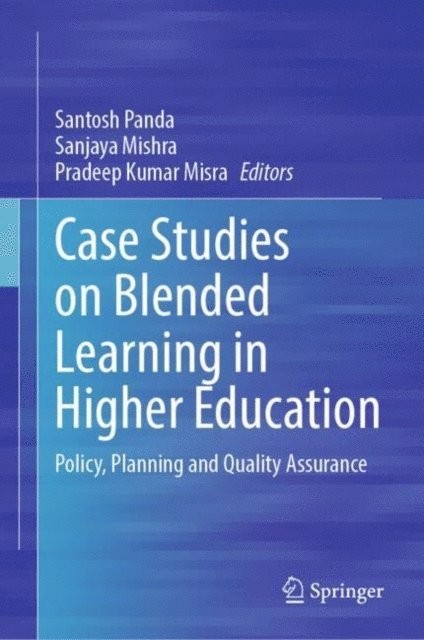
This book presents a collection of curated case studies written by esteemed international experts, focusing on planning, management, and evaluation of designing, developing, and delivering high-quality blended programmes and courses. Embracing a holistic perspective of online and blended learning and based on the mapping of diverse national and institutional education systems, it offers an insightful exploration of innovative and best practices through case studies on policy, planning and management, and quality assurance for blended learning in higher education. Each chapter presents a theoretical background, contextual analysis, and a reflective practitioner approach. The topics covered include national and international policies and guidelines for blended learning in higher education, issues related to planning and management, learner satisfaction and engagement, costing of blended learning and return on investment, quality assurance, and program evaluation. The book explores blended learning as a scholarly practice for continuous learning and improvement and for generating new knowledge and insights. Each chapter concludes with reflective questions to help the reader apply the lessons learned. This book interests a diverse audience, including policymakers, accreditation agencies, managers of teaching and learning centers in higher education institutions, teachers in HEIs, and those involved in blended learning research. Its comprehensive coverage and practical insights make it an essential resource for those seeking to navigate the complexities of implementing effective blended learning initiatives.