Sara Martin – författare
Visar alla böcker från författaren Sara Martin. Handla med fri frakt och snabb leverans.
47 produkter
Masculinity and Patriarchal Villainy in the British Novel
From Hitler to Voldemort
Av Sara Martín
Inbunden, 2019
2879 kr
Lägg i varukorg
Masculinity and Patriarchal Villainy in the British Novel: From Hitler to Voldemort sits at the intersection of literary studies and masculinity studies, arguing that the villain, in many works of contemporary British fiction, is a patriarchal figure that embodies an excess of patriarchal power …
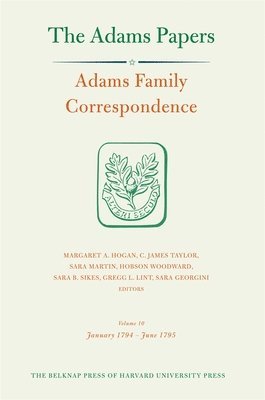
Adams Family Correspondence, Volume 10
January 1794 – June 1795
Av Adams Adams Family, Margaret A. Hogan m. fl.
Inbunden, 2011
1156 kr
Lägg i varukorg
This volume offers over 300 letters from the irrepressible Adamses, including many between John and Abigail never before printed. As always, Adams family members serve as important observers of and commentators on national and international events, from America’s growing tensions with Britain and …
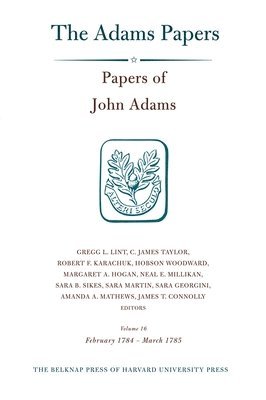
Papers of John Adams
February 1784 – March 1785
Av John Adams, Gregg L. Lint m. fl.
Inbunden, 2012
967 kr
Lägg i varukorg
“Once more after an Interruption of ten Years, I pronounce myself a happy Man, and pray Heaven to continue me so.” Thus wrote John Adams in late August 1784 after the arrival in Europe of his wife Abigail and daughter Nabby. Adams and his family were living together in the pleasant Paris suburb of …
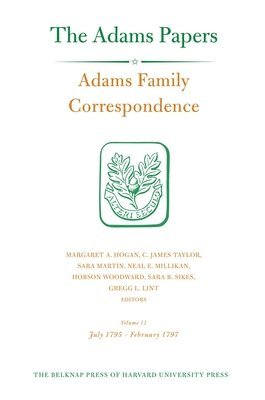
Adams Family Correspondence, Volume 11
July 1795–February 1797
Av Adams Adams Family, Margaret A. Hogan m. fl.
Inbunden, 2013
997 kr
Lägg i varukorg
The letters in this volume of Adams Family Correspondence span the period from July 1795 to the eve of John Adams’s inauguration, with the growing partisan divide leading up to the election playing a central role. The fiery debate over funding the Jay Treaty sets the political stage, and the …
Adams Family Correspondence, Volume 14
October 1799 – February 1801
Av Adams Adams Family, Hobson Woodward m. fl.
Inbunden, 2019
870 kr
Lägg i varukorg
John and Abigail Adams’ reflections on an emerging nation as they move into the new President’s House in Washington, D.C., are a highlight of the nearly 280 letters written over seventeen months printed in volume 14 of Adams Family Correspondence. The volume opens with the Adamses’ public and …
Papers of John Adams
June 1789 – February 1791
Av John Adams, Sara Georgini m. fl.
Inbunden, 2020
915 kr
Lägg i varukorg
John Adams’s shaping of the vice presidency dominates this volume of the Papers of John Adams, which chronicles a formative era in American government spanning June 1789 to February 1791. As the first federal Congress struggled to interpret the US Constitution and implement a new economic …
Adams Family Correspondence, Volume 15
March 1801 – October 1804
Av Adams Adams Family, Hobson Woodward m. fl.
Inbunden, 2022
897 kr
Lägg i varukorg
John and Abigail Adams remained fully engaged in American political life after they left Washington, DC, for retirement in Quincy. A highlight of Volume 15 of Adams Family Correspondence is a series of letters between Abigail Adams and Thomas Jefferson that debated fundamental questions of the …
Adams Family Correspondence, Volume 16
November 1804 – July 1809
Av Adams Adams Family, Hobson Woodward m. fl.
Inbunden, 2025
870 kr
Lägg i varukorg
A growing tension between the United States and Great Britain permeates the 236 letters printed in Volume 16 of Adams Family Correspondence. The Embargo Act of 1807 cut off trade with the British in response to the harassment of American ships. John and Abigail Adams witnessed their neighbors’ …
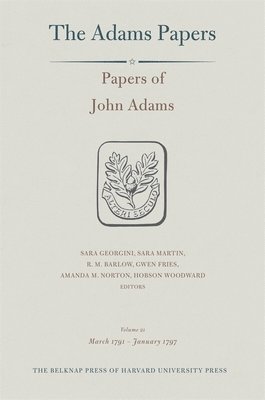
Papers of John Adams, Volume 21 – March 1791 – January 1797
March 1791 – January 1797
Av John Adams, Sara Georgini m. fl.
Inbunden, 2022
942 kr
Lägg i varukorg
Vice President John Adams and the US government faced a turbulent world of rebellion in this volume of the Papers of John Adams, which chronicles the period from March 1791 to January 1797. The grim shadow of the French Revolution and the whirlwind of a massive European war left political leaders …
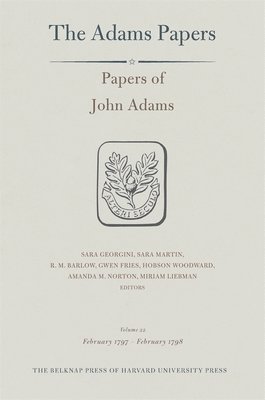
Papers of John Adams, Volume 22 – February 1797 – February 1798
February 1797 – February 1798
Av John Adams, Sara Georgini m. fl.
Inbunden, 2024
915 kr
Lägg i varukorg
Entering the presidency in full service to the American people, John Adams vowed: “Their Confidence, which has been the Chief Consolation of my Life, is too prescious and Sacred a deposit ever to be considered lightly.” This volume of the Papers of John Adams charts the period from February 1797 to …
Papers of John Adams, Volume 23
March 1798 – June 1799
Av John Adams, Sara Georgini m. fl.
Inbunden, 2026
1713 kr
Lägg i varukorg
This volume of the Papers of John Adams explores the period from March 1798 to June 1799, showing how President John Adams strained to repair Franco-American relations. The XYZ Affair sank his initial plans for peace, compelling Adams to recalibrate his policy. Anxious to counter French …
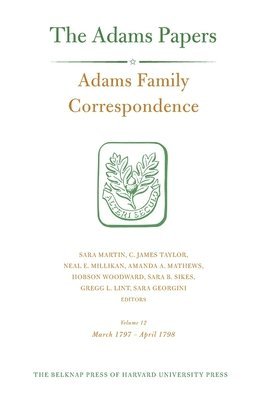
Adams Family Correspondence, Volume 12
March 1797 – April 1798
Av Adams Adams Family, Sara Martin m. fl.
Inbunden, 2015
951 kr
Lägg i varukorg
Volume 12 of Adams Family Correspondence, with 276 documents spanning from March 1797 through April 1798, opens with the inauguration of John Adams as president and closes just after details of the XYZ affair are made public in America. Through private networks of correspondence, the Adamses reveal …
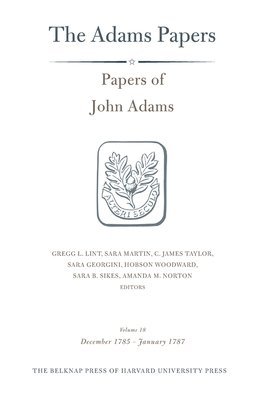
Papers of John Adams, Volume 18 – December 1785 – January 1787
December 1785 – January 1787
Av John Adams, Gregg L. Lint m. fl.
Inbunden, 2016
915 kr
Lägg i varukorg
Volume 18 is the final volume of the Papers of John Adams wholly devoted to Adams’ diplomatic career. It chronicles fourteen months of his tenure as minister to Great Britain and his joint commission, with Thomas Jefferson, to negotiate treaties with Europe and North Africa. With respect to …
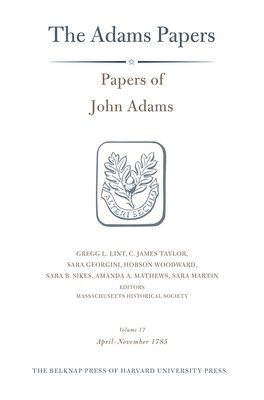
Papers of John Adams
April–November 1785
Av John Adams, Gregg L. Lint m. fl.
Inbunden, 2014
997 kr
Lägg i varukorg
"You may well Suppose that I was the Focus of all Eyes," John Adams wrote on 2 June 1785 of his first audience with George III, which formally inaugurated the post of American minister to Great Britain. Eager to restore "the old good Nature and the old good Humour" between the two nations, Adams …
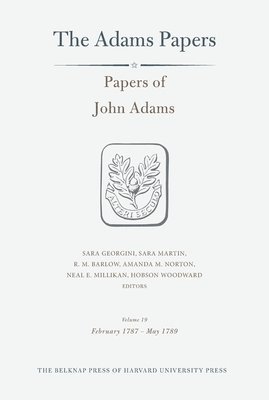
Papers of John Adams, Volume 19 – February 1787 – May 1789
February 1787 – May 1789
Av John Adams, Sara Georgini m. fl.
Inbunden, 2018
897 kr
Lägg i varukorg
“Huzza for the new World and farewell to the Old One,” John Adams wrote in late 1787, wrapping up a decade’s worth of diplomatic service in Europe. Volume 19 of the Papers of John Adams chronicles Adams’s last duties in London and The Hague. In the twenty-eight months documented here, he petitioned …
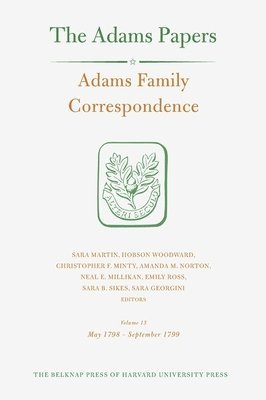
Adams Family Correspondence, Volume 13
May 1798 – September 1799
Av Adams Adams Family, Sara Martin m. fl.
Inbunden, 2017
888 kr
Lägg i varukorg
The almost 300 letters in volume 13 of Adams Family Correspondence were written during seventeen tumultuous months of John Adams’s presidency. Consumed with executive duties, he depended on surrogates for much of his correspondence with family members. From Quincy, an ailing Abigail Adams wrote …
Typescript of the Second Origin
Av Manuel de Pedrolo, Sara Martín m. fl.
Häftad, 2018
276 kr
Lägg i varukorg
Manuel de Pedrolo’s widely acclaimed post-apocalyptic novel, which includes a foreword by Kim Stanley Robinson, tells the story of two children who survive the brutal destruction of Earth by alien explorers. The protagonists, Alba and Dídac, retreat to the forest, then journey to the rubble of …
Typescript of the Second Origin
Av Manuel de Pedrolo, Sara Martín m. fl.
Inbunden, 2018
867 kr
Lägg i varukorg
Manuel de Pedrolo’s widely acclaimed post-apocalyptic novel, which includes a foreword by Kim Stanley Robinson, tells the story of two children who survive the brutal destruction of Earth by alien explorers. The protagonists, Alba and Dídac, retreat to the forest, then journey to the rubble of …
Masculinity and Patriarchal Villainy in the British Novel
From Hitler to Voldemort
Av Sara Martin
E-bok, 2019
956 kr
Lägg i varukorg
Masculinity and Patriarchal Villainy in the British Novel: From Hitler to Voldemort sits at the intersection of literary studies and masculinity studies, arguing that the villain, in many works of contemporary British fiction, is a patriarchal figure that embodies an excess of patriarchal power …
Masculinity and Patriarchal Villainy in the British Novel
From Hitler to Voldemort
Av Sara Martin
E-bok, 2019
926 kr
Lägg i varukorg
Masculinity and Patriarchal Villainy in the British Novel: From Hitler to Voldemort sits at the intersection of literary studies and masculinity studies, arguing that the villain, in many works of contemporary British fiction, is a patriarchal figure that embodies an excess of patriarchal power …